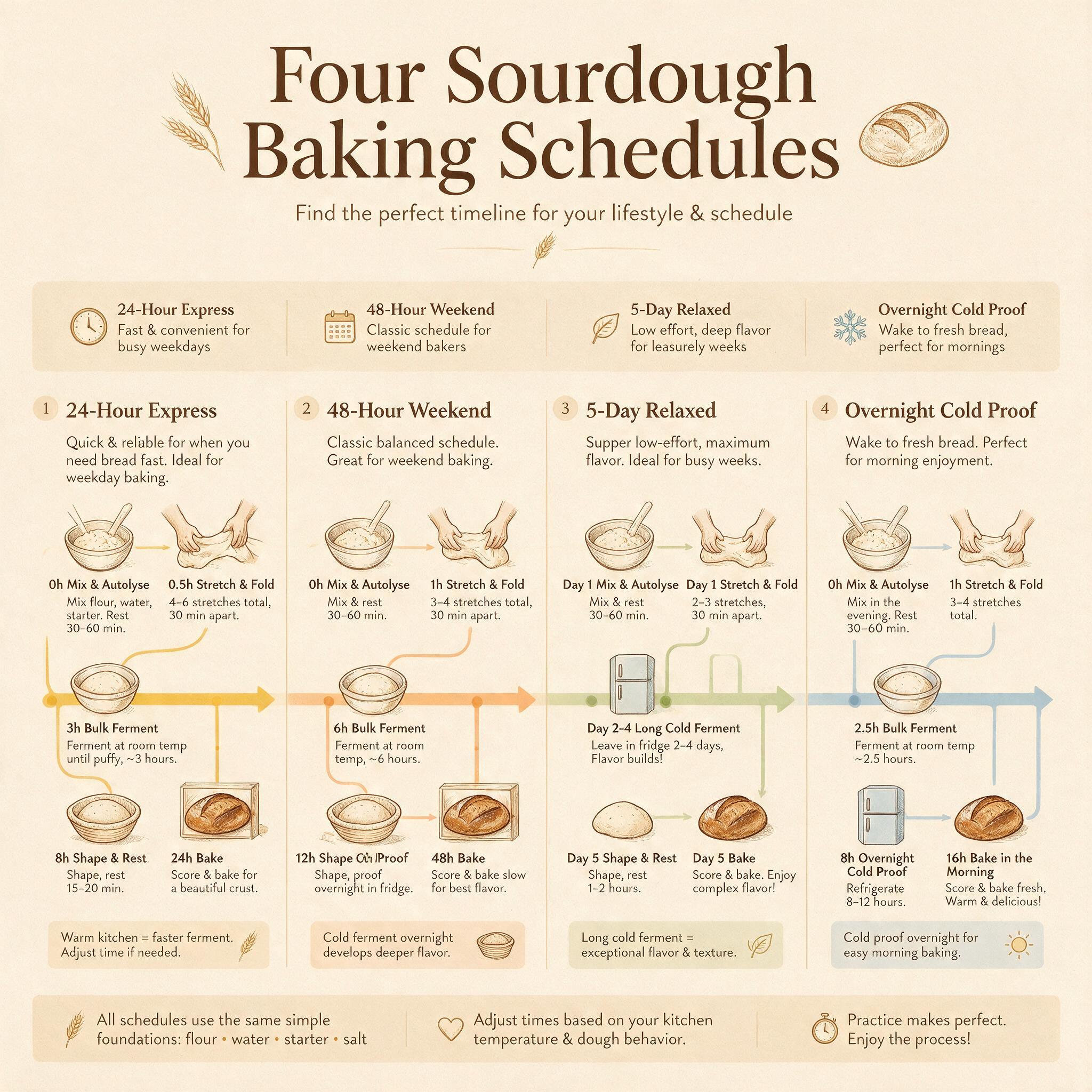
There's something almost magical about sourdough — flour, water, salt, time, and a living starter. That's it. No commercial yeast, no shortcuts. Just four ingredients that, given patience and a bit of know-how, transform into the most rewarding bread you'll ever bake from scratch.
But there's one ingredient that doesn't go in the bowl: your schedule. And if you've ever stared at a recipe that starts at 8 AM on Saturday morning, glanced at your work calendar, and thought "I can't do this right now," you're not alone. The truth is, sourdough baking fits into nearly every lifestyle — you just need to match the timeline to your rhythm rather than forcing your life to fit a recipe.
Why Your Schedule Matters More Than You Think
Here's something I learned after my first dozen or so loaves: a good schedule makes the difference between frustration and flow. When you build dough around your natural daily rhythm — not against it — everything clicks into place. The levain has time to peak while you're at work. Shaping happens when you actually have fifteen minutes free. You bake before the kids wake up, or right in time for dinner, or whenever makes sense for your kitchen.
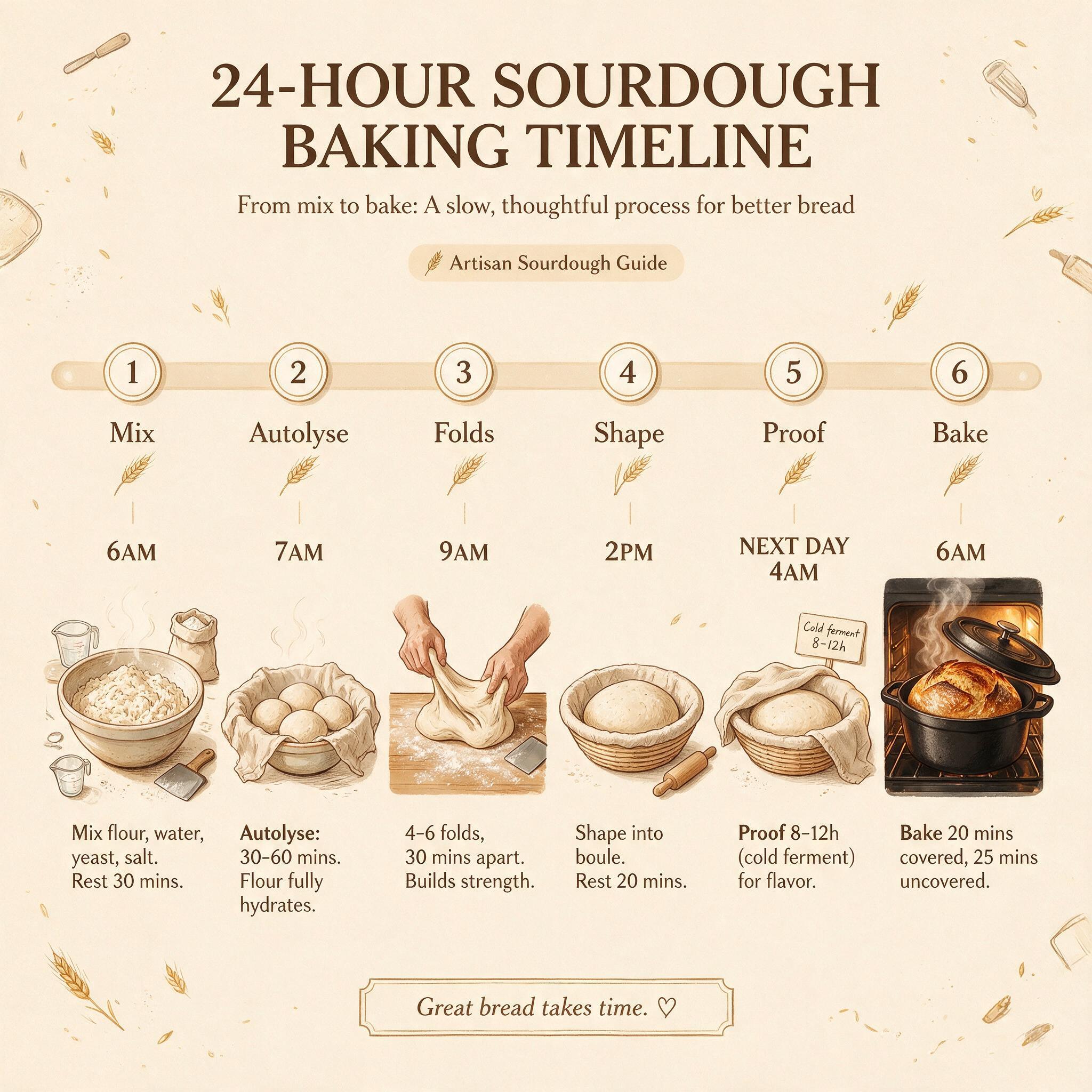
Without a schedule, sourdough feels like a series of emergencies: "Did I feed my starter? When do I mix dough? Oh no, is bulk fermentation done?" With one, it becomes a gentle guide — a set of signposts that tell you what's coming next without demanding your full attention at every step.
In this post, I'll walk you through four distinct scheduling approaches. Each one uses the same basic technique — levain building, mixing, folding, shaping, proofing, baking — but arranges them differently to fit different lives. Pick whichever resonates with yours. You can always try a different one later. There's no single "correct" way.
Schedule A: The Full Weekend Baker (Complete 24-Hour Project)
Best for: Weekends, full days off, bakers who want the complete sourdough experience from start to finish.
If you've ever wanted a Saturday morning project that fills your kitchen with incredible aroma and ends with a loaf so good it tastes like time itself, this is your schedule. It's the most traditional approach — what most beginner recipes follow — and for good reason: it gives you plenty of control at every stage.

How It Works
You start by feeding your starter (or levain) first thing Saturday morning. By midday, it should be at peak activity, ready to mix into dough. You spend the afternoon folding and fermenting while the dough does its work. Late evening, you shape and pop it in the fridge for a cold proof overnight. Sunday morning, you bake.
The Timeline
Saturday: Mix and Ferment

- •8:00 AM — Feed your levain: 35g starter + 35g flour + 35g water. This is your starter's breakfast, and it needs several hours to become active enough for baking. I find a 1:1:1 ratio works well here.
- •12:00–2:00 PM — When the levain has doubled and is bubbly (4–6 hours after feeding), mix your dough. Combine water, levain, flour, and salt. That's about three minutes of work. Bulk fermentation begins immediately.

- •12:30 / 2:30 PM — First set of stretch-and-folds (four directions around the bowl). Rest 30 minutes between sets. This builds strength in your dough without degassing it — think of it as gentle stretches for your loaf.
- •1:00 / 3:00 PM — Second set of folds, then coil fold set one. Rest 30 minutes between each set. Coil folds are my favorite technique because they build structure so gently. Wet your hands, slide them under the center of the dough, lift it softly, and fold it over itself. Rotate and repeat four times. That's one set.
- •1:30 / 3:30 PM — Second coil fold set. After this, bulk fermentation continues on its own. I like to transfer a small piece of dough into a measuring cup at this point so you can visually track how much it's rising throughout the day. It's amazing to watch.
- •5:00–7:00 PM — Bulk is done when your dough has risen 50–100% and looks puffy with some visible air bubbles on the surface. The key word here is time — stiffness alone doesn't guarantee readiness. The dough should jiggle slightly like set custard when you shake the bowl. Pre-shape, then bench rest for 15 minutes.
- •5:30 / 7:30 PM — Final shape into your banneton or a towel-lined bowl. Place seam-side up. This is shaping time — not fast, but meditative. Roll the dough between your palms to create surface tension, then tuck it into its final form.
- •6:00 / 8:00 PM — Refrigerate for cold proof (12–14 hours). Cover loosely. The fridge at 38–40°F slows fermentation dramatically while developing that beautiful sourdough flavor you're after.
Sunday: Bake Day
- •8:00 AM — Preheat your Dutch oven to 500°F (260°C) with the lid on. Give it a full 30-minute preheat so everything is piping hot when your dough arrives.
- •8:30 AM — Take your dough from the fridge, turn it out onto a lightly floured surface, score with a lame or sharp knife at a 30-degree angle about 1 cm deep. Bake straight from cold — no need to warm up first.
- •8:40 AM — Bake: lid on for 20 minutes at 500°F, then remove the lid, reduce heat to 450°F, and bake another 17–20 minutes until deep golden brown. The steam trapped under the lid during those first 20 minutes gives your loaf its oven spring — that beautiful initial rise.
- •9:20 AM — Remove from oven. Cool on a wire rack for at least two hours before cutting. I know, two hours feels like forever when bread smells this good. But cutting early means gummy interior. Trust me on this one — I learned it the hard way with my very first loaf.
Total elapsed: about 26 hours from Saturday morning to Sunday mid-morning. You get a full weekend of bread-making satisfaction.
Schedule B: The Working Weekday Baker (Overnight Levain + Evening Shaping)
Best for: Nine-to-five workers who can't bake during the day but have evenings free.
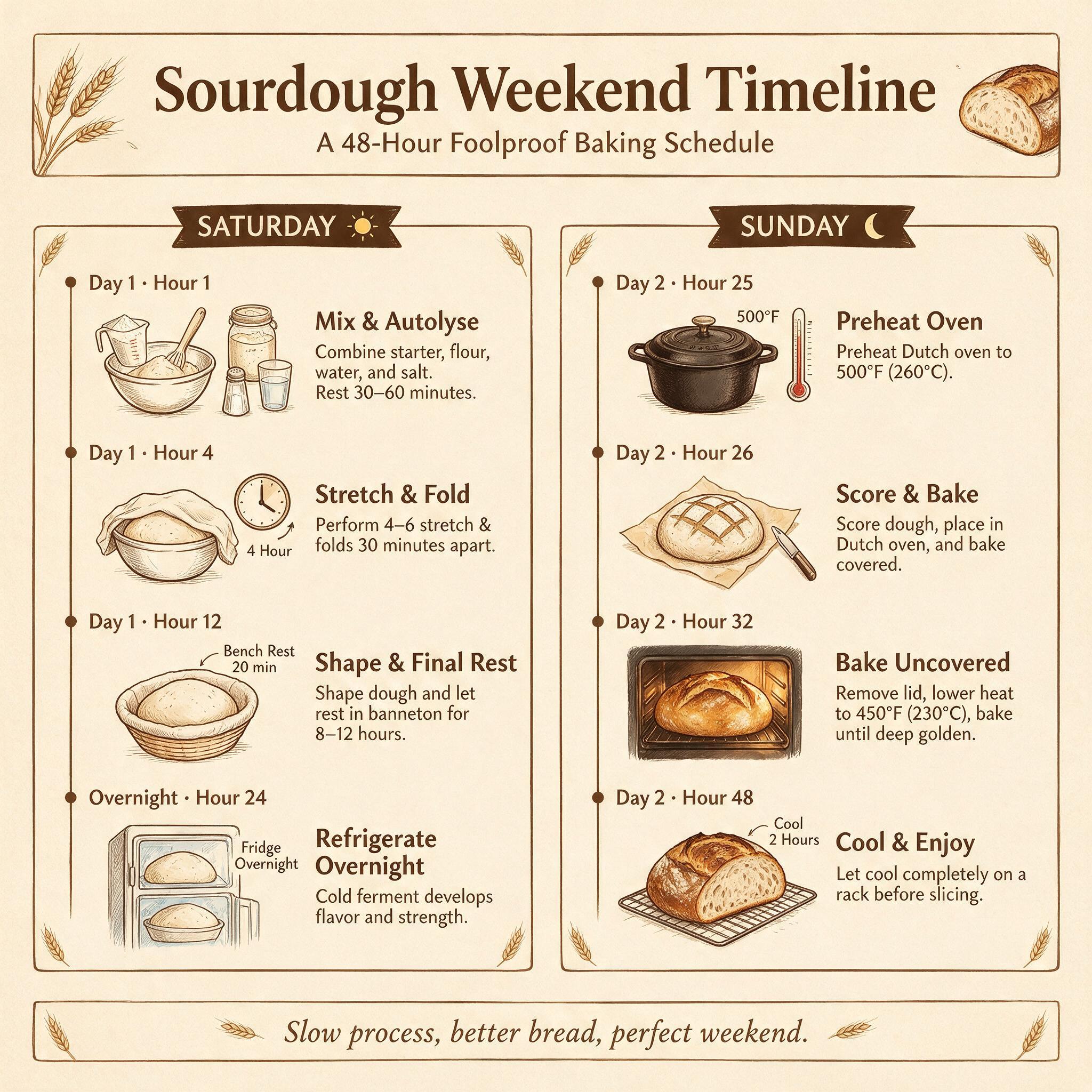
This schedule is my go-to recommendation for working bakers, and here's why: it requires only about 45 minutes of active work time split across two days, and most of that happens while you're at home. The overnight levain builds while you sleep or commute. You mix dough quickly in the early afternoon before heading to work. All your folding is done before you leave the house. Shaping happens after dinner. And Sunday morning? You bake bread for breakfast.
How It Works
The secret to this schedule is the cold proof — that overnight fridge rest acts as a pause button on your fermentation. Your dough sits quietly in the refrigerator while you live your life, then wakes up perfectly ready to bake when you need it.
The Timeline
Saturday: Levain Build + Evening Shaping
- •7:00 AM — Feed starter for levain: 35g starter + 35g flour + 35g water. Do this right after waking up or during your morning coffee routine. It'll be ready by early afternoon.
- •12:00–2:00 PM — When the levain peaks, mix your dough. Three minutes of work. Bulk begins immediately. Try to time this so you can finish all folding before you leave for work (or right after you get home — either works).
- •12:30 / 2:30 PM through ~4:00–6:00 PM — Do your stretch-and-folds and coil folds at 30-minute intervals. That's two sets of each, roughly two hours of folding time spread across the afternoon. If you're at work during this window, no problem — your dough doesn't care where you are. It ferments on its own schedule.
- •4:00–6:00 PM (after work) — Bulk should be done by now. Pre-shape, bench rest 15 minutes, then final shape into the banneton. This takes about 30 minutes of active time. Shape at your kitchen counter after getting home from work.
- •6:30–7:00 PM — Refrigerate for cold proof (8–12 hours minimum). You don't need as long a cold proof with this schedule since bulk fermentation has already progressed significantly during the day.
Sunday: Morning Bake
- •7:30 AM — Preheat Dutch oven to 500°F while coffee brews. Thirty minutes is all you need.
- •8:00 AM — Score dough straight from fridge and bake (lid on 20 min, then lid off 17–20 min). About 40 minutes of active time.
- •8:45 AM — Remove bread. Cool minimum two hours. Bread is done by lunchtime.
Total elapsed: roughly 16 hours from Saturday morning to Sunday lunch. Minimal active work, maximum reward.
Schedule C: The Split-Shift Method (Levain Morning, Bake Night)
Best for: People who want bread ready for dinner or evening meals; bakers who prefer same-day baking without an overnight fridge wait.
This schedule is a favorite among bakers who like to see results the same day they start. You build your levain in the morning while you're at work (the starter does its thing all by itself), mix dough in the early afternoon, shape after getting home, proof at room temperature for a few hours, and bake late evening. Same-day bread from start to finish — no overnight cold proof required.
How It Works
The beauty of this approach is that you never have to think about your starter during work hours. You feed it first thing in the morning, let it sit quietly on the counter until peak (4–6 hours), mix dough when it's ready, and let bulk fermentation progress while you're at work. By the time you get home in the late afternoon, shaping is waiting for you.
The Timeline
Same Day: Full Process from Morning to Night
- •7:00 AM — Feed starter (levain): 35g + 35g flour + 35g water. Start this first thing in the morning and forget about it until lunchtime.
- •12:00–2:00 PM — When levain is at peak, mix your dough. Three minutes of work. Bulk fermentation begins.
- •12:30 / 2:30 PM through ~4:00 PM — Do two sets each of stretch-and-folds and coil folds at 30-minute intervals. All folding done before afternoon break or while you're away. Your dough ferments on its own.
- •4:00–6:00 PM (after work) — Bulk should be complete. Pre-shape, bench rest 15 minutes, final shape into banneton. About 30 minutes of active time after getting home from work.
- •6:30–7:00 PM — Final proof at room temperature for 2–4 hours depending on your kitchen temperature. The dough should pass the poke test before baking — gently press a finger into it and watch how quickly it springs back. If it springs back fast, it needs more time. If it holds its indentation, it's ready.
- •9:00–11:00 PM — Bake (lid on 20 min, then off 17–20 min). Score from room-temperature dough and bake immediately. About 40 minutes of active baking time.
Total elapsed: about 14 hours from 7 AM to 11 PM same day. You get bread ready for dinner or late-night satisfaction — no overnight refrigeration needed.
This schedule works particularly well if you prefer a milder sourness profile, since the shorter proof time (no extended cold rest) produces less acetic acid development. If you love deep tang, extend that final proof or add a brief cold rest before baking.

Schedule D: The Ultra-Flexible Slow Fermentation (5+ Days)
Best for: Maximum schedule flexibility; bakers chasing maximum flavor complexity; slow-fermentation purists.
This is the schedule for people who want to bake bread whenever they feel like it — not when a recipe tells them to. You build your levain one day, mix dough the next (or even two days later), shape at whatever time works, and refrigerate the dough where it can sit for up to 48 hours — or even 72 hours if you're feeling ambitious. Bake whenever your schedule allows within that window.
How It Works
The cold proof is your "pause button" here. Once shaped and refrigerated, dough doesn't change significantly after its first 12–24 hours in the fridge. You choose exactly when to bake based on your life — a busy Tuesday evening, a lazy Sunday afternoon, whenever it makes sense. Extended cold fermentation also develops deeper sour complexity and more complex flavor notes that you simply can't achieve with faster schedules.
The Timeline
Day 1: Levain Build
- •Feed starter anytime convenient: 35g + 35g flour + 35g water. It'll be ready in 4–6 hours. That's it for Day 1.
Day 2: Mix Dough
- •When levain peaks, mix your dough (water, levain, flour, salt). Three minutes of work.
- •Do two sets each of stretch-and-folds and coil folds at 30-minute intervals. All folding done in about two hours.
- •Shape the dough at the end of bulk fermentation whenever it's convenient — late morning, afternoon, early evening. Whatever works.
Days 2–5: Flexible Cold Proof Window
- •Place shaped dough in the fridge immediately after shaping. It can stay there for up to 48 hours (the sweet spot) or even 72 hours if you're comfortable with advanced fermentation.
- •Bake on any day within that window. Choose your bake time based entirely on your schedule — not a recipe's timeline.
Total elapsed: 5–7+ days, but only about 30–45 minutes of actual active work spread across multiple days. This is the ultimate low-maintenance schedule. The trade-off is patience — you need to plan ahead and trust that the dough will be ready whenever you are.
I personally prefer a milder sourness for everyday sandwiches, so I tend toward the shorter cold proof window (24–36 hours). But if you love tangy, complex bread with deep earthy notes from whole grains, push toward those 48–72 hour marks and see what develops. You might discover a flavor profile you didn't know sourdough could achieve.
Temperature: The Universal Adjustment Knob
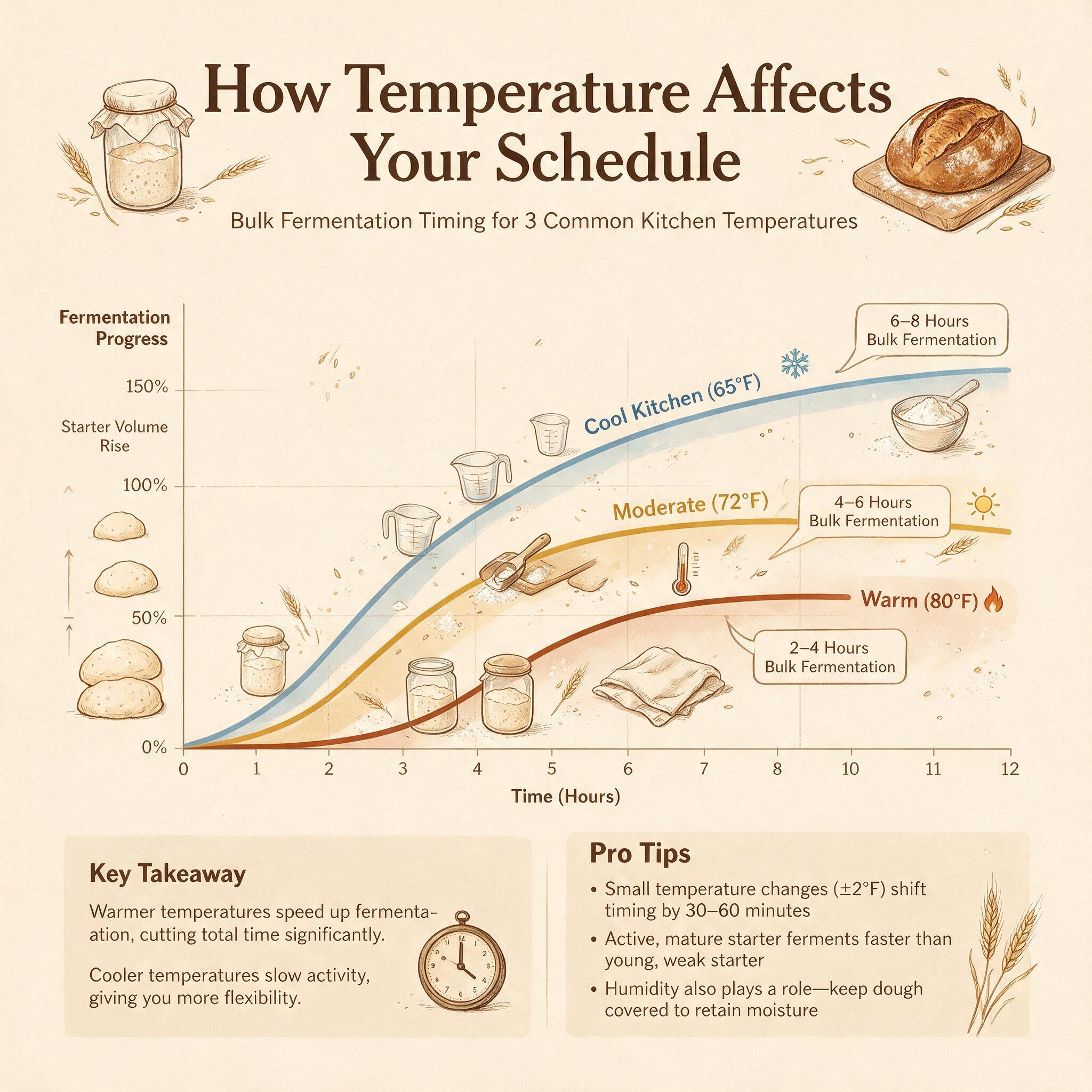
No matter which schedule you choose — weekend baker, working weekday, split-shift, or ultra-flexible — temperature is the one lever that adjusts everything. Every 1°C above 22°C (72°F) cuts bulk fermentation by roughly 10–15%, and every 1°C below adds about the same amount of time.
Here's what that means in practice:
Warm kitchen (80°F+ / 27°C+): Shorten all fermentation times by 30–50%. Move your dough to the fridge earlier during bulk — you'll want to catch it before it over-ferments. Consider using cooler mixing water to slow things down slightly. In summer, bulk might take only 3–4 hours instead of the usual range.
Cool kitchen (65°F / 18°C or below): Extend all fermentation times significantly. Bulk might need 8–10 hours instead of 4–6. Your levain will also take longer to peak — give it an extra hour or two and check for signs of activity rather than relying on a fixed timeline.
Ideal range: 72–78°F (22–26°C). This is the sweet spot where fermentation is predictable, manageable, and gives you enough time to work without rushing. Most kitchens hover in this range during spring and fall.
The important thing to remember: these are starting points, not rules. Your kitchen has its own personality — some corners are warmer near the oven, others cooler near exterior walls. Pay attention to how your dough behaves in your space over time, and you'll develop an intuition for timing that no recipe can teach you.
Troubleshooting: When Things Don't Go as Planned
Even with a solid schedule, things don't always go according to plan. Here are the most common hiccups and how to handle them:
The levain isn't peaking on time. This is almost always a temperature issue or a weak starter. Make sure your starter is active and fed regularly before building levain. If your kitchen is cool, give it extra time — check for bubbles and volume increase rather than watching the clock. A healthy starter will peak; it just might take longer in winter.
Bulk fermentation finished too fast. Your dough rose 100% in three hours? No problem — that just means your kitchen was warm or your starter is particularly vigorous. Shape early, refrigerate sooner. You can always bake a few hours ahead of schedule. The cold proof gives you plenty of flexibility here.
Bulk fermentation took forever. Eight hours and the dough barely moved? Cool kitchen, likely. Give it more time — up to 12 hours isn't unusual in winter. Check for visual signs: increased volume, bubbly surface, a slightly tangy aroma. When doubt creeps in, trust your eyes over your timer.
The dough won't hold its shape during shaping. This usually means under-fermentation — the gluten structure hasn't developed enough strength yet. Let it bulk ferment longer and check again. Alternatively, you may be working with a very wet dough that requires more handling practice. Wet dough is normal for sourdough; it tightens up as fermentation progresses.
Bread didn't oven-spring well. This can happen if the dough was over-proofed (too much final proof time), under-developed during folding, or if the Dutch oven wasn't hot enough. Always preheat your Dutch oven fully — 30 minutes minimum at maximum temperature. And always bake straight from the fridge for that cold-dough-to-hot-oven contrast that creates spring.
A dense loaf isn't wasted bread. Slice it up and make the best French toast you've ever had, or turn it into croutons. Every failed loaf teaches something. I still have a mental note of my third bake — flat as a frisbee because I shaped too aggressively and degassed everything I'd built up during folding. Lesson learned: gentle hands win every time.
Frequently Asked Questions
Which schedule should I choose as a beginner?
Start with Schedule A (the Weekend Baker). It gives you the most control, plenty of time to observe each stage, and builds confidence before moving to tighter schedules. Once you understand how your dough behaves on weekends, try Schedule B for weekday baking.
Can I switch between schedules depending on my week?
Absolutely. Pick whichever fits your current life. Some weeks you have free weekends — go with Schedule A or D. Other weeks you're swamped but have evenings free — Schedule B is perfect. The dough doesn't care which schedule you use; it just responds to temperature and time.
Do I need a Dutch oven for any of these schedules?
No, though it helps immensely. You can bake on a baking stone or even directly on an oven rack with a pan of water below for steam. But the Dutch oven (or any lidded heavy pot) creates its own steam environment during those critical first 20 minutes, which is why most bakers swear by them.
Can I divide Schedule D dough into multiple loaves?
Yes — if you have enough starter and flour to mix a larger batch, you can divide the bulk-fermented dough into two or three smaller portions before shaping. Each one goes into its own banneton and fridge slot. This is great for giving bread away or freezing extra loaves.
What's the minimum cold proof time that still works?
About 8 hours for Schedule B (working weekday). You can go as low as 6 hours in a pinch, though you'll lose some of the flavor development and schedule flexibility that makes cold proofing so valuable. The dough will bake fine — it just won't have quite the same depth of flavor.
How do I know when bulk fermentation is actually done?
Watch the dough, not the clock. It's ready when it has visibly spread and risen (typically 50–100% increase in volume), feels puffy and light, shows some surface bubbles, and jiggles like set custard when you gently shake the bowl. If your kitchen is warm, this might happen in 4 hours. If cool, it could take 8 or more. Both are fine.
Closing Thoughts
Sourdough is deeply personal — what works in my kitchen might need tweaking in yours, and that's the beauty of it. These four schedules aren't rigid formulas; they're starting points. Pick one that matches your current lifestyle, run with it for a few bakes, notice what feels natural and what needs adjusting, then adapt.

I've found that most bakers naturally gravitate toward one schedule after baking a few loaves with each approach. Maybe you love the weekend ritual of Schedule A. Maybe Schedule B fits your work life perfectly. Or maybe you'll discover that ultra-flexible Schedule D is exactly what you needed — bread that bakes whenever you have time, not when a recipe demands it.
Pay attention to how your dough behaves in your kitchen during each schedule. Take mental notes (or real ones if that helps). Over time, you'll develop an intuition for timing and temperature that no written guide can fully capture. And then — the best part — you'll start bending those schedules to your will instead of following them rigidly.
Happy baking. Whatever schedule you choose, there's a loaf waiting at the end of it.