There's something almost magical about sourdough — flour, water, salt, time, and a living starter. That's it. No commercial yeast, no shortcuts. Just four ingredients that, given patience and a bit of know-how, transform into the most rewarding bread you'll ever bake from scratch.
But here's one of those moments where the magic gets even better: putting your shaped loaf in the fridge overnight. It sounds like a simple scheduling trick, but cold proofing does so much more than fit sourdough into your day. It deepens flavor, improves crust color, makes scoring dramatically easier, and gives you that dramatic ear you've been chasing.
If you've ever wondered why some bakers swear by an overnight fridge rest while others bake their dough the same hour it's shaped, this is for you.
Why Cold Proofing Matters (Beyond Scheduling)
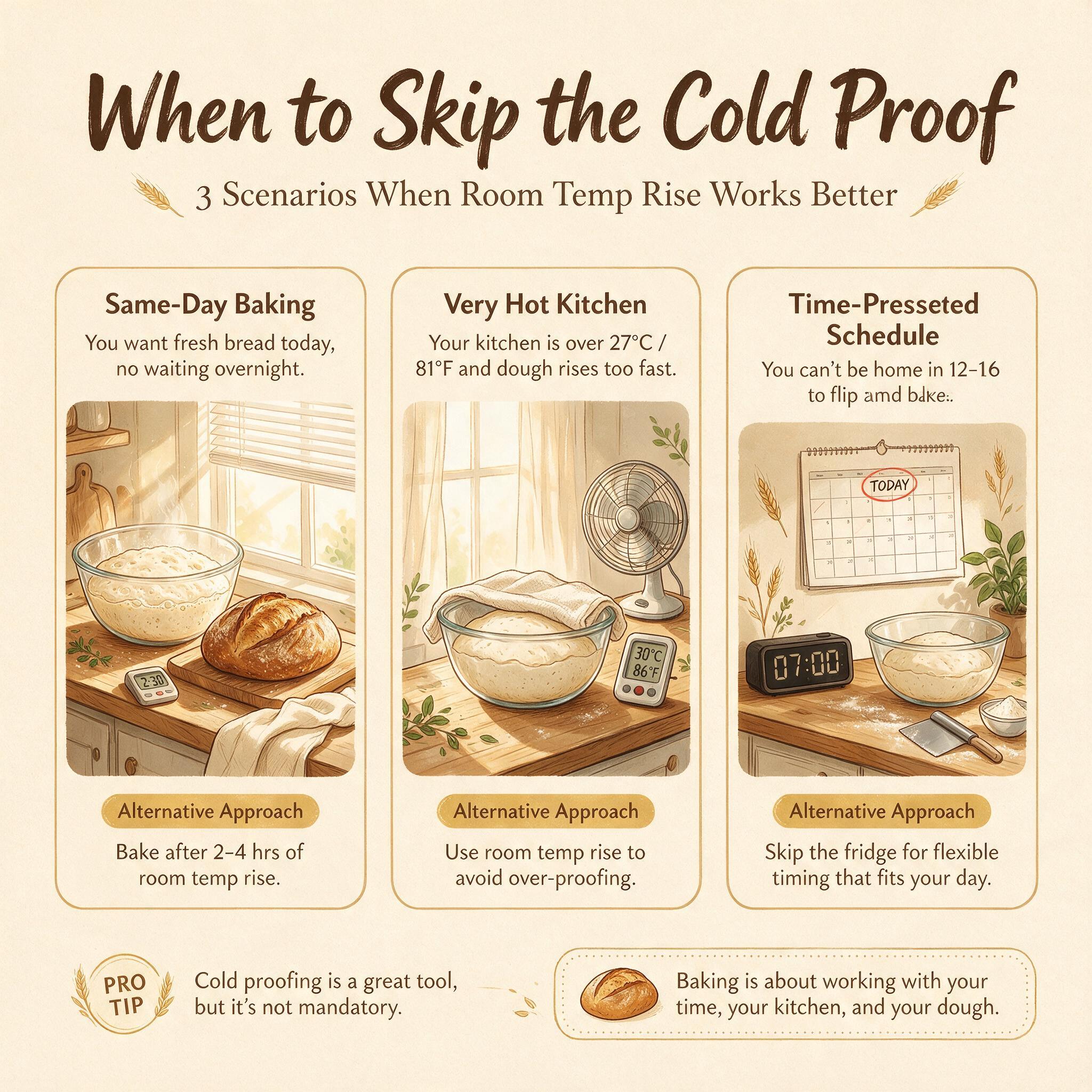
Most published sourdough recipes assume same-day baking. You mix, bulk ferment, shape, let it proof at room temperature, then load it into a hot Dutch oven — all in one sitting. That works beautifully when your schedule allows it. But life doesn't always cooperate. More importantly, cold proofing isn't just about convenience — it fundamentally changes what happens to your dough.
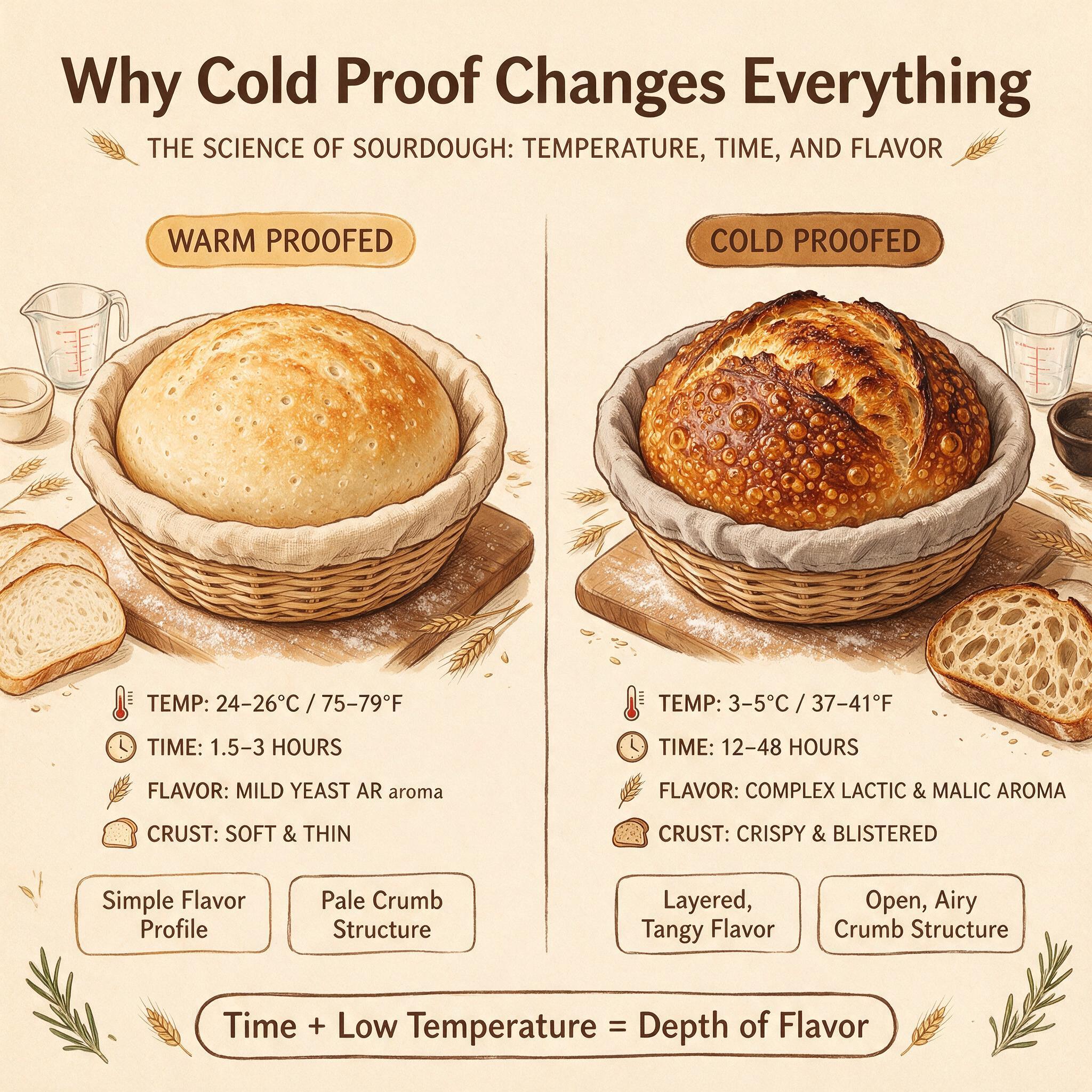
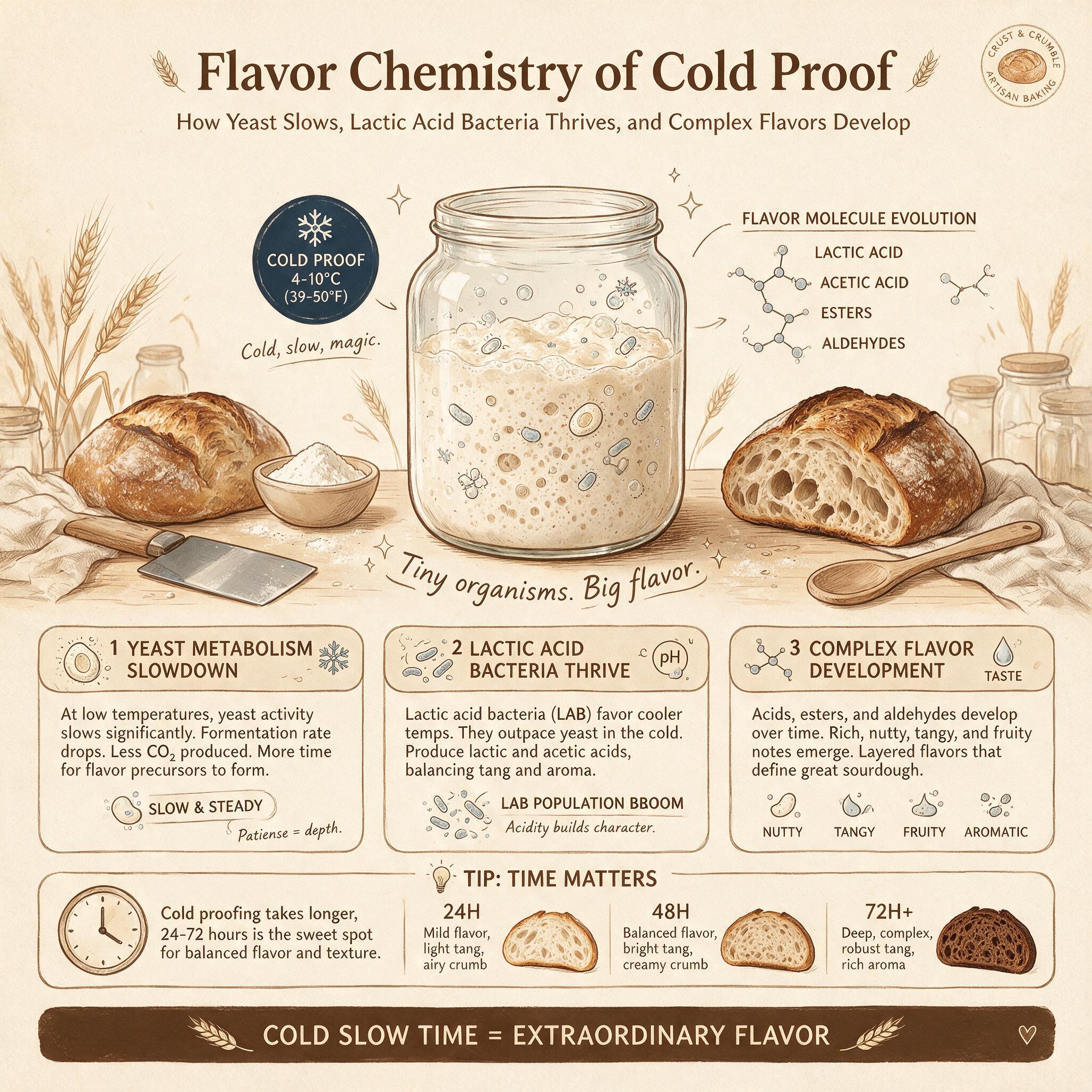
When you place shaped dough in the refrigerator (ideally 37–40°F / 3–4°C), two things happen at once: yeast activity drops by roughly 70%, while lactic acid bacteria keep working at a reduced but steady rate. This differential effect is what makes cold proofing possible — you get continued acid accumulation and flavor development without the dough overproofing and collapsing under its own weight.
The acids build slowly, creating deeper sourness, while the gluten network relaxes gradually in the cold. And when that cold dough hits a blazing-hot oven, it takes five to ten minutes longer than room-temperature dough to warm through — giving the yeast precious extra time for final rise before the crust sets.
Let's walk through what happens at each stage of cold proofing, how long you can go, and where things start to fall apart.
How Long Is Too Long? A Duration Guide
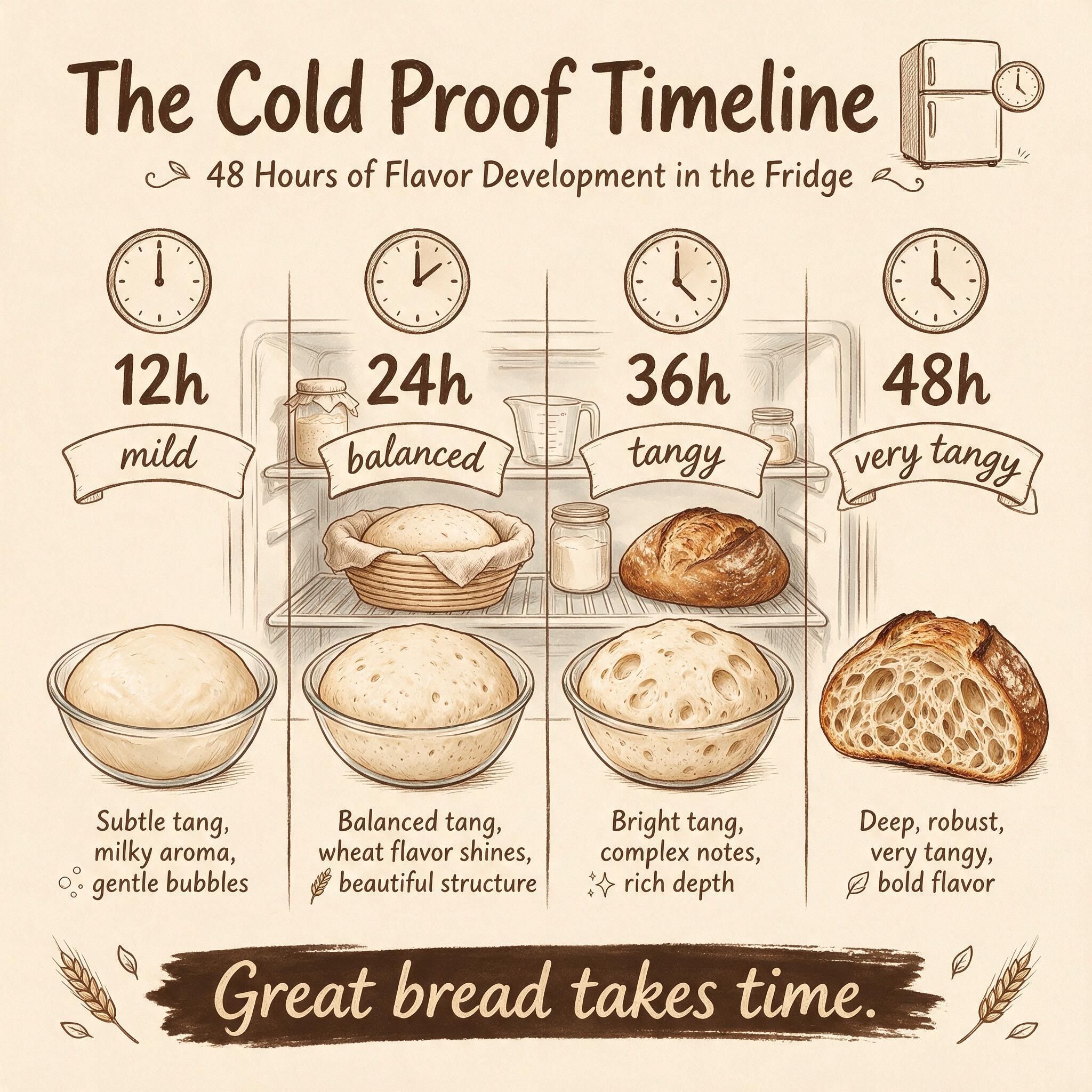
Not all cold proofs are created equal. The length of time your dough spends in the fridge dramatically affects flavor, oven spring, crust color, and crumb structure. Here's what each window produces based on extensive testing across multiple bakeries and home kitchens.
8–12 Hours: The Convenience Window
This is where most beginners start — shape your dough after dinner, pop it in the fridge, bake before work the next morning. It works because you're not pushing the limits of what cold fermentation can do.
The flavor lift is mild but noticeable. You'll get slightly better crust browning than a same-day bake, which alone makes this window worthwhile for many home bakers. Oven spring stays excellent — your dough retains nearly all its structural strength. The crust develops just enough extra blistering to make the difference worth it.
This is ideal when your kitchen runs warm and you're worried your dough might overproof during bulk fermentation before you can shape it. It's also perfect for learning cold proofing without risking an overproofed loaf.
12–18 Hours: The Everyday Sweet Spot
I recommend this window as a starting point for most bakers, and I suspect it'll become your default once you see what it does. You get pleasant tang — noticeable sourdough character without being aggressive. Oven spring remains strong because the dough retains good tension while flavor has developed enough to make a real difference.
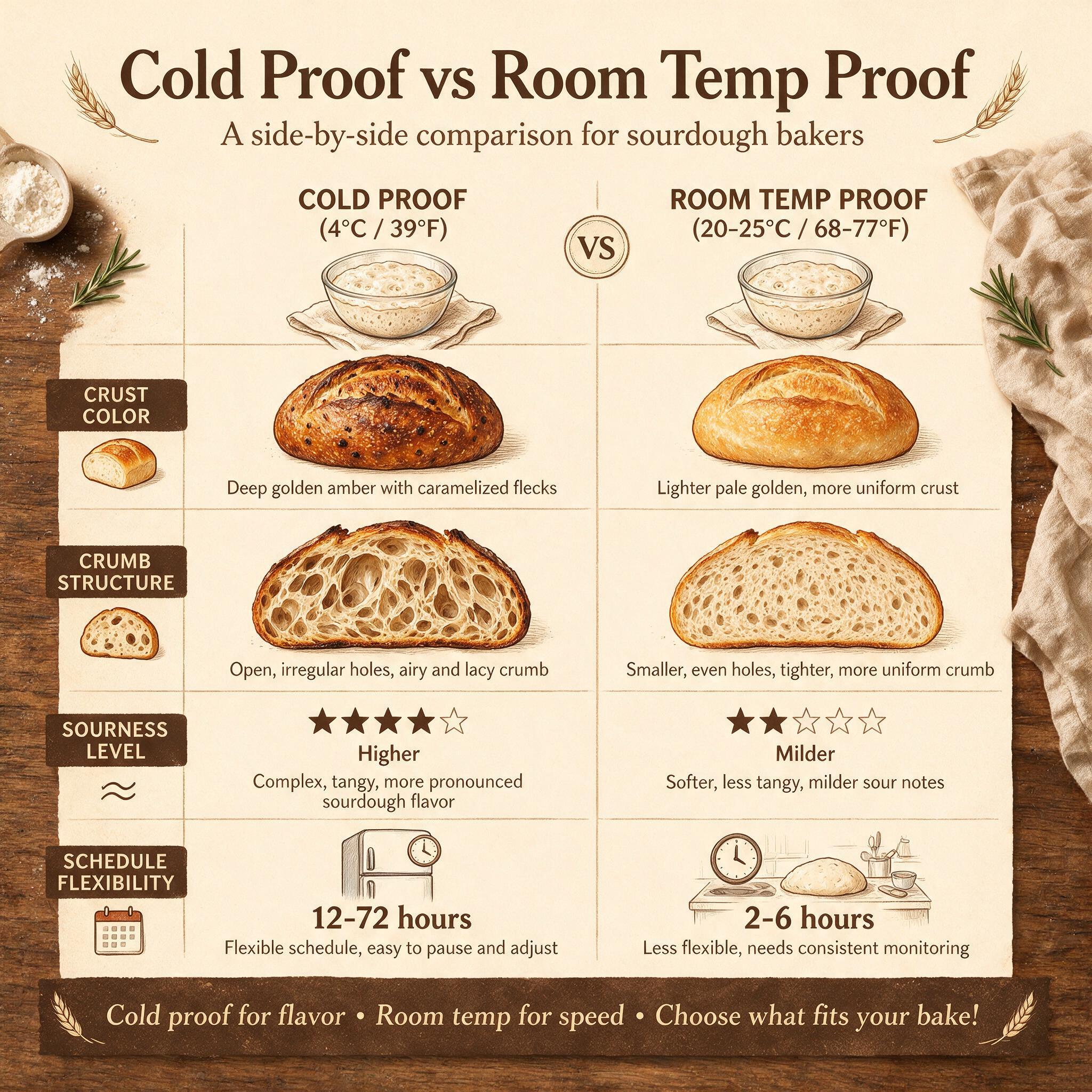
The crust improvement is dramatic at this stage. What used to be a pale golden surface becomes deeply caramelized with beautiful blistering. And scoring cold dough? It's one of those things that, once you've done it, you wonder why you didn't start doing it years ago. Cold dough holds its score line beautifully and gives the most satisfying ear I know.
This is also where the scheduling magic really shines. Shape in the evening, bake the next morning — no alarm clock required. Ninety percent of sourdough recipes and home bakers live comfortably in this window.
24–36 Hours: Deep Flavor Zone
Now we're getting into territory where the bread starts tasting distinctly sour — not vinegary aggressive, but deep and complex, almost cheese-like in its richness. The tang is assertive enough that it changes how you eat the loaf. This isn't bread for plain butter sandwiches anymore; this is a loaf with personality.
Oven spring takes a slight hit at this stage. Some gluten relaxation has occurred during the long cold rest, so your loaf won't rise quite as dramatically in the oven. But if you shaped strongly, the ear will still be huge and the crumb only slightly tighter than usual. The crust reaches very dark mahogany with excellent blistering — it'll look like something from a serious artisan bakery.
The main caveat: this window demands healthy starter activity and well-developed bulk fermentation going in. If your dough was already borderline before refrigeration, 36 hours might push it over the edge. Trust your judgment on bulk readiness.
36–48 Hours: Advanced Territory
By now you're an experienced sourdough baker who knows what you're doing and wants maximum flavor at any cost. The sourness is intense — complex, layered tang that borders on cheese-like depth. Every bite has character.
Oven spring is noticeably reduced. Gluten has relaxed significantly during the long cold proof, so expect a slightly tighter crumb and less dramatic rise. The crust will be very dark and deeply caramelized, almost approaching burnt sugar in its richness.
Scoring becomes trickier at this duration because the dough has relaxed more — you need to watch your score angles carefully. Loaves may spread slightly if shaping wasn't tight enough going into the fridge. This window is best for bakers with strong doughs who prioritize flavor over volume.
48–72 Hours: The Danger Zone
Beyond two days, things get interesting but risky. The sourness becomes very intense — almost vinegary at the upper end of this range. Oven spring drops significantly and your loaf will be flatter than usual. The crumb tightens further, and there's real potential for structural collapse during baking.
This is experimentation territory. High-hydration doughs (75%+ hydration) are especially vulnerable to collapsing during long cold proofs because the gluten network has weakened considerably. That said, if you're making crackers or flatbreads where chew matters more than oven spring, 48–72 hours can produce excellent results.
The warning for most table loaves: beyond 48 hours, gluten degrades faster than fresh flavor builds. You're trading structure for sourness at a steep rate.
The Hidden Variable Most Recipes Don't Mention: Cooling Lag
When you place warm dough into the fridge, it takes one to two hours for a shaped loaf's core to fully cool to refrigerator temperature. During that cooling lag period, fermentation continues at an accelerated rate because the dough is still carrying warmth from your kitchen.
This changes everything about how you plan your cold proof. If your kitchen runs hot (80°F or above), your dough carries significant momentum into the fridge and continues fermenting aggressively for those first couple of hours — meaning a 12-hour cold proof might actually behave like a 16-hour proof once you account for that warm-up period.
Conversely, if your kitchen is cool (68°F or below), yeast activity was already sluggish before refrigeration. The fridge stops fermentation sooner, but the dough may be underproofed if bulk fermentation was short.
The golden rule: End bulk at 50–75% rise — not fully doubled — before chilling. The fridge will catch up during the cooling lag plus cold proof period. If you wait for full room-temperature proof before refrigerating, your dough overproofs in the fridge and bakes flat.
I learned this the hard way on my third or fourth attempt at cold proofing. I waited until my dough looked perfectly doubled, popped it in the fridge, and woke up to a loaf that spread like a pancake. Lesson learned: err on the side of underproofing before refrigeration. You can always let it go longer; you can't un-overproof once it's happened.
Baking Straight from the Fridge
Here's the method I use almost exclusively now, and it works beautifully every time:
- Pull your banneton out of the fridge
- Dust the top with a thin layer of rice flour (this helps with scoring grip)
- Flip onto parchment paper — yes, directly from the banneton, no warming period needed
- Score with a sharp lame at roughly a 30-degree angle, going about one centimeter deep
- Load directly into your Dutch oven preheated to 250°C (480°F)
Why bake cold? Cold dough holds its score line better than warm dough — less deflating under the blade as you cut. The ear blooms dramatically when heat hits because cold dough resists opening initially, then expands like a flower unfurling. And that gradual warm-up gives the yeast more time for final rise before your crust sets.
You do not need to let dough come to room temperature first. Skip it entirely and save fifteen minutes on your morning routine. I've baked dozens of loaves straight from the fridge, and they all perform consistently well — sometimes better than their room-temperature counterparts because of that extra oven-spring time.
When Cold Proof Goes Wrong: Troubleshooting
Every baker has been here at some point. Here's what to watch for and how to fix it.
Loaf is dense after bake
The usual suspects: bulk was under-fermented before chilling (the fridge stopped fermentation too early), or your starter was past peak when you mixed it, carrying excessive acid that weakened the gluten from the start. Make sure bulk reaches 50–75% rise before refrigerating, and use your starter at or near its feeding peak — usually four to six hours after feeding for a room-temperature starter.
Loaf spreads sideways out of the oven
This means overproofing in the fridge. Either you left it too long, or your refrigerator is running warmer than you think (above 40°F / 4°C). Pull your next retard time back by four to six hours and check your fridge temperature with a thermometer.
Surface looks dry or leathery in the morning
Fridge airflow dehydrates dough surfaces overnight. Cover loosely with plastic wrap or a shower cap — not airtight, just enough to trap moisture without creating condensation that makes the surface wet. A slightly damp cloth placed over (not touching) the banneton works too if you prefer natural materials.
Crust browned but interior is gummy
Cold dough takes longer to reach internal baking temperature. You need a little more bake time — add five to ten minutes, or use slightly lower heat for cold-loaded loaves so the crust doesn't set before the interior fully bakes through. Always check with an instant-read thermometer: you want 200–210°F internally for properly baked bread.
Adapting Any Recipe to a Cold Retard Schedule
Converting a same-day recipe is straightforward — there's only one knob to turn:
- End bulk at 50% rise instead of waiting for fully doubled
- Shape your dough as usual
- Refrigerate immediately
- Next morning: bake straight from the fridge
Salt stays the same. Hydration stays the same. Nothing changes except that cold proof duration. Your existing recipes are already cold-retard-ready; you just need to shift when you put them in the fridge.
Know Your Fridge Temperature
Not all refrigerators are created equal, and this matters more than most bakers realize. Here's what different fridge temperatures mean for your cold proof:
35–38°F (1–3°C): Very slow fermentation. You can safely go up to 18–24 hours in here without overproofing risk. This is the coldest practical range for sourdough cold proofing.
38–40°F (3–4°C): The ideal zone. Twelve to sixteen hours is your sweet spot — maximum flavor development with minimal overproofing risk. Most fridges sit somewhere in this range, which is why it's the most commonly recommended window.
40–45°F (4–7°C): Faster than you'd expect. Limit cold proof to 10–14 hours because fermentation accelerates noticeably above 40°F. Your dough might behave like a 16-hour proof even after only 12 hours in the fridge.
45°F+ (7°C+): Too warm for reliable cold proofing. Either limit to 8–10 hours or skip it entirely and bake same-day. A fridge at this temperature is essentially a slow-proofing counter, not a retardation chamber.
Recommendation: Place a cheap refrigerator thermometer on the shelf where you keep your dough. I know — it feels like overkill. But I've seen fridges read 45°F when the dial said "38," and that seven-degree difference can turn a perfectly proofed 16-hour loaf into an overproofed disaster. Your dough doesn't care what the dial says; it cares about actual shelf temperature.
Frequently Asked Questions
Can I double-stack loaves in the fridge during cold proof?
Yes, but leave space between them for airflow. Stacking too tightly can create warm spots and uneven proofing. If you're proofing multiple loaves, stagger them on different shelves or use a cooling rack to improve air circulation.
Should I use rice flour or wheat flour in the banneton for cold proof?
Rice flour is preferable because it doesn't absorb moisture from the dough surface during the long fridge rest. Wheat flour can create a thin skin that makes scoring harder and affects your ear. Rice flour stays dry and gives you better grip when scoring.
Does cold proof make sourer bread? How much more sour?
It depends on duration. Eight to twelve hours adds mild tang — noticeable but subtle. Twelve to eighteen hours gives pleasant sourdough character without being aggressive. Twenty-four to thirty-six hours produces deep, complex sourness that's definitely assertive. Beyond forty-eight hours, you'll get vinegary intensity that changes the entire eating experience.
Can I cold proof during bulk fermentation instead of after shaping?
Yes — this is called "cold bulk" and it works differently than cold proof (which happens after shaping). Cold bulk develops more acetic acid (sharper tang) because the dough has more room to move and bacteria produce different acids during active fermentation. Cold proof after shaping tends toward milder, creamier sourness from lactic acid. Both are valid; they just produce different flavor profiles.
What if my fridge doesn't get cold enough — can I still cold proof?
If your fridge tops out at 45°F or above, you can still cold proof but with shorter times (8–10 hours). You won't get the same depth of flavor as a proper retard, and oven spring may be slightly compromised. It's better than nothing if scheduling demands it, but not ideal for maximum flavor development.
Closing Thoughts
Cold proofing is one of those techniques that feels like a cheat code once you've mastered it. You get better crust color, more complex sourness, easier scoring with dramatic ears, and the freedom to bake on your schedule rather than your dough's schedule. It's genuinely transformative for home bakers who want artisan results without living in their kitchens all day.
But remember: sourdough is deeply personal. What works in my kitchen might need tweaking in yours — different fridge temperatures, different room temps, different starters with slightly different personalities. Pay attention to how your dough behaves during cold proof. Take notes if that helps you. Trust your eyes more than any timer or recipe.
Start with the 12–18 hour window. It's forgiving, it works reliably across kitchens, and it gives you a taste of what cold proofing can do without pushing you into risky territory. Once you're comfortable, experiment with longer proofs and see how flavor changes in your bread. You'll develop an intuition for your own loaves that no recipe can teach.
Happy baking!
Sources & Further Reading
The mechanism behind cold retard — slow enzymatic activity at refrigerator temperatures — is well-established in baking science. The most relevant primary references:
Reference books:
- •Raymond Calvel, The Taste of Bread (translated by Ronald L. Wirtz), Springer, 2001 — Springer Link — covers cold retard and enzymatic activity in depth as part of the broader flavor development framework
- •Jeffrey Hamelman, Bread: A Baker's Book of Techniques and Recipes, 2nd ed., Wiley — the appendix on amylase activity during retardation is the standard baking-school reference
Practitioner resources (named home-baking references):
- •The Sourdough Journey — thesourdoughjourney.com — temperature-driven fermentation timing, including the cold-retard window
- •The Fresh Loaf community — thefreshloaf.com — extensive practitioner discussion of cold retard and enzymatic activity, with citations back to Hamelman
- •proofit-app blog — proofit-app.com — accessible breakdown of amylase + protease activity during cold retard
Where attribution is widely-attributed but not primary-sourced here: the specific claim that "Most published sourdough recipes assume same-day baking" reflects the working observation of the home-baking community rather than a survey study. The enzymatic mechanism (alpha-amylase breaks starch into sugars; protease shortens gluten strands) continues at refrigeration temperatures but at greatly reduced rates — the qualitative mechanism is well-attested; the specific rates at 38°F vs 40°F are flour-dependent and outside the scope of a single primary source.