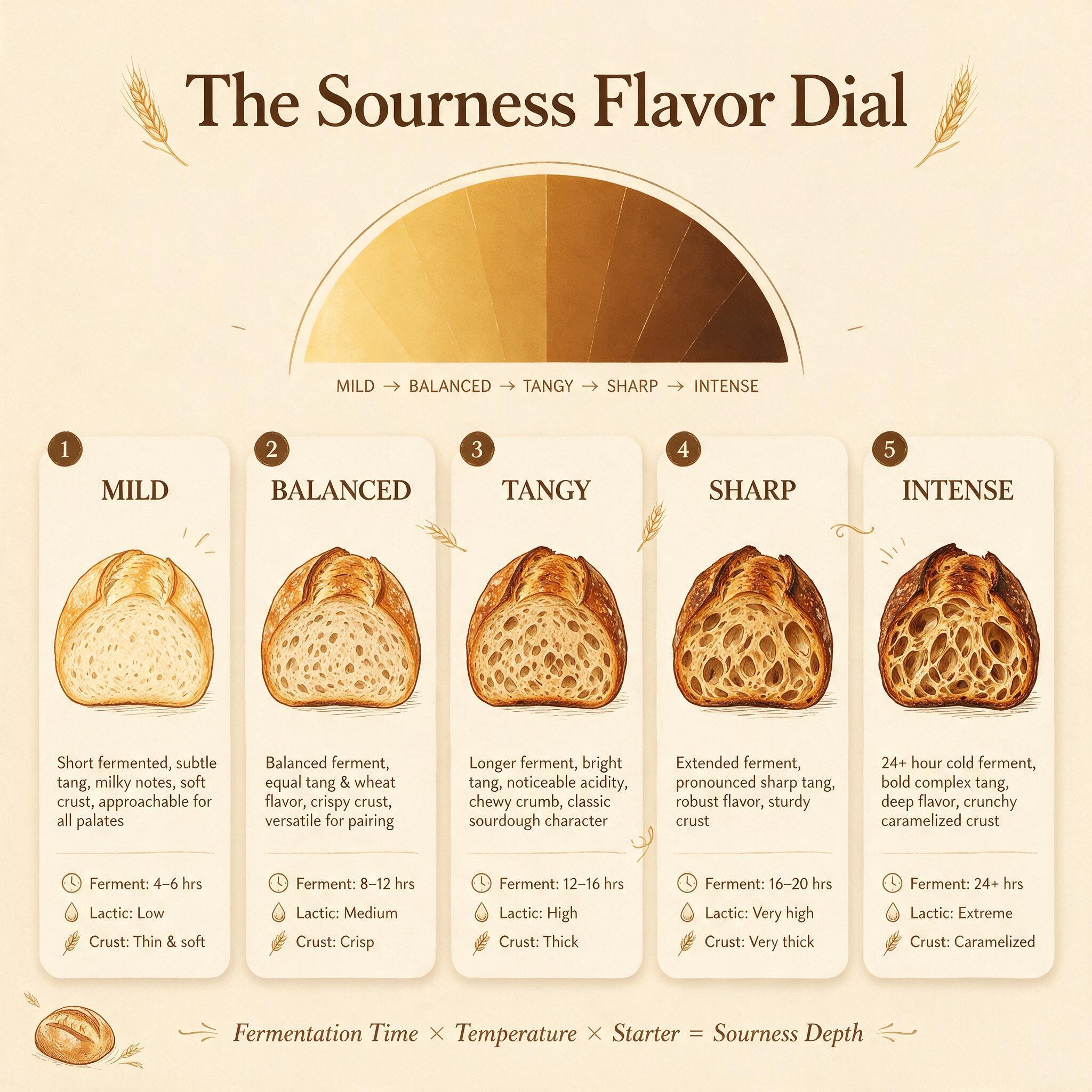
There's something almost magical about sourdough — flour, water, salt, time, and a living starter. That's it. No commercial yeast, no shortcuts. Just four ingredients that, given patience and a bit of know-how, transform into the most rewarding bread you'll ever bake from scratch.
But one ingredient above all else gives sourdough its identity: tang. That bright, complex sourness is what separates a loaf of sourdough from any other bread in your kitchen. And here's the thing I've learned after baking hundreds of loaves — that sourness isn't random. It's not something you just hope for or accidentally stumble into. Sourness is a dial. You control it at nearly every stage of the process, with tools already in front of you.
This guide covers everything you need to know about dialing your bread anywhere from barely-tangy to aggressively sour — including why each technique works and how to combine them for the flavor profile you want.
Why Sourness Matters (And Why It Varies)
If you've ever baked two loaves back-to-back and wondered why one tasted like a bakery loaf and the other was barely tangy at all, you're not alone. I learned this the hard way — I once spent weeks thinking my starter was "having an off week" when really it was just the fermentation temperature in my kitchen that had shifted with the season.
Sourdough sourness comes from two organic acids produced by lactic acid bacteria during fermentation: lactic acid and acetic acid. Understanding these two acids is the foundation for controlling your bread's flavor, because they behave differently depending on what you feed them — temperature, hydration, time, and flour type.
Lactic acid gives you a mild, creamy, yogurt-like sourness that lingers in the background. It thrives in warmer temperatures, higher hydration environments, and faster fermentation conditions. Acetic acid is the sharp one — vinegary, assertive, mouth-puckering. It prefers cooler temperatures, lower hydration, slower fermentation, and oxygen exposure.
Here's a practical insight: bacteria are sensitive to pH. As they produce acid during fermentation, the dough's acidity rises, which eventually slows bacterial activity. There's a natural ceiling on total sourness — and that ceiling is set by your flour's ash content (its mineral content). This is why whole grain flours allow more total acid accumulation than white flour. The minerals in whole grains act as a buffering system, giving bacteria room to produce more acid before the dough gets too acidic for them.
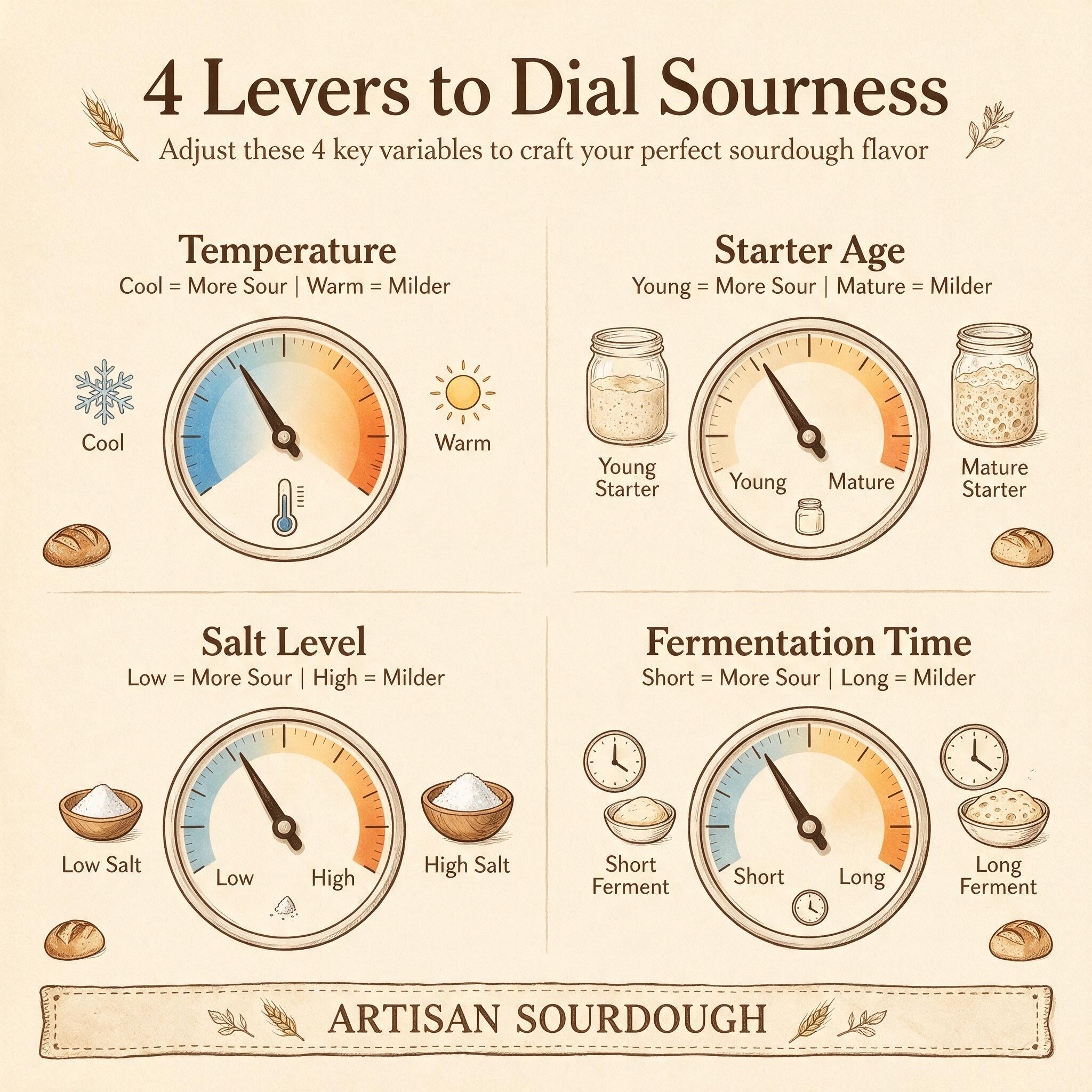
Now let's walk through the six main levers you can pull to control your bread's sourness.
Lever 1: Starter Ripeness
The easiest lever — and one of the most powerful.
Your starter's ripeness level has an immediate, direct effect on how tangy your loaf will taste. Think of it like this: a starter past peak is essentially a bag of acid waiting to happen. It's consumed nearly all its food, built up significant acidity, and carries that sourness straight into your dough.
For more sourness: Use your starter past peak — when it's collapsed, frothy on top, has a strong sour aroma, and feels loose in consistency. Build your levain from this mature starter, and you're already starting with acidity baked in (literally).
For milder bread: Use your starter at peak ripeness — risen, dome-shaped, with a mild aroma and just a few small bubbles visible. This starter has consumed its food but hasn't yet developed excessive acid. The bread will still have that characteristic sourdough tang, but it'll be gentler.
The key word here is immediate effect. Unlike some of the other levers we'll cover, starter ripeness changes your bread's flavor profile noticeably from one bake to the next — sometimes dramatically. If you want consistent results, try to use your starter at the same stage each time and note how it tastes.
Lever 2: Stiff vs Liquid Levain
This is one of my favorite levers because it's not widely discussed outside serious sourdough circles, yet it makes a significant difference in flavor profile. The hydration level of your levain shifts the balance between those two acids — lactic and acetic.
Stiff levain (50–65% hydration) — meaning less water relative to flour — shifts the acid ratio toward acetic acid production. This gives you sharper, more aggressive tang. Think of it like a slower, more concentrated fermentation within your starter culture itself.
Liquid levain (100% hydration or higher) favors lactic acid, which produces smoother, creamier sourness. The extra water keeps both yeast and bacteria active relative to each other, resulting in a gentler tang profile.
Here's an important caveat I learned the hard way: stiffness alone doesn't guarantee sourness — time matters just as much. A stiff levain that you feed frequently and keep on a tight schedule (like Italian lievito madre for panettone) actually produces very mild bread because frequent feeding dilutes acid before it has time to accumulate. It's the combination of low hydration plus long ripening time that pushes toward sharper tang.
If you want to experiment with stiff levain, try this: use 50% hydration (50g flour, 25g water, 25g starter), let it ripen for 8–12 hours at room temperature until bubbly and fragrant, then use it in your dough. You should notice a difference in the tang profile compared to a liquid levain of the same age.
Lever 3: Cold Proof Duration
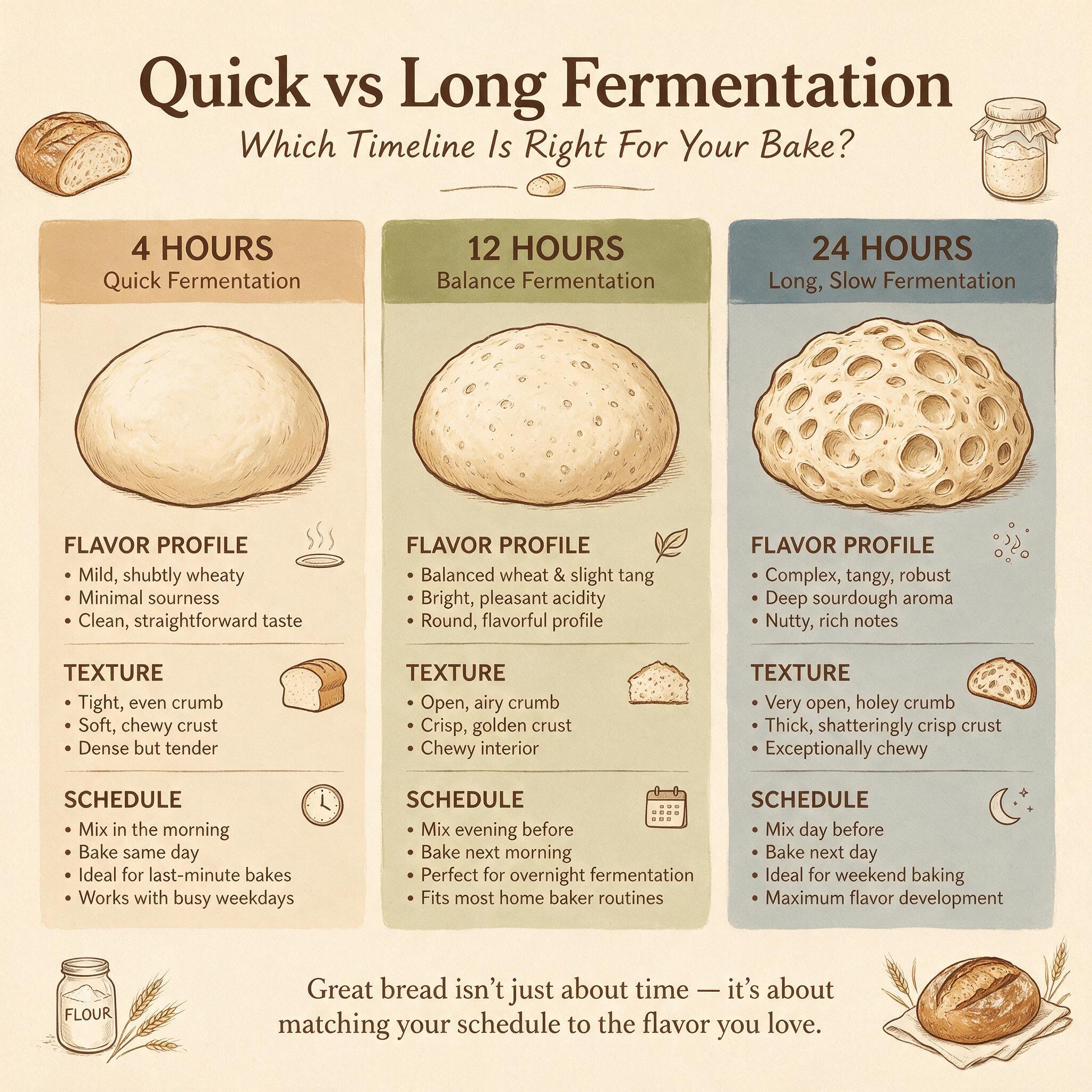
The cold proof — or retard — is where you shape your loaves and put them in the refrigerator before baking. This is perhaps the single most reliable lever for controlling sourness, and it's also incredibly schedule-friendly if you're working a 9-to-5.
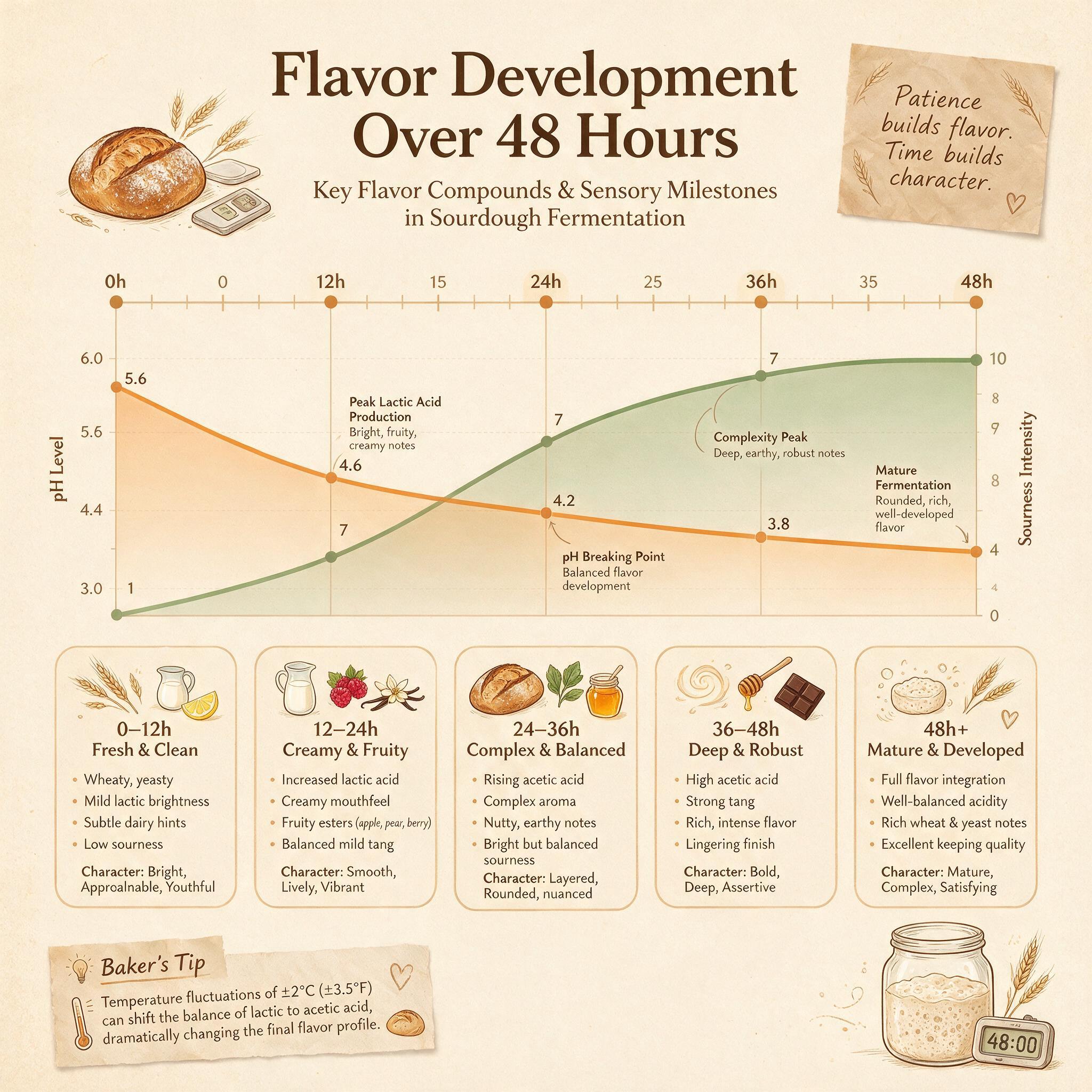
Cold temperatures slow both yeast and bacteria during fermentation, but here's the interesting part: bacteria keep working longer relative to yeast. As yeast continues releasing sugars that bacteria prefer, more total acid builds up over time — and with cooler temps favoring acetic acid production, your bread gets sharper tang.
Here's what a practical timeline looks like based on testing from professional bakers:
- •12 hours: Subtle, well-integrated sourness. Great for everyday baking when you want mild tang without much planning ahead.
- •18–24 hours: Tang becomes noticeably present. This is the sweet spot for many home bakers — enough character without overwhelming the other flavors.
- •48+ hours: Quite pronounced sourness, assertive but not unpleasant. You'll definitely taste it, and people will ask if you used a special starter.
- •Beyond 72 hours: Risk of gluten degradation starts creeping in. The flavor dominates, and oven spring may suffer as enzymes break down the dough's structure over time.
The tradeoff to keep in mind: extended cold proof means more sourness but potentially less oven spring, because those long hours in the fridge allow enzymes to gradually break down gluten. If you push past 48 hours regularly, consider adding a small percentage of strong bread flour or reducing the total fermentation time slightly on bulk to compensate.
For milder bread, shorten your cold proof to 10–12 hours, or skip it entirely and let shaped loaves proof at room temperature for just 2–4 hours before baking. You'll lose some flavor complexity but gain a gentler tang profile.
Lever 4: Whole Grain Percentage
This lever is all about flour choice — specifically, the mineral content (ash) of your flour. I think of it as setting the ceiling on how sour your bread can get.
Whole grain flours have significantly higher ash content than refined white flour. That ash acts as a buffering system in the dough, allowing bacteria to produce more acid before the pH drops low enough to slow them down. In practical terms: the more whole grain you use, especially rye, the more sour your bread can become.
For maximum tang: Increase your whole grain percentage, particularly with rye flour. Even 10–20% rye in your levain or dough noticeably boosts acidity. Rye is the most effective grain for this purpose — it has a uniquely high mineral content and provides abundant food for acid-producing bacteria.
For milder bread: Use more white (refined) flour. Without that mineral buffering capacity, bacteria simply can't produce as much total acid regardless of how long you ferment.
One compelling piece of evidence: professional bakers have documented loaves where 100% whole wheat sourdough had significantly more pronounced tang than the same recipe made with mostly white flour — using identical fermentation timelines and starter. Add rye to that mix, and the difference becomes even more dramatic.
If you're new to whole grain in your levain or dough, start small. Try 10% whole wheat or rye mixed into your feeding routine or dough formula and taste the difference on your next bake. You might be surprised how quickly a small percentage shifts the flavor profile.
Lever 5: Fermentation Temperature
Temperature is perhaps the most intuitive lever — warm equals faster, cool equals slower — but its effect on sourness has some nuance worth understanding.
Warmer fermentation (78–82°F / 25–28°C) keeps bacteria in their comfort zone and allows more total acid production over time. Bacteria thrive around 89–91°F, so a warm kitchen gives them plenty of runway to build up lactic character during bulk fermentation.
Cooler fermentation (68–72°F / 20–22°C) slows bacteria significantly, producing less total acid overall but shifting the ratio toward acetic acid. The result: sharper tang, but less sourness total. It's a subtler difference than you might expect — cooler doesn't automatically mean more sour in every sense of the word.
The best-of-both-worlds approach, which I personally prefer for flavor complexity: run a moderately warm bulk fermentation (target dough temperature around 78°F / 25°C) followed by an extended cold proof. This gives you lactic character from the warm bulk — that creamy, rounded sourness — combined with acetic development during the cold retard. The result is bread with depth and nuance rather than a single-note tang.
Of course, your kitchen temperature dictates how much control you have here. In summer, I find myself reaching for cooler mixing water to keep dough from fermenting too fast. In winter, bulk fermentation might take 7 hours instead of 4 — and both are perfectly fine. The key is watching the dough, not the clock.
Lever 6: Levain Percentage
This one's counterintuitive, so bear with me: using less starter can yield more sour bread.
Here's why. A large levain percentage (25–35% of your total flour weight) drops the dough's pH quickly from the very beginning because you're introducing a lot of pre-fermented, acidic starter. Bacteria are sensitive to low pH — as acidity rises, their growth slows considerably. So when your dough starts more acidic, bacteria actually have less runway to produce additional acid during fermentation.
Conversely, a smaller levain percentage (10–15% of total flour weight) means the dough starts at a higher pH. Bacteria have more room to gradually build up acidity over time, and because they're working in a less-acidic environment initially, they stay active longer and produce more total sourness.
For more sourness: Use 10–15% levain (pre-fermented flour) and give fermentation extra time to develop.
For milder bread: Use 25–35% levain for faster fermentation and less room for additional acid development. This is also great when you're short on time — a larger levain speeds up bulk fermentation considerably.
Putting It All Together: Your Sourness Decision Framework
Now that we've covered the levers individually, let's talk about how to combine them based on what flavor profile you're chasing.
"I Want More Sourdough Tang" — Prioritized Checklist
Start at the top and work down. Each step amplifies sourness further:
- Use starter past peak — easiest lever with immediate effect
- Extend cold proof to 24–48 hours — most reliable single action for building noticeable tang
- Switch to stiff levain at 50–65% hydration with a long ripening time (8–12+ hours)
- Increase whole grain percentage, especially rye at 10–20%, in your dough or levain
- Ferment warmer during bulk for greater total acid accumulation
- Use smaller levain percentage (10–15%) and extend fermentation times
Try combining the first two — past-peak starter plus a 48-hour cold proof — and you'll get bread with serious character. Add rye to that equation, and it gets even more pronounced.
"I Want Less Sourness" — Prioritized Checklist
For those days when you want gentle tang rather than bold sourness:
- Feed starter frequently and use at peak ripeness — most effective lever
- Use young levain — risen but not yet peaked, about 3–4 hours at warm temperature (78–80°F)
- Shorten or skip cold proof — proof shaped loaves at room temperature for just 2–4 hours before baking
- Switch to liquid levain at 100% hydration for smoother, creamier sourness
- Ferment cooler with shorter bulk time (68–72°F / 20–22°C)
- Use larger levain percentage (25–35%) to speed fermentation and limit acid development
Troubleshooting: Why Is My Sourdough So Mild?
If your sourdough tastes more like regular sandwich bread than anything tangy, check these common culprits:
Your starter isn't mature enough. If it's less than 2–3 weeks old, the acid-producing bacteria haven't fully established themselves yet. Keep feeding consistently — flavor develops as the microbial ecosystem matures. This is one of those things that just takes time.
You're using levain too young. Make sure your levain has doubled in size, shows bubbles throughout (not just on top), and smells sweet with only a hint of tang before you use it. A young levain hasn't had time to develop meaningful acidity.
Fermentation is moving too fast. If your kitchen runs warm — above 80°F / 27°C — bulk fermentation might be complete in 3 hours instead of the usual 5 or 6. That leaves little time for acid-producing bacteria to do their work. Try using cooler mixing water, or extend your cold proof to compensate.
You're using mostly refined white flour. Low ash content sets a low ceiling on acidity regardless of what other levers you pull. Even adding a small percentage of whole wheat or rye can make a noticeable difference in sourness potential.
Frequently Asked Questions
Can I control sourness after the dough is already mixed?
You have some control — primarily through cold proof duration and fermentation temperature during bulk. But the biggest levers (starter ripeness, levain hydration, whole grain percentage) need to be set before mixing begins. Think of it like seasoning: you can adjust at the end, but the foundation was laid earlier.
Does sourness mean healthier bread?
Not necessarily — though more fermentation time does produce more beneficial compounds like prebiotics and lower glycemic impact. Sourness itself is just a flavor profile. A mildly tangy loaf fermented for 6 hours has different nutritional properties than an aggressively sour loaf fermented for 48 hours, but both are nutritious in their own right.
Can I make bread too sour?
Yes, though it's harder than you'd think. Beyond about 72 hours of cold proof, gluten degradation starts affecting texture, and the dough can become slack or even start breaking down. The flavor becomes dominant — some people love this, others find it overwhelming. There's no universal "too sour" because taste is personal. I personally prefer a milder tang, but my neighbor loves aggressive sourness and will happily ferment for 5 days.
What about store-bought starters? Will they give me the same results?
Store-bought or dehydrated starters work fine — they just need time to establish. Once your starter is mature (usually 2–3 weeks of consistent feeding), the levers we've discussed all apply regardless of where it came from. The microorganisms in a well-maintained home starter are functionally equivalent whether they started from dried flakes or flour and tap water on day one.
Is there a "best" sourness level?
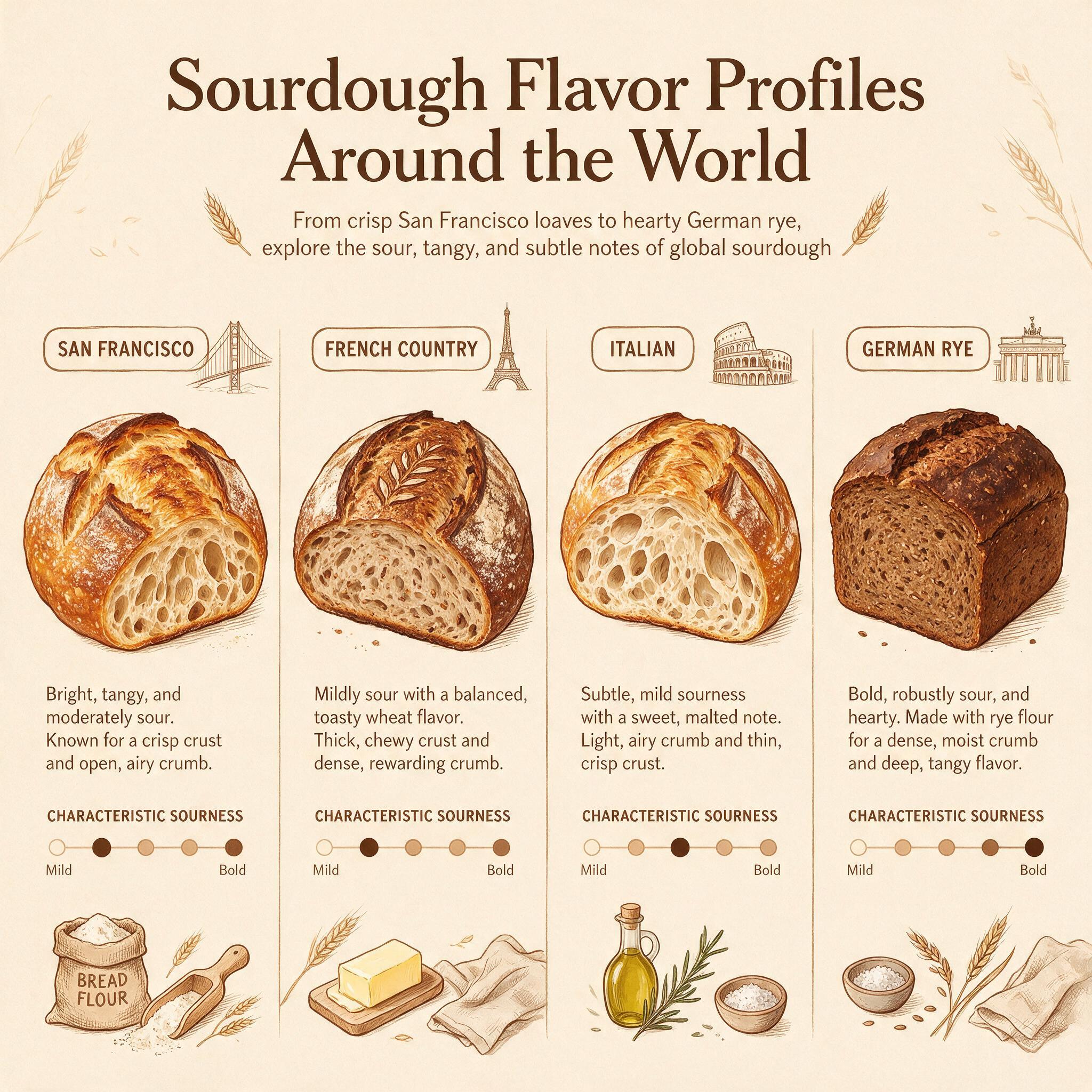
Nope. This is deeply personal bread, and the best flavor profile is the one you enjoy eating. Some cultures favor intensely sour loaves — traditional European sourdoughs can be quite assertive. Others prefer gentle tang that complements rather than dominates. Pay attention to what you like, find the combination of levers that consistently delivers it, and adjust from there.
Closing Thoughts
Sourdough is deeply personal — what works in my kitchen might need tweaking in yours, and that's the beauty of it. Temperature varies by season, flour by brand, starter by feeding schedule. There's no single correct way to make sour bread or mild bread. There are just levers, and you get to decide how far to turn each one.
The next time you bake, try changing just one variable from what you normally do — maybe use your starter past peak instead of at peak, or extend that cold proof by an extra 12 hours. Taste the difference on your next loaf. Over time, you'll develop an intuition for how each lever affects your bread's flavor, and sourness will become one of the most satisfying tools in your baking toolkit.
Happy baking!
Sources & Further Reading
This post is more practical than research-based — the "flavor dial" framing is built on well-established sourdough microbiology rather than new primary literature. The underlying science is documented in:
Primary literature (peer-reviewed):
- •Landis E.A., et al., "The diversity and function of sourdough starter microbiomes," eLife, 2020 — PMC7837699 — establishes that AAB populations shape aroma variation across starters
- •Gänzle M.G., "Enzymatic and bacterial conversions during sourdough fermentation," Food Microbiology, 2014 — the canonical review on microbial succession, organic acid production, and flavor development
Practitioner resources (named home-baking references):
- •The Sourdough Journey — the "use at peak vs past peak" principle and temperature-driven fermentation timing
- •King Arthur Baking — the hydration/oxygen mechanism for the LAB → AAB balance
- •The Perfect Loaf — Maurizio Leo's working approach to cold retard and its effect on flavor development
- •Brod & Taylor — proofer manufacturer whose documentation covers temperature control and its effect on starter activity
Where attribution is widely-attributed but not primary-sourced here: the specific quantitative thresholds (78–82°F for lactic dominance, 68–70°F for acetic dominance, 60–70% hydration for stiff starter effects) come from accumulated practitioner experience and the home-baking literature. They reflect real-world consistency but are not from a single primary study. The qualitative mechanisms (warm/anaerobic favors LAB; cool/oxygenated favors AAB) are well-established — see the Gänzle 2014 review.
Related Posts
Keep going with these related guides.