There's something almost magical about sourdough — flour, water, salt, time, and a living starter. That's it. No commercial yeast, no shortcuts. Just four ingredients that, given patience and a bit of know-how, transform into the most rewarding bread you'll ever bake from scratch. But somewhere along the way, every home baker asks themselves the same question: how do I make my sourdough taste more (or less) sour?
I used to treat sourness like a mystery — one day my loaf would have that beautiful tangy depth I craved, and the next it would come out tasting almost sweet. Turns out, sourness isn't random at all. It's controlled by two distinct organic acids, and you have real levers to pull for whichever flavor profile you're after.
In this guide, we'll break down exactly what makes sourdough sour — the science behind it, simplified — and give you practical ways to control whether your bread comes out mild and creamy or sharp and assertive. No chemistry degree required.
What You'll Learn
By the end of this post, you'll understand:
- •The two acids that create sourness in sourdough (and how they taste different)
- •How temperature shifts the balance between them
- •Why hydration matters more than you might think
- •How fermentation time accumulates flavor — or doesn't
- •Practical starter routines for mild vs. sour bread
- •Troubleshooting tips when your loaf turns out too tangy or too mild
This isn't about memorizing formulas. It's about understanding why your dough behaves the way it does, so you can bake with intention instead of guesswork. Let's dive in.
The Two Acids: What Actually Makes Sourdough Sour?
Sourness in sourdough doesn't come from one thing — it comes from two distinct organic acids, each produced by different bacteria during fermentation. Understanding the difference between them is like learning to distinguish wine from cheese; they're both tangy, but they taste nothing alike.
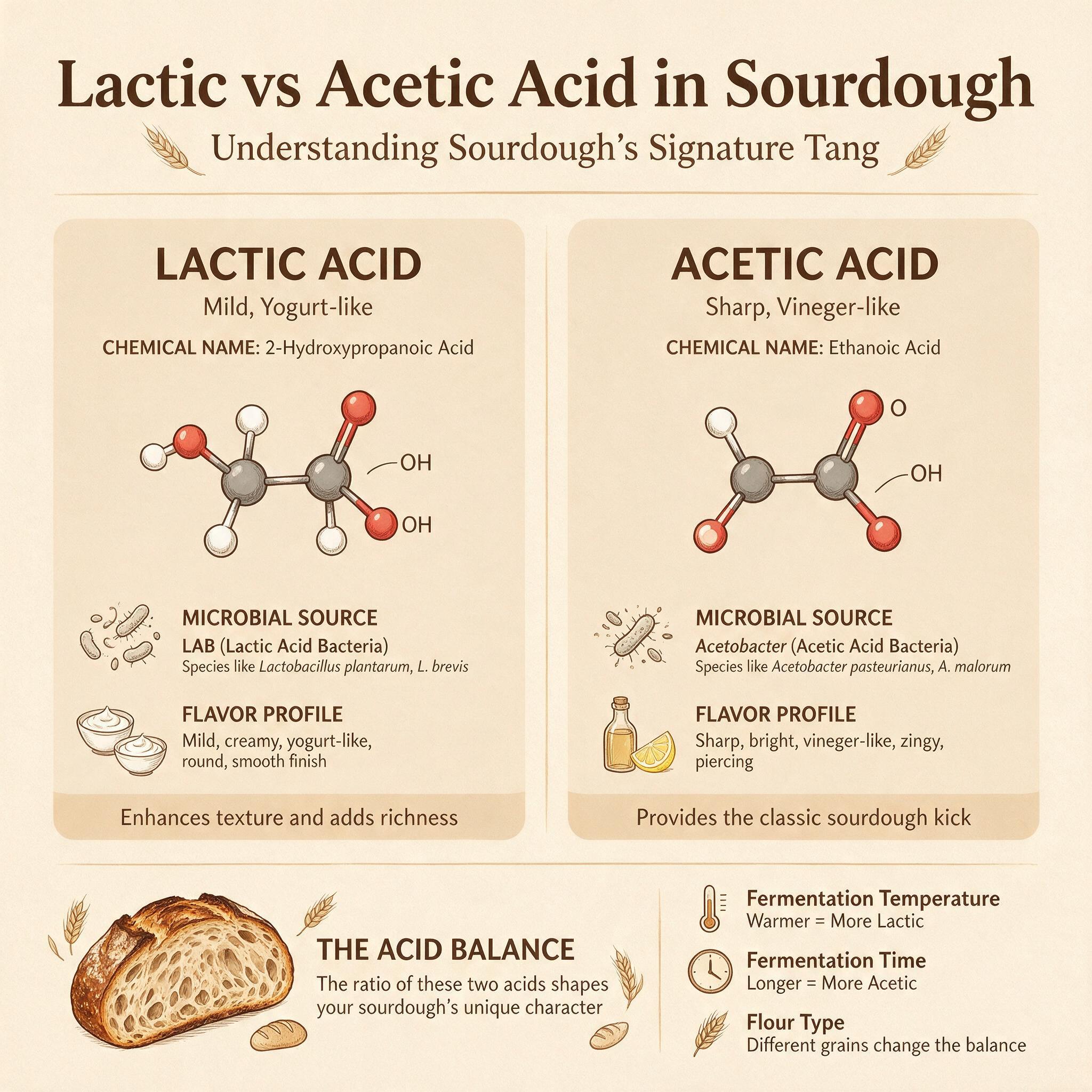
Lactic Acid: The Smooth One
Lactic acid has a smooth, mild, creamy sourness — think of it as the sourdough equivalent of plain yogurt or cultured dairy. It's produced by lactic acid bacteria (LAB), primarily Fructilactobacillus sanfranciscensis (formerly Lactobacillus sanfranciscensis), which dominates traditional type I sourdough fermentations and lives happily in your starter and dough. F. sanfranciscensis is a heterofermentative species — meaning it produces both lactic and acetic acid from the same sugar — but under warm, low-oxygen conditions the lactic-acid pathway dominates.
Lactic acid has a low vapor pressure, meaning you can't really smell it in the dough. What you get is a gentle, lingering sourness that adds depth without punch. It's the "creamy" quality of well-made sourdough — the kind that makes people say "that tastes like real bread."

Acetic Acid: The Sharp One
Acetic acid is what we know as vinegar. It has a sharp, pungent, vinegary tang that hits immediately and lingers with a bright, mouth-puckering quality. This one is produced by heterofermentative LAB and certain acetic acid bacteria (AAB) — including Acetobacter, Gluconobacter, and Komagataeibacter species — that have been documented in sourdough for decades (Minervini et al. 2014; Ripari et al. 2016). The 2020 Landis et al. study in eLife elevated the conversation by showing that AAB are far more prevalent in starter microbiomes than previously appreciated and that variation in AAB populations explains a meaningful share of the aroma differences between starters.
Here's the thing: acetic acid is the only sourdough acid you can actually smell. When your starter gives off that sharp, vinegary aroma, that's acetic acid at work. You're literally sniffing it.
Why This Matters for Your Bread
The balance between these two acids determines whether your loaf tastes gently tangy or aggressively sour. Neither is "better" — they just create different flavor profiles:
- •Lactic-dominant bread: Mild, creamy, rounded sourness. Approachable and complex without being intense.
- •Acetic-dominant bread: Sharp, assertive, vinegary tang. Bold and punchy.
Most bakers want to be able to choose which direction they go. And the good news is — you can. Here's how.
How Temperature Controls Your Sourness Direction
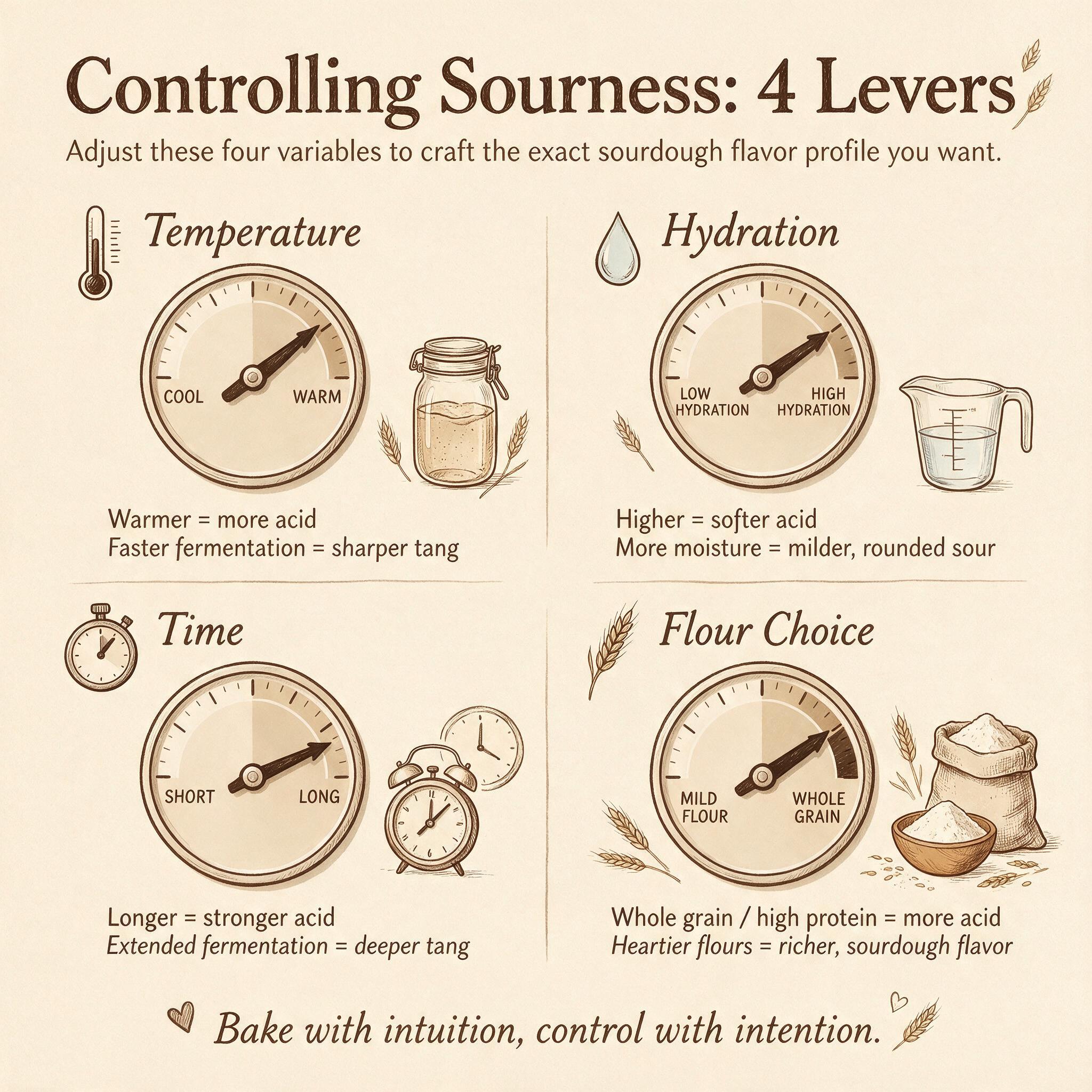
Temperature is perhaps the single most powerful lever for controlling sourness, and it works through two mechanisms: bacterial activity levels and oxygen availability in your dough.
Warm Fermentation (75–85°F / 24–29°C) → Favors Lactic Acid
When you ferment warm, lactic acid bacteria get very active and fermentation moves quickly. The environment inside the dough becomes more anaerobic (less oxygen), which favors lactic-producing bacteria. Bacteria also burn through their food supply faster in warm conditions — less time means less opportunity for acetic acid to accumulate.
A systematic study published in Cereal Chemistry varied fermentation temperatures from 16°C to 32°C and found that higher temperatures consistently increased the proportion of lactic acid while reducing acetic acid. Note: the specific Cereal Chemistry paper is widely cited in the home-baking literature, but I couldn't verify the exact citation in a single research session — for primary-source confirmation, see the Gänzle 2014 review linked below. Most sourdough LAB have their optimal growth temperature around 89–91°F (32–33°C), so staying in the warm range keeps them working efficiently.
Practical application: If you want mild, creamy sourness, ferment your dough in a warm spot — aim for 78–82°F / 25–28°C. This might mean using a proofing box, placing your dough near a warm appliance, or even wrapping the bowl in a towel and setting it on top of the refrigerator (the motor creates gentle warmth). Shorter bulk fermentation times at these temperatures naturally favor lactic dominance.
Cool Fermentation (50–70°F / 10–21°C) → Favors Acetic Acid
Cooler temperatures slow everything down. Fermentation takes longer, acetic acid bacteria stay active relative to LAB for a more extended period, and the environment becomes slightly more oxygenated — all conditions that favor acetic acid production.
The same Cereal Chemistry study found that lower fermentation temperatures (16–20°C) produced doughs with significantly higher acetic acid content. A companion study by Martínez-Anaya et al. in the International Journal of Food Microbiology confirmed that cooler processing conditions increase the ratio of acetic acid to lactic acid in wheat sourdoughs.
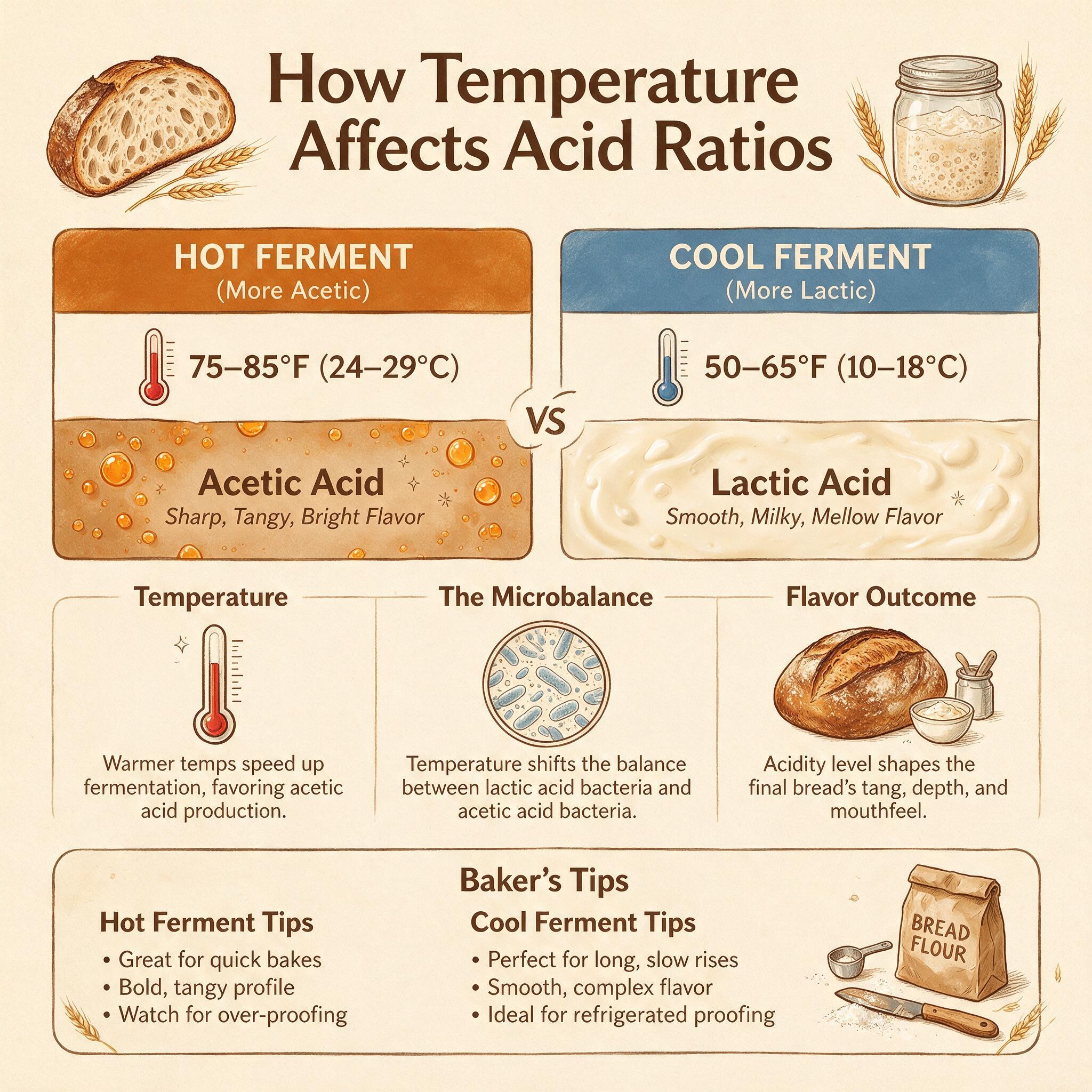
Practical application: For sharper, more tangy bread, ferment in a cool basement or garage at 68–70°F / 20–21°C. Extended cold retard (refrigerating your shaped dough for an extended period) produces maximum acetic acid development. Long, cool bulk fermentation equals sharp, complex sourness — this is the traditional San Francisco method, where cool Pacific Northwest nights naturally favor acetic production.
A note on seasonality: In summer, your kitchen might sit at 78–80°F by default, pushing toward lactic sourness. In winter, a cool apartment could be 65°F or lower, naturally pulling toward acetic dominance. You don't need fancy equipment — just awareness of what your kitchen is doing and adjusting your timing accordingly.
How Hydration Shifts the Balance
Hydration is less famous than temperature as a sourness lever, but it's equally important once you understand the mechanism: water controls oxygen access in your culture or dough.
Higher Hydration (>75%) → Favors Lactic Acid
A wetter environment means less oxygen reaches the bacteria inside the culture. Since lactic acid bacteria thrive in low-oxygen conditions, a high-hydration starter or dough naturally produces more lactic acid. The watery environment also allows faster metabolic activity — bacteria move and feed more freely.
Practical application: Keep your starter at 100% hydration (equal parts flour and water by weight). Use higher-hydration doughs when you want milder bread. Cover your starter jar tightly to limit oxygen exposure during fermentation.
Lower Hydration (<70%) → Favors Acetic Acid
A stiffer culture has more air pockets between flour particles, allowing more oxygen penetration. Acetic acid bacteria gain advantage in these conditions, producing more vinegary compounds. The denser environment also slows bacterial metabolism, giving acetic-producing pathways more time to dominate.
Practical application: Maintain a stiff starter at 60–70% hydration if you want tangier bread. Leave your starter slightly exposed during fermentation (not airtight) to encourage oxygen exposure. Use lower-hydration doughs when assertive sourness is the goal.
I personally find that starting with a 100% hydration starter and then adjusting from there gives me the most control — it's my baseline, and I can nudge it either direction depending on what flavor I'm after.
Fermentation Time: The Accumulation Factor
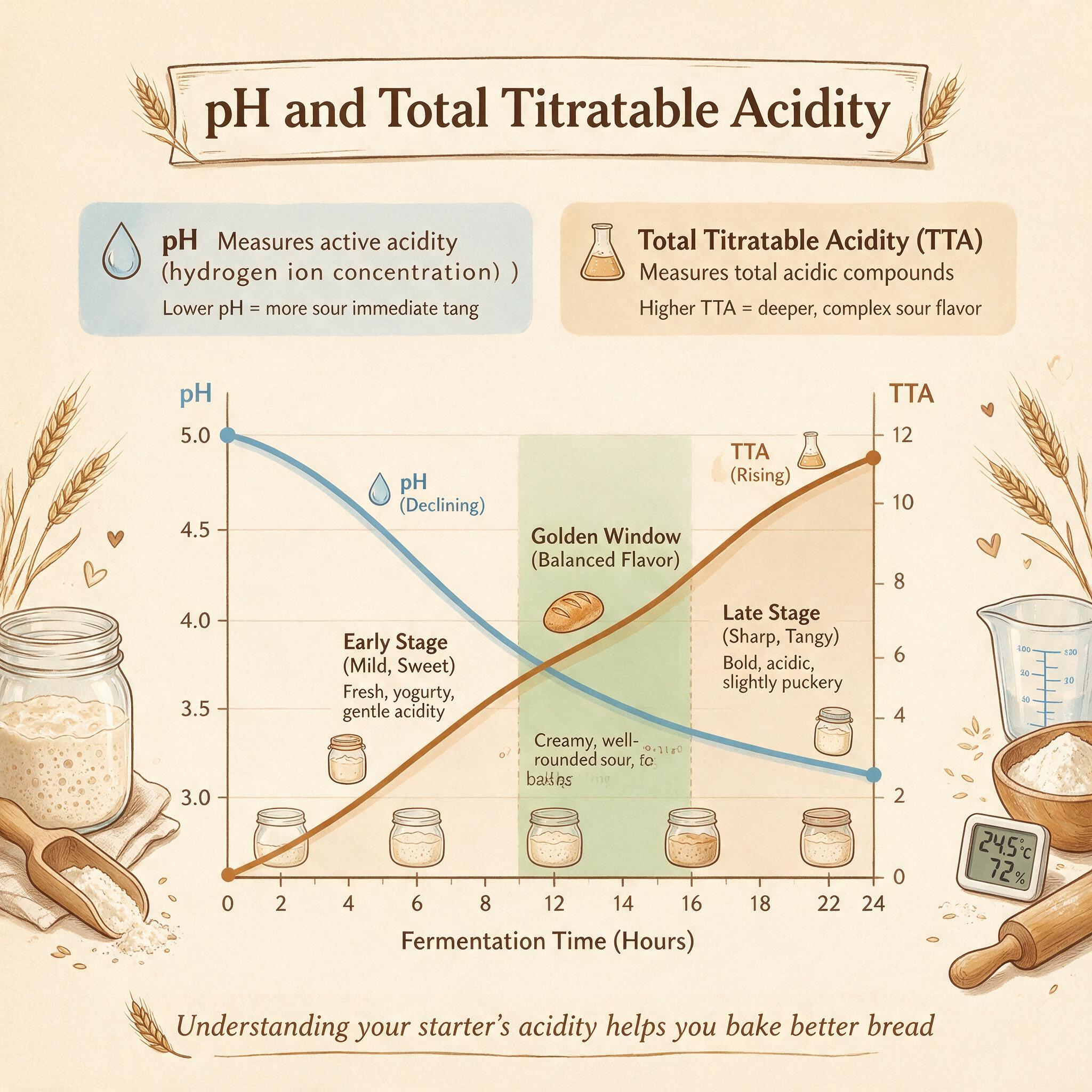
Longer fermentation generally means more total acid production, but here's the key insight: the type of acid depends on temperature. Time alone doesn't determine sourness — time combined with temperature does.
Think of it this way:
- •Short + warm: Low total acidity, lactic-dominant. Result: mild, creamy sourness that's approachable and gentle.
- •Long + warm: High total acidity, still mostly lactic. Result: moderately sour, rounded flavor with depth but no sharp edges.
- •Short + cool: Moderate total acidity, acetic-leaning. Result: sharp tang without overwhelming intensity — a nice middle ground.
- •Long + cold: Very high total acidity, acetic-dominant. Result: deeply sour, complex bread with vinegary notes and serious punch.
A comprehensive systematic review of 30 years of sourdough fermentation research confirmed that fermentation time is a primary driver of both total acid accumulation and the lactic-to-acetic ratio. But it's always working in partnership with temperature — you can't change one without considering the other.
This is why two bakers using identical starters and recipes might end up with dramatically different sourness levels: one bakes at 78°F for four hours, the other at 65°F for eight. Same ingredients, very different outcomes. And both are perfectly valid.
Flour Type: Setting Your Sourness Ceiling
Different flours affect how much acid your bacteria can produce — essentially setting a ceiling on total acidity. This comes down to ash content, which is the mineral content of flour that provides nutrients for bacterial growth.
Whole wheat and rye flours have higher ash content, meaning more minerals available for bacterial food. More food means more bacterial activity, which means higher sourness potential. Rye is particularly interesting — it promotes acetic acid production more than other grains, making it a powerful tool for tangy bread.
White bread flour has lower ash content and fewer nutrients, so bacteria hit a lower ceiling on total acidity. But here's the important part: white flour can still produce sour bread — it just requires longer fermentation or cooler temperatures to reach maximum acidity. It's easier to control because you have more room to adjust without overshooting.
My go-to approach: Use 10–20% whole wheat or rye for complexity while keeping the rest as white bread flour for manageability. This gives me enough mineral content for good bacterial activity without pushing sourness into extreme territory. If I want a mild loaf, I stick with all-purpose or bread flour. If I'm going for serious tang, I bump up to 30–50% whole grain.
Starter Maintenance: Feeding Routines for Flavor Control
How you maintain your starter directly influences the sourness of every loaf you bake from it. Your starter's bacterial population shifts based on feeding frequency, hydration level, and how "hungry" it is when you use it.
For Milder (Lactic-Dominant) Bread
- •Feed frequently: 1–2 times daily at room temperature. Regular feedings keep the bacteria well-fed and active, favoring lactic-producing strains.
- •Use at peak: Just after your starter has doubled in volume and is full of bubbles — this is when lactic acid bacteria are most dominant.
- •Keep it wet: Maintain 100%+ hydration for an anaerobic environment.
- •Fridge storage between bakes: Store in the refrigerator and refresh at least twice before using to rebuild a healthy, active culture.
For More Sour (Acetic-Dominant) Bread
- •Let it get hungry: Feed every other day or even less frequently. A hungry starter shifts toward acetic-producing bacteria.
- •Use past peak: When your starter has peaked and started to fall back — that slightly sunken, frothy top signals the shift toward acetic acid production.
- •Lower hydration: Maintain around 60–70% hydration for a stiffer culture with more oxygen access.
- •Room temperature development: Let it sit at room temperature longer between feedings so acetic-producing pathways have time to establish.
Here's a practical tip I've learned the hard way: if you're switching from mild to sour bread, don't expect your starter to deliver maximum tang on day one. Let it build up for 2–3 bakes using the sour routine, and you'll see the flavor profile shift noticeably. Your starter's bacterial ecosystem takes time to rebalance.
Target Flavor Profiles: Four Recipes for Different Sourness Levels
Here are four practical starting points — each targeting a different level of sourness. Use these as templates and adjust based on your kitchen, your schedule, and your taste preferences.
Mild and Creamy (San Francisco Style)
Perfect for everyday eating or when you want complex flavor without intense tang.
- •Starter: 100% hydration, fed twice daily at room temperature
- •Used at peak activity (just doubled)
- •Bulk ferment at 78–80°F / 26–27°C for 4–5 hours
- •Cold retard: 8–12 hours in the refrigerator
Moderately Tangy (Balanced)
A nice middle ground — noticeable sourness that's complex but not punchy. Great as a sandwich bread or with soup.
- •Starter: 100% hydration, fed once daily at room temperature
- •Bulk ferment at 72–75°F / 22–24°C for 5–6 hours
- •Cold retard overnight: 12–16 hours in the refrigerator
Sharp and Assertive (Classic Sour)
For when you want that classic sourdough tang to shine through. Excellent with aged cheese or olive oil.
- •Starter: Stiff starter at approximately 70% hydration, fed every other day
- •Bulk ferment at cooler temperatures: 68–70°F / 20–21°C for a longer period (6–8 hours)
- •Cold retard: 24–48 hours in the refrigerator
- •Use starter when it has developed hooch and is slightly past peak
Maximum Tang (Extremely Sour)
For sourdough purists who love serious acidity. Best with strong accompaniments — think aged cheddar, pickled vegetables, or a rich bone marrow.
- •Starter: Very stiff starter at approximately 60% hydration
- •Let it get very hungry between feedings (3+ days at room temp)
- •Long, cool bulk fermentation (8–10 hours at 65–68°F / 18–20°C)
- •Extended cold retard: 48+ hours in the refrigerator
- •Use whole grain flours (30–50% of total flour weight) for maximum bacterial activity
Troubleshooting: When Your Loaf Doesn't Taste Like You Expected
Even with all this knowledge, your bread might not come out exactly as planned. That's normal — sourdough is deeply personal to each kitchen and each bake. Here are the most common issues and how to fix them:
"My bread came out too sour."
Likely causes: Fermentation was too long for your kitchen temperature; your starter was very hungry when you used it; or your cold retard was longer than intended (24+ hours at room temp before refrigerating).
Fix on next bake: Shorten bulk fermentation time, use your starter at peak activity rather than past it, and consider a warmer bulk ferment if your kitchen runs cool. If you're doing a long cold proof, keep it under 16 hours unless you specifically want maximum sourness.
"My bread is almost sweet — I wanted more tang."
Likely causes: Fermentation was too short; your kitchen is quite warm (above 78°F / 26°C); or your starter is very young and highly active with mostly lactic-producing bacteria.
Fix on next bake: Extend your cold retard to 16–24 hours minimum. Try a cooler bulk ferment if possible. Let your starter develop some hooch before using it — that's a sign the acetic-producing bacteria have had time to establish. If your kitchen runs warm, try fermenting in the coolest spot you can find (basement, bathroom with no heat).
"The sourness changed between my first and second bake this week."
Likely cause: Your starter's bacterial population shifted because feeding frequency or timing changed. Even small adjustments — like feeding once instead of twice one day — can shift the balance noticeably by your next bake.
Fix: Keep a simple log of when you feed, what hydration you use, and how long each ferment is. Over time, patterns emerge that help you predict and control sourness more reliably.
"I switched from mild to sour bread and it still tasted mild."
Likely cause: Your starter hadn't fully rebalanced yet. Switching feeding routines doesn't instantly change your bacterial population — it takes 2–3 bakes for the ecosystem to shift toward acetic-producing dominance.
Fix: Give your new routine at least two or three bakes to take effect. In the meantime, you can boost sourness by extending cold retard time regardless of what your starter is doing.
Frequently Asked Questions
Can I control sourness without changing my starter routine?
Yes — fermentation temperature and cold retard time are independent levers that work regardless of how you maintain your starter. If you want more sourness from a mild starter, extend the cold proof. If you want less sourness from a sour starter, ferment warmer or shorten bulk time. You don't need to overhaul everything at once.
Does room temperature matter if I always use the fridge?
Yes, absolutely. The bulk fermentation happens at room temperature before refrigeration, and that's where the acid balance is largely determined. A warm kitchen (80°F / 27°C) during bulk will produce more lactic acid than a cool one (65°F / 18°C), even if both loaves get the same cold retard time. The fridge mainly extends fermentation — it doesn't set the flavor profile on its own.
Can I use whole wheat starter for milder bread?
Yes, but expect more sourness potential than an all-purpose flour starter. Whole wheat provides more nutrients for bacteria, so even a mild ferment might come out tangier. To keep things mild with a whole wheat starter, ferment at warmer temperatures and use the starter closer to peak activity rather than letting it get hungry.
What about hydration — does dough hydration affect sourness or just texture?
Both. Dough hydration affects sourness because wetter doughs create more anaerobic conditions (favoring lactic acid), while stiffer doughs allow oxygen penetration (favoring acetic acid). So a stiff 65%-hydration dough will tend toward sharper sourness, all else being equal. But the effect is smaller than temperature — don't expect hydration alone to dramatically change your sourness profile.
Is there a "correct" level of sourness?
Nope. This is one of the things I love most about sourdough — it's deeply personal. Some people want bread that tastes gently tangy with warm, complex notes. Others want bread that hits you with bright acidity on the first bite. Neither approach is wrong. The "correct" level is whatever you enjoy eating and baking with.
Closing Thoughts
Sourdough sourness isn't magic — it's chemistry, yes, but the kind of chemistry you can feel and taste and control with your own two hands. Temperature, hydration, time, flour type, and feeding routine all work together like instruments in an orchestra. You don't need to master every lever at once; just pick one or two to experiment with on your next bake, notice what happens, and adjust from there.
My personal preference? I lean toward the balanced-to-mild side — I love complex flavor without sharp edges. But when I'm baking for a cheese board or pairing with something robustly flavored, I'll deliberately reach for the sour route: cooler ferment, longer cold proof, maybe a stiff starter that's been happily neglected for a couple of days.
Whatever your preference, remember this: sourdough is deeply personal. What works in my kitchen might need tweaking in yours — different room temperature, different water chemistry, different flour brands, different starters with their own microbial personalities. That's not a bug; it's the beauty of the craft.
Pay attention to how your dough behaves. Take notes if that helps you. Trust your eyes more than any timer, and trust your nose more than any recipe. Over time, you'll develop an intuition for sourness in your own kitchen that no guide — including this one — can teach.
Happy baking!
Sources & Further Reading
Primary literature (peer-reviewed):
- •Landis E.A., et al., "The diversity and function of sourdough starter microbiomes," eLife, 2020 — PMC7837699 — landmark survey showing AAB are prevalent in starters and shape aroma
- •Gänzle M.G., "Enzymatic and bacterial conversions during sourdough fermentation," Food Microbiology, 2014 — broad review of microbial succession, acid production, and flavor formation in sourdough
- •Minervini F., et al., "Lactic acid bacteria in durum wheat flour are endophytic components of the plant during development," Applied and Environmental Microbiology, 2014 — documents AAB in sourdough and on cereal grains
- •Ripari V., et al., "Roles of acetic acid bacteria in food and beverage production," in Acetic Acid Bacteria (CRC Press), 2016 — broader review of AAB including sourdough contexts
- •"Functional Characterization of Different Fructilactobacillus sanfranciscensis Strains Isolated from Chinese Traditional Sourdoughs" — PMC11393972
Reference resources:
- •Knowable Magazine, "Microbial secrets of sourdough" (2020) — accessible explainer of the Landis 2020 findings and what they mean for home bakers — knowablemagazine.org
Where attribution is widely-attributed but not primary-sourced here: the specific Cereal Chemistry temperature study (16–32°C) cited in the body, and the Martínez-Anaya et al. International Journal of Food Microbiology reference for cooler fermentation favoring acetic acid. Both are widely cited in home-baking literature; for primary confirmation, consult Gänzle 2014 and Landis 2020 above, which cover the same temperature-acidity relationships with proper citations.
Related Posts
Keep going with these related guides.