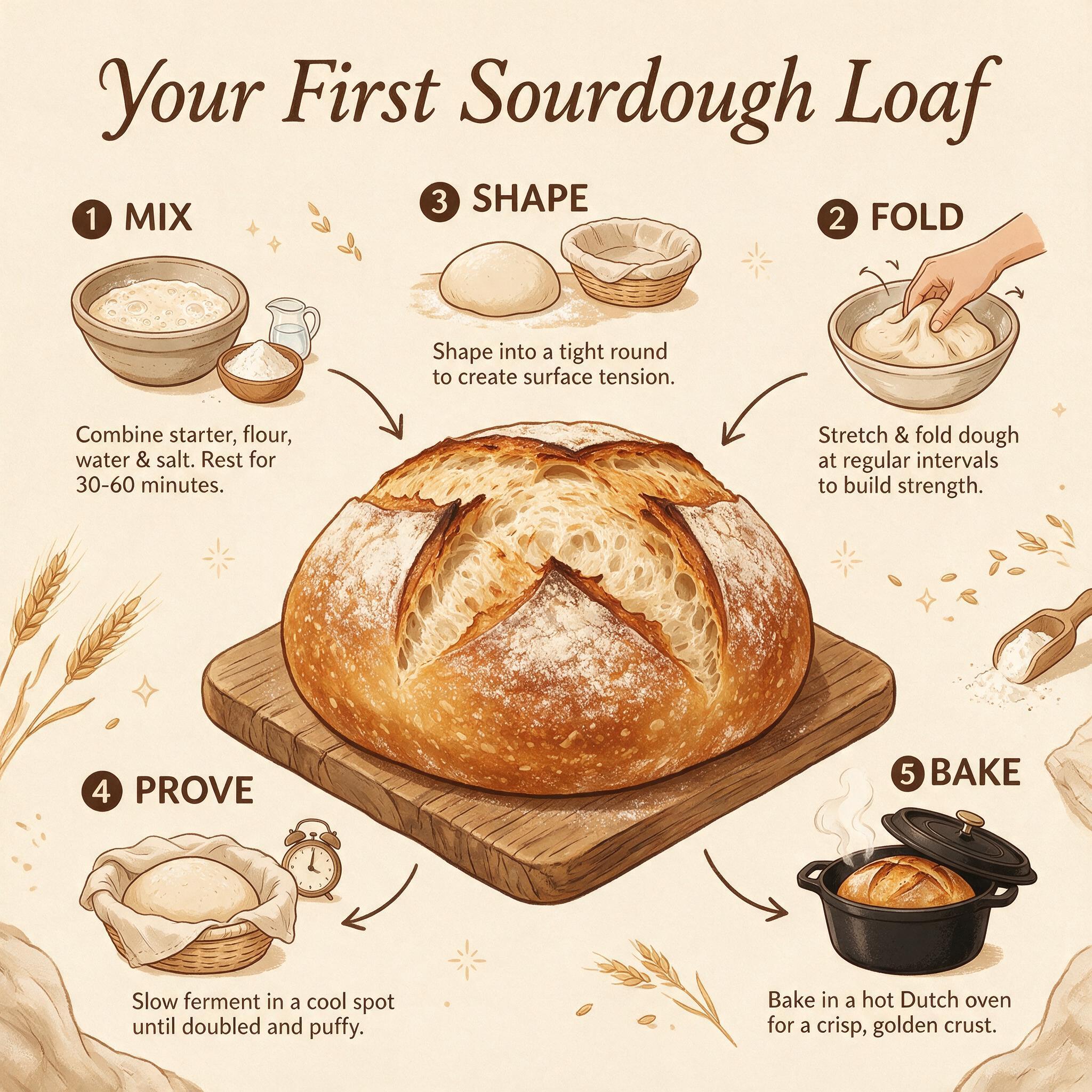
There's something almost magical about sourdough — flour, water, salt, starter, and time. That's it. No commercial yeast, no shortcuts. Just four ingredients that, given patience and a bit of know-how, transform into the most rewarding bread you'll ever bake from scratch.
I still remember my first loaf: slightly flat on top, dense in the middle, but absolutely magnificent when I finally sliced into it anyway. (Pro tip: dense sourdough makes incredible French toast.) Every baker's first loaf looks different — maybe yours will be better than mine was, or maybe you'll hit a similar snag and learn something along the way. Either way, that first loaf is special. It taught me everything I know about patience in the kitchen.
This guide strips away all the fancy techniques and expensive equipment most guides assume you have. You need four ingredients, basic tools, and visual cues instead of strict timers. Let's make your first loaf together.
What You Actually Need (Hint: Not Much)
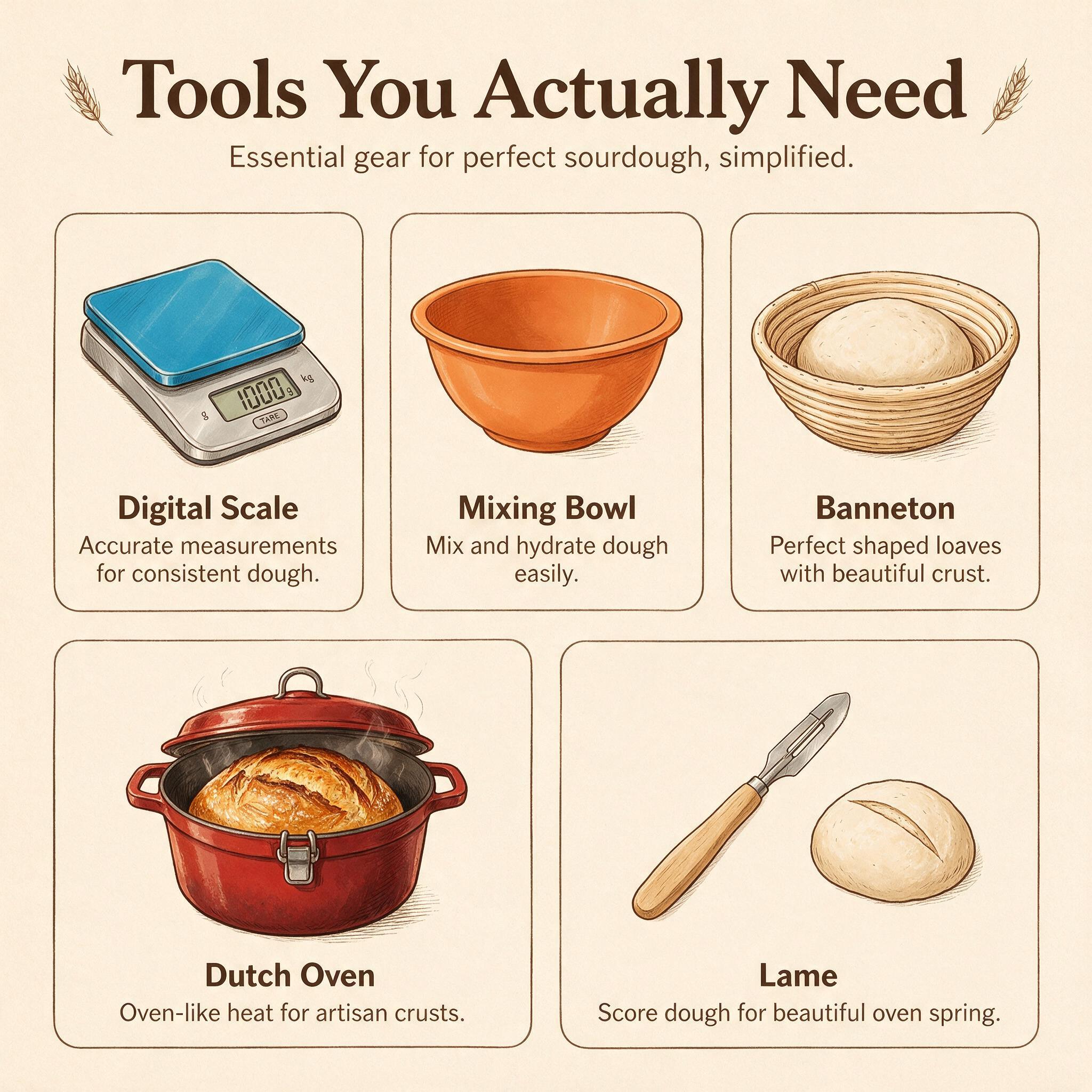
Before we start mixing, let's talk about what's on your counter. The beauty of sourdough is how little you actually need to begin.
Required — Non-Negotiable Tools
A digital kitchen scale. This is the single most important tool in sourdough. Baker's percentages are measured by weight, not volume. "2 cups flour" can vary wildly depending on how tightly you packed it; 300g of flour is always 300g. Any scale with at least 1g precision works fine — no need for the fancy 0.1g models yet.
A large mixing bowl. Big enough to mix and fold without splashing everywhere. I like a wide bowl because it gives me room to work, but any bowl that holds your dough with room to spare will do.
A straight-sided container with measurement marks. A 2L glass measuring cup or a clear plastic container works perfectly. You'll draw a line at the starting level of your dough and watch it rise past that mark — this visual cue is far more reliable than any timer for knowing when bulk fermentation is complete.
A banneton (proofing basket) or a bowl lined with a floured linen/cotton towel. Rice flour works best in a banneton because it doesn't absorb moisture like wheat flour does, and it prevents sticking beautifully. If you don't have a banneton — which is completely fine for your first loaf — use a medium bowl and line it generously with a clean kitchen towel dusted heavily with regular flour.
Helpful But Not Required
- •Dutch oven or roasting pan. Traps steam during baking, giving you better oven spring and crust development. If you don't have one, an inverted metal bowl placed over your loaf works too.
- •A bread lame (sharp scoring blade) or a sharp kitchen knife. For making the slash across your dough before baking. A regular sharp knife works perfectly fine.
- •Parchment paper. Makes transferring dough into your hot Dutch oven much easier — less sticking, less stress.
What Beginners Don't Need (Yet)
Skip these for now: spiral mixer, professional proofing box, specialty dough scrapers (a regular spatula works), baking steel or stone, water spray bottle. You can always add tools later when you know what you're missing.
The Recipe — Simple, Low-Hydration Dough
Here's the approach I recommend for your first loaf: a lower hydration recipe at about 68%. This means less water relative to flour, which makes the dough much easier to handle than the sticky, wet doughs you see in fancy bread shops. It holds its shape during shaping, it's forgiving if you're still learning, and it produces a beautiful crust once baked.

Levain Build (Morning of Bake Day):
- •35g active starter
- •35g all-purpose or bread flour
- •35g water
Dough:
- •400g bread flour or all-purpose flour (bread flour gives more structure, but AP works fine for your first loaf)
- •280g water (room temperature)
- •70g levain (your fully risen starter from above)
- •90g salt
The dough hydration comes out to roughly 68%, which is gentle enough for beginners. Feel free to adjust the water by ±15g based on your flour's absorption — different flours drink differently, and that's okay.
Step-by-Step: Your First Loaf
Day 1 — Mix, Fold, and Ferment
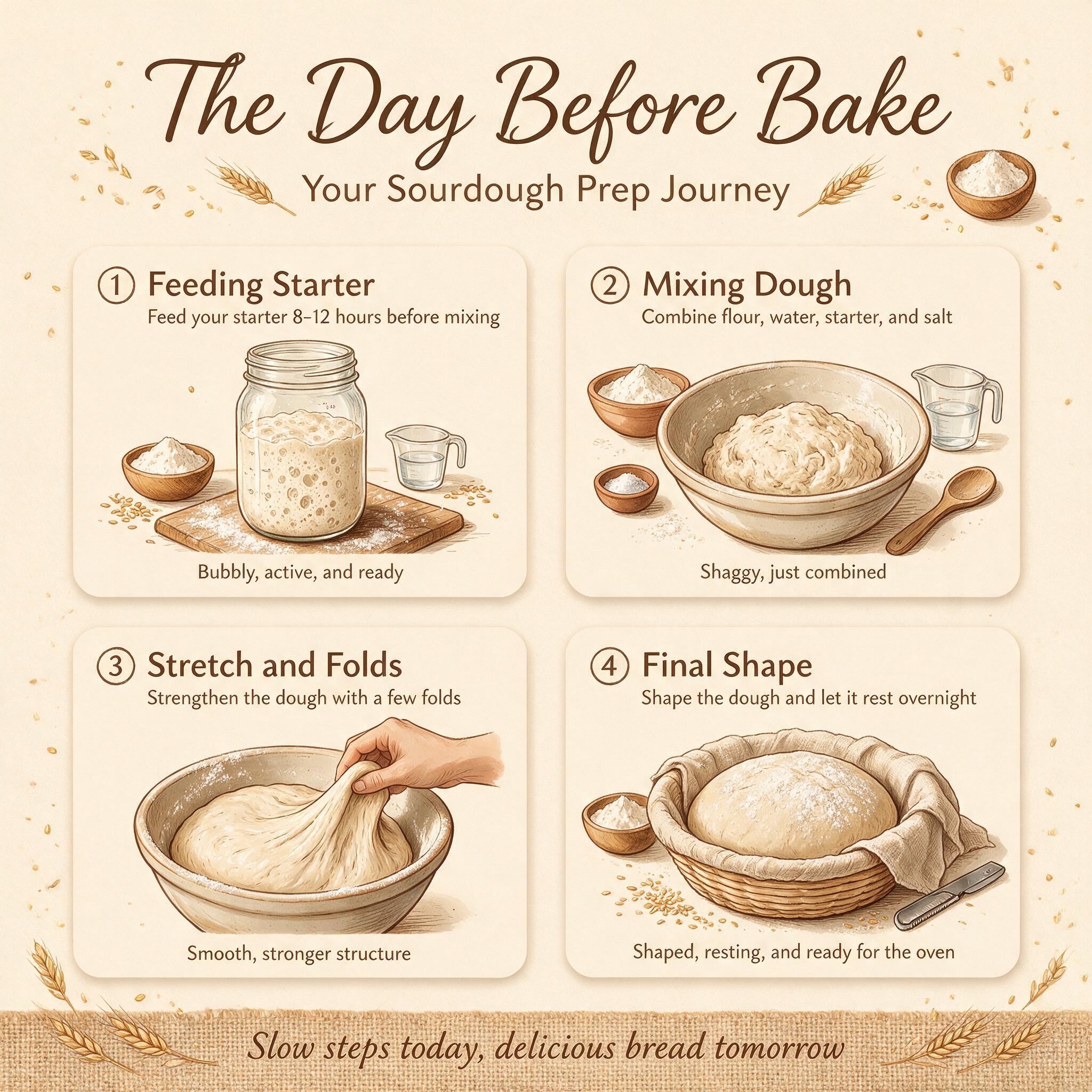
8:00 AM — Build Your Levain. Feed your starter with equal parts flour and water: 35g starter, 35g flour, 35g water. This is your levain — the active culture you'll use to leaven the dough. By building it fresh on bake day rather than overnight, you avoid guessing whether your starter will peak at the right time.
Noon (4–6 hours later) — Mix Your Dough. When your starter has doubled in volume and is domed at the top with small bubbles visible across its surface, it's ready. It should smell pleasant and slightly tangy, not aggressively sour or runny. That's your window.
Combine the levain with 280g water in your mixing bowl and stir to dissolve the starter. Add the flour and mix until a shaggy mass forms — about 3–5 minutes of stirring with your hands or a sturdy spoon. At this point, add the salt and mix it in thoroughly. The dough will look rough and uneven. That's normal.

12:30 PM — First Stretch-and-Fold Set. Wet your hands slightly to prevent sticking. Reach under one side of the dough, lift it gently upward (don't tear), and fold it over toward the center. Rotate the bowl a quarter turn and repeat on each side — four folds total. This is called a stretch-and-fold: you're building structure without aggressively degassing the dough.
1:00 PM — Second Set. Rest for 30 minutes, then do another set of four folds. Your dough should already feel noticeably smoother and more cohesive than when you started.
1:30 PM — First Coil Fold Set. Wet your hands again. Slide them under the center of the dough, lift gently, and let gravity stretch it before folding it over itself. Do this two times in opposite directions. Coil folds are gentler than stretch-and-folds and help develop strength while keeping the dough airy.
2:00 PM — Second Set. After another 30-minute rest, do one final set of two coil folds. That's all the folding you'll need for this recipe. From here, the dough does its own work during bulk fermentation.
Bulk Fermentation — Let Time Do Its Thing
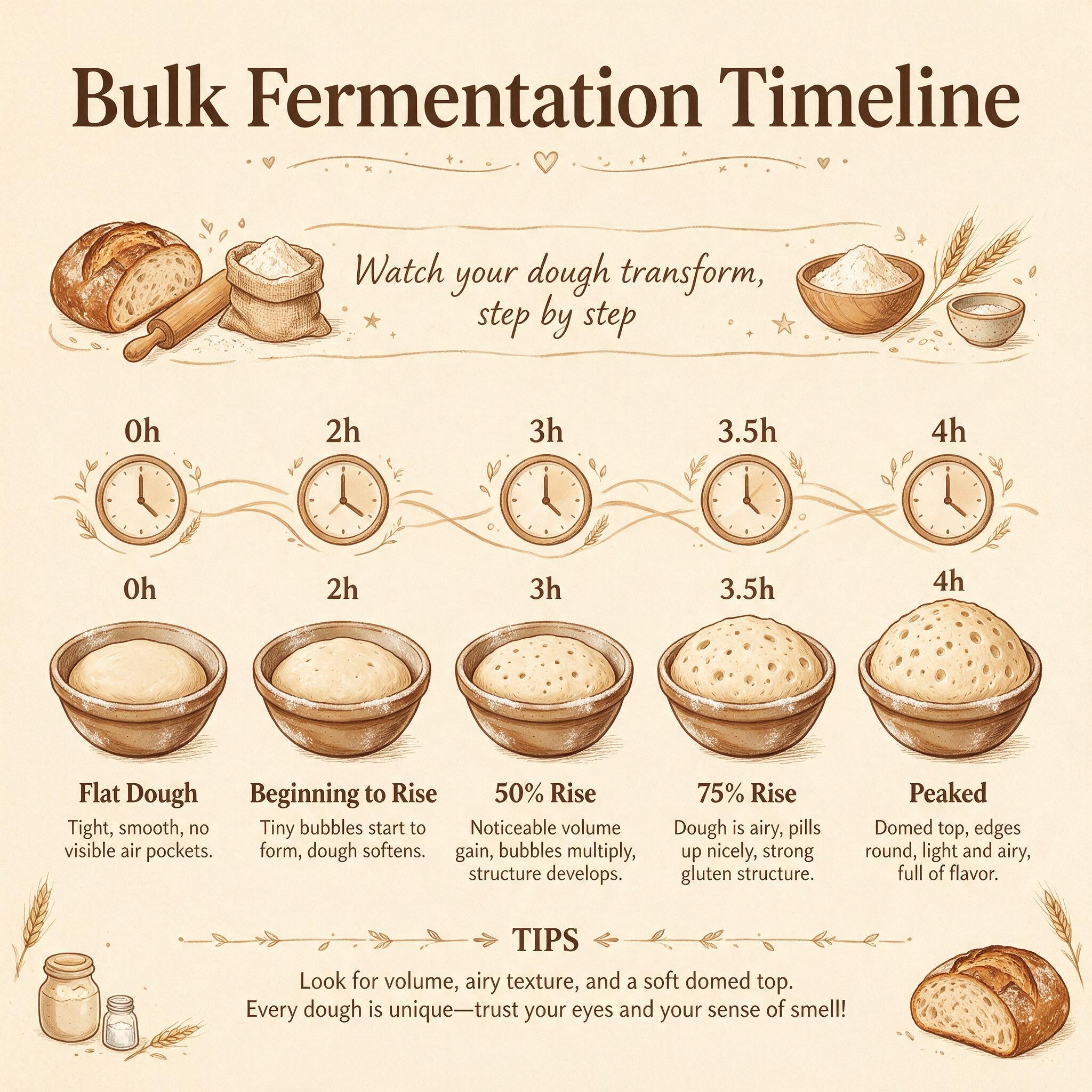
Now comes the patient part: bulk fermentation. This is where the flavor develops and the dough rises. Set your bowl with a mark at the starting level on the counter and walk away for about 5–6 hours (at a kitchen temperature around 73°F / 23°C).
How do you know when bulk fermentation is done? Watch the dough, not the clock. Your dough is ready when:
- •It has risen 50–100% from your starting line (aim for about 75% as a good target)
- •The surface looks slightly domed rather than flat or sunken
- •You can see large bubbles on top and smaller bubbles along the sides of your container
- •The dough pulls away easily from the edges of the bowl when you shake it gently
- •It jiggles like set custard when you give the bowl a little shake
If you're in a cooler kitchen (65–70°F / 18–21°C), bulk may take closer to 8–10 hours. Warmer kitchens speed things up. Both are fine — sourdough doesn't care about your schedule, but it does respond beautifully to temperature.
A note on winter baking: If you're starting this recipe between January and March (the busiest time for new bakers), your kitchen is likely cooler than 73°F. That's perfectly normal — bulk fermentation will simply take longer. Don't be tempted to think "my dough didn't rise" when it's actually just fermenting slowly at a lower temperature. Consider using slightly warmer water during mixing to bring the initial dough temperature into the 73–75°F range if your kitchen runs cold.
Shaping — Give It Form
When bulk fermentation is complete, turn the dough onto a lightly floured surface. Gently press it into a rough rectangle — no need to degas it completely. Fold the sides toward the center and roll the dough away from you into a tightish round or oval shape. Place it seam-side up in your banneton or towel-lined bowl, dusted generously with flour.
If you're feeling rushed (or if dinner is calling), this is where a cold proof saves the day: pop the shaped dough directly into the refrigerator for 12–14 hours overnight. The cold slows fermentation dramatically, gives you schedule flexibility, and actually improves crust color during baking. I personally prefer this approach because it lets me bake fresh bread on a morning when I'm not rushing around all day.
Day 2 — Bake Your Loaf
8:00 AM — Preheat. Place your Dutch oven (with lid on) in the oven and preheat to 500°F / 260°C for at least 30 minutes. The oven and pot need to be fully heated before the dough goes in.
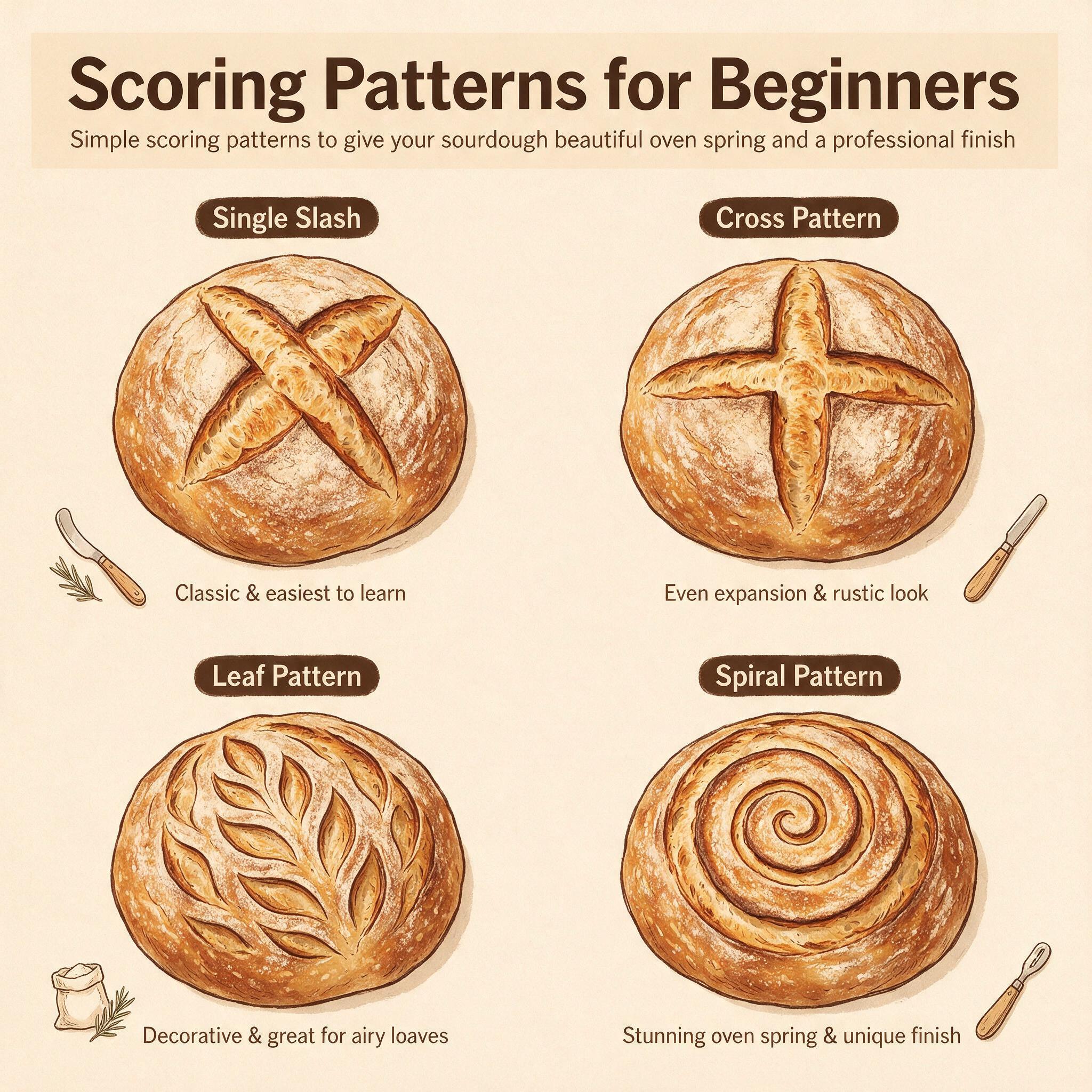
8:30 AM — Score. Turn the proofed dough out onto a piece of parchment paper (this makes transferring easier). Use a lame or sharp knife to make one decisive slash across the top of the dough — about ¼ inch deep, at a slight angle. This "ear" is where the bread will expand in the oven. Don't overthink this; confident slashes beat hesitant ones every time.
8:40 AM — Bake. Lower the dough (on its parchment) into your hot Dutch oven. Put the lid on tight and bake at 500°F for 20 minutes. Then remove the lid, reduce the temperature to 450°F, and continue baking for another 17–20 minutes until the crust is a deep golden brown all around — darker than you think it needs to be.
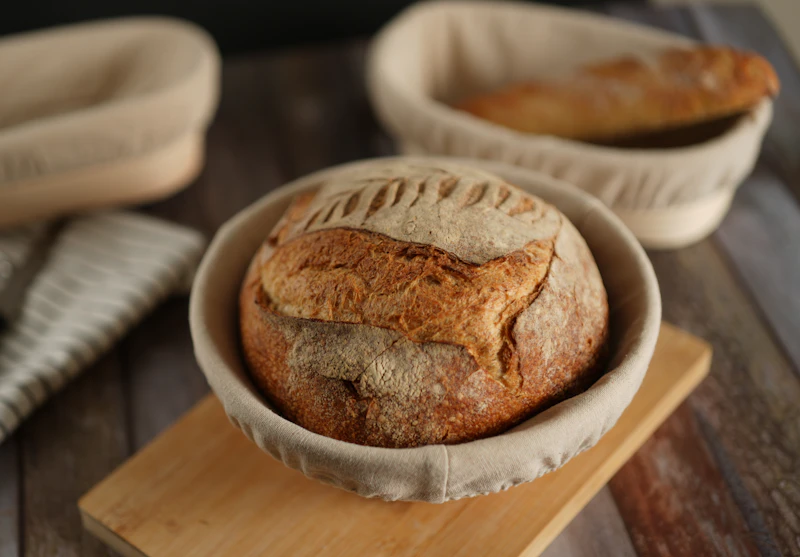
9:20 AM — Cool. Remove from oven and transfer to a wire rack. Here's the most important rule for beginners: let the bread cool completely before slicing, at least 2 hours minimum. Cutting into warm sourdough gives you that gummy, undercooked texture because the crumb structure hasn't set yet. Patience here pays off enormously.
Troubleshooting — What Went Wrong (And How to Fix It)
Every baker goes through these phases. You will too. Here are the most common beginner experiences and what they mean:
"My dough turned into a puddle."
Most likely cause: The hydration was too high for your first attempt, or not enough folds were done before bulk fermentation.
Fix next time: Stick with 68% hydration for your first few loaves — it's much more manageable. Make sure you complete all the fold sets during the early stage; they build the structure that holds everything together later.
"My bread is dense with no rise."
Most likely cause: The dough was under-fermented (you shaped it before bulk fermentation was truly complete) or your starter wasn't fully active when you built the levain. Cold kitchens slow things down significantly.
Fix next time: Wait until the dough has visibly risen 50–100% before shaping. Make sure your starter is at peak activity — domed, bubbly, and fragrant — before mixing the dough.
"My bread collapsed in the oven and tastes sour."
Most likely cause: Over-fermentation. The bulk was too long, or the dough sat in the fridge past its proofing window. Warmer kitchens accelerate fermentation faster than recipes predict.
Fix next time: Watch the dough's appearance rather than following a clock. When the surface starts to flatten and you see lots of large bubbles, it may be nearing overproofed territory.
"My bread tastes like plain store-bought bread — no sourdough tang at all."
Most likely cause: Your starter is still young (less than 2–3 weeks old), the fermentation was too short for acid development, or your kitchen ran very warm so everything finished fermenting before significant acidity built up.
Fix next time: Be patient with new starters — they take a few weeks to establish robust microbial communities. Extending bulk fermentation or adding a cold proof gives more time for sourness to develop. A small percentage of whole wheat flour also adds complexity and feeds the culture.
"The bottom burned but the top is pale."
Most likely cause: The oven rack was positioned too low, conducting excess heat through your Dutch oven or baking sheet.
Fix next time: Position your rack in the upper-middle of the oven. If you're using a baking sheet instead of a Dutch oven, double up sheets for insulation.
FAQ — Quick Answers to Common Questions
Can I use all-purpose flour instead of bread flour? Yes. All-purpose works perfectly fine for your first loaf and several more beyond that. Bread flour has slightly higher protein content, which gives more structure and better oven spring, but AP is absolutely acceptable — especially while you're learning.
How do I know if my starter is active enough to use? It should have at least doubled in volume from its feeding level, be domed on top (not collapsed), show small bubbles across the surface, and smell pleasantly tangy rather than sharply acidic or like nail polish remover. If it's past peak — sunken, very liquid, strong sour smell — feed it again and wait.
What if I don't have a banneton? Use a medium bowl lined with a clean linen or cotton kitchen towel. Dust the towel generously with flour (regular wheat flour is fine here). The flour creates a barrier between the dough and fabric. Shape your dough seam-side up, and it should release easily after proofing.
Can I bake this recipe without a Dutch oven? Absolutely. You can use an inverted metal bowl over the loaf, or bake directly on a baking sheet with a pan of water in the oven below for steam. The Dutch oven is just the most convenient way to trap steam — which creates better crust and oven spring.
How long does sourdough stay fresh? Store cooled bread in a paper bag at room temperature for 2–3 days, or in a plastic bag for up to a week. You can also freeze sliced sourdough for longer storage — it reheats beautifully in a toaster.
Closing Thoughts
Sourdough is deeply personal — what works perfectly in my kitchen might need tweaking in yours, and that's the beauty of it. Your first loaf won't look like every other loaf, and that's exactly how it should be. The dough responds to your kitchen's temperature, your starter's unique microbial community, even the humidity in the air. There is no single "correct" sourdough.
Pay attention to how your dough behaves during each step — take mental (or actual) notes if that helps you. Trust your eyes more than any timer or recipe. Over time, you'll develop an intuition for what "ready" looks like in your own kitchen, and future loaves will get easier and better with every bake.
A dense loaf isn't wasted bread. A flat loaf isn't a failure. Every loaf — even the ones that don't look like bakery bread — teaches you something about how sourdough works. Slice it up, share it with someone you care about, and start planning your second one. That's where the real learning begins.
Happy baking. Your first loaf is waiting.