There's something almost magical about sourdough — flour, water, salt, time, and a living starter. That's it. No commercial yeast, no shortcuts. Just four ingredients that, given patience and a bit of know-how, transform into the most rewarding bread you'll ever bake from scratch.
But here's the thing nobody tells beginners: that living starter needs to be fed, and how often depends entirely on your baking rhythm. Some bakers feed daily. Others feed once a week in the fridge. A few maintain stiff levain doughs for enriched breads. All of them are right — because sourdough isn't one-size-fits-all, and neither is starter maintenance.
In this guide, I'll walk you through four real-world routines that actually work (not just the ones that look pretty on Instagram). You'll learn which routine fits your schedule, how to execute each one, what to expect, and how to troubleshoot when things don't go perfectly — because they rarely do on day one.
Why This Matters
Your starter is the engine of every sourdough loaf you bake. If it's sluggish or underfed, your bread will be dense. If it's past peak and over-fermented, your bread will taste sharp and collapse. Getting to know your starter's rhythm — and choosing a maintenance routine that matches how often you actually bake — is the single most important skill in sourdough baking.
The good news: once you pick a routine and stick with it for a few weeks, things become predictable. Your starter will tell you what it needs through its smell, its rise time, and its behavior when you do the float test. You'll start recognizing those signals without checking a recipe or reading a blog post.
Let's get there.
Routine A: Daily Room-Temperature Feeding (For Frequent Bakers)
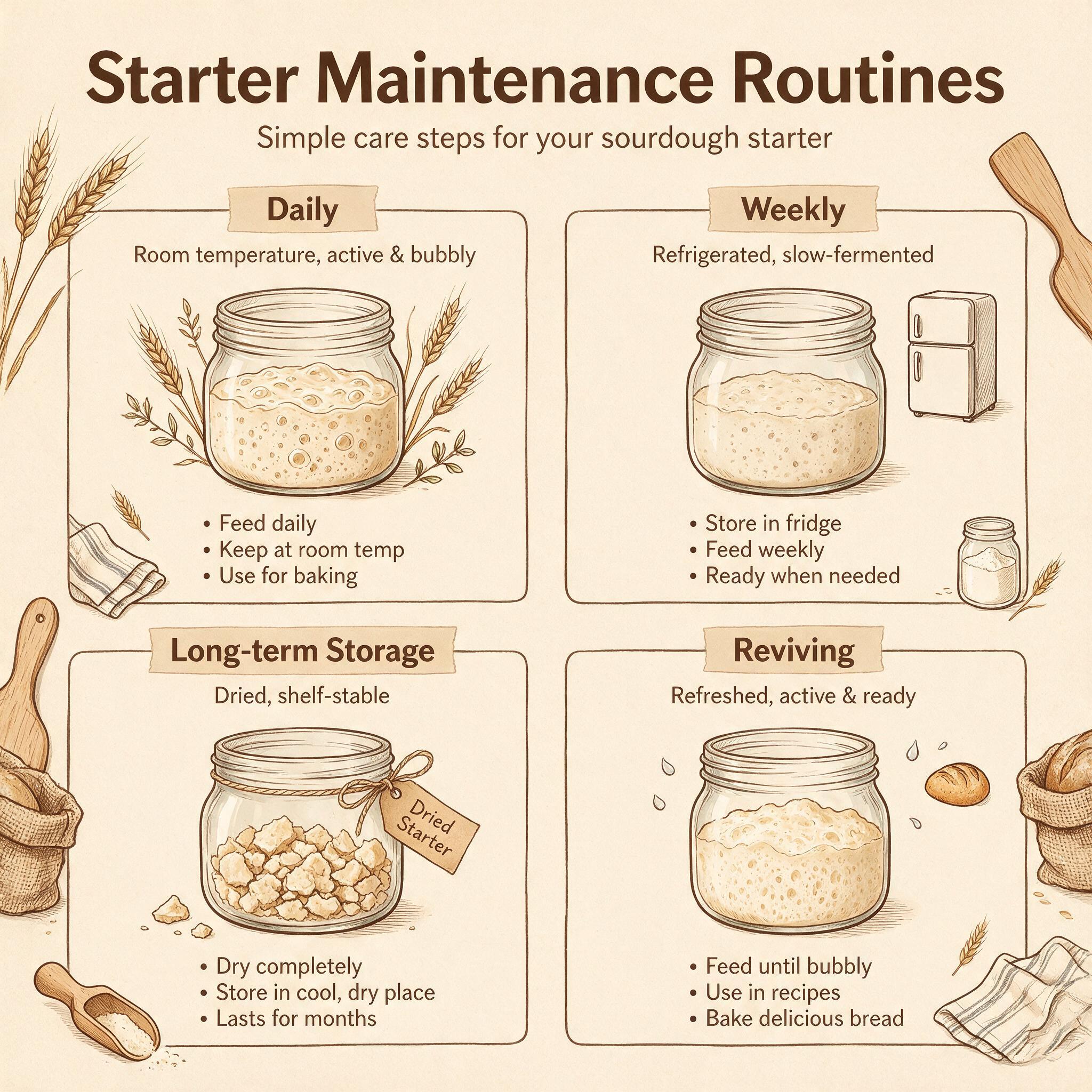
Feeding frequency: Once or twice daily at room temperature
Best for: Bakers who bake every 1–3 days and want a predictable, always-ready starter
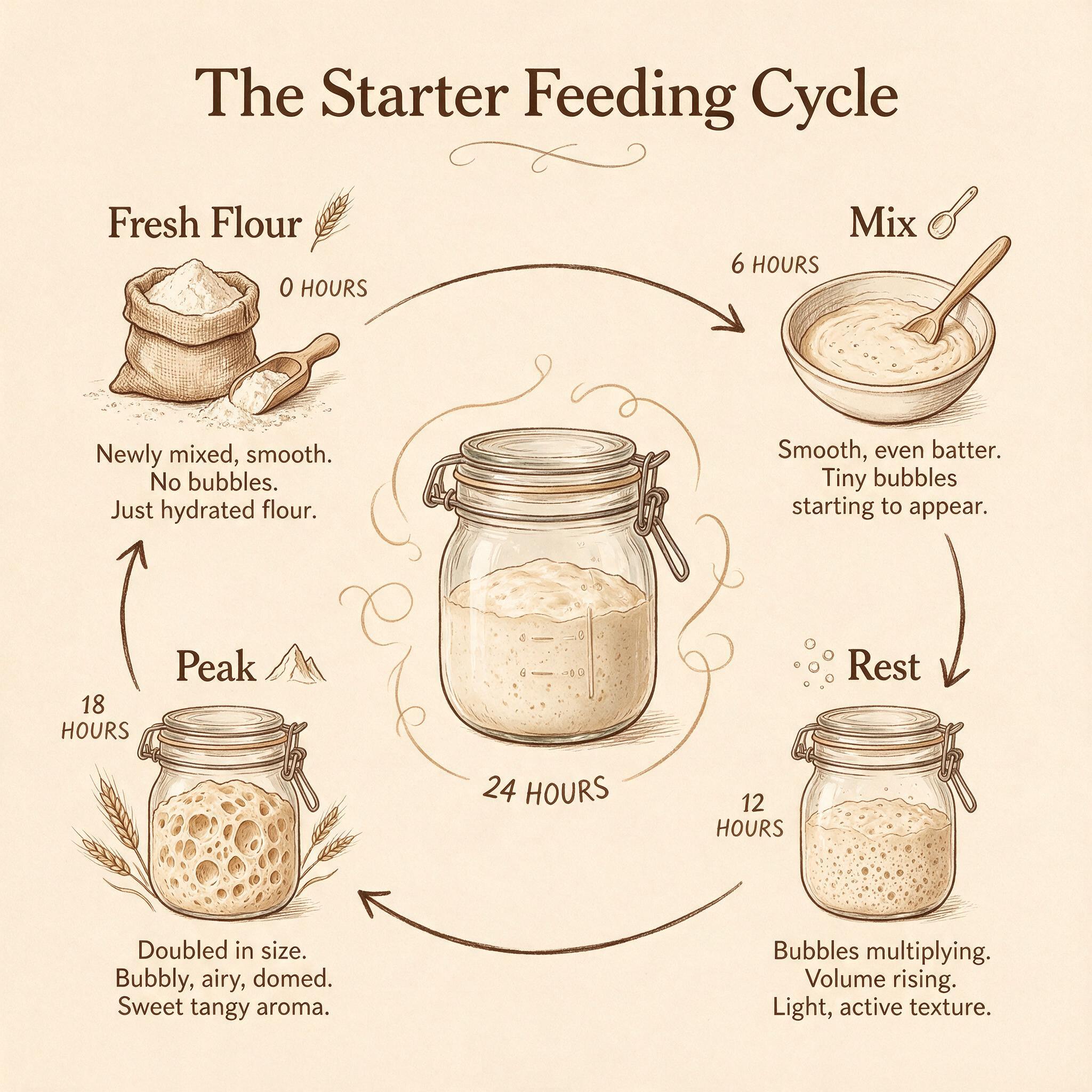
This is the gold standard for serious home bakers. Your starter lives on the counter, gets fed once or twice a day, and peaks reliably within 4 to 8 hours of each feeding — depending on your kitchen temperature.
How It Works
- Discard most of the starter. Keep only what you need for your next bake (or a small maintenance amount).
- Feed with equal parts flour and water by weight. A common ratio is 1:1:1 — for example, 50g starter + 50g bread flour + 50g water. Mix until no dry spots remain.
- Let it rise at room temperature. At a warm kitchen (75–78°F / 24–26°C), expect peak in about 4 to 6 hours. Cooler kitchens push that toward 6 to 8 hours.
- Use at peak. Your starter should be doubled, bubbly, and domed on top — not collapsing yet.
Why This Routine Shines
I find this approach gives you the most predictable results. You know exactly when your starter will be ready because it's never rested or dormant. Every feeding follows the same rhythm: feed, wait for peak, bake. There's no "waking up" period to plan around.
The tradeoff is effort and volume. You're looking at 200–500g of discard per week if you're baking regularly, and you need to remember to feed it every single day (or twice a day in warm weather). Some bakers find the discard overwhelming — which is totally fair. If that's you, check out Routine D later for a lower-volume alternative.
Troubleshooting This Routine
It peaks and collapses before I can use it. Your kitchen might be too warm, or your feeding ratio is too low (not enough food between feedings). Try bumping up to a 1:3:3 ratio — keep 50g starter, feed with 150g flour and 150g water. This gives the culture more fuel and stretches its peak window. Feed earlier in the day so you're not chasing a morning peak.
It smells strongly of acetone or nail polish remover. The starter is going hungry between feedings — it's consumed all its food and is now eating itself. Feed more frequently, or increase your feeding ratio so there's always fresh flour available.
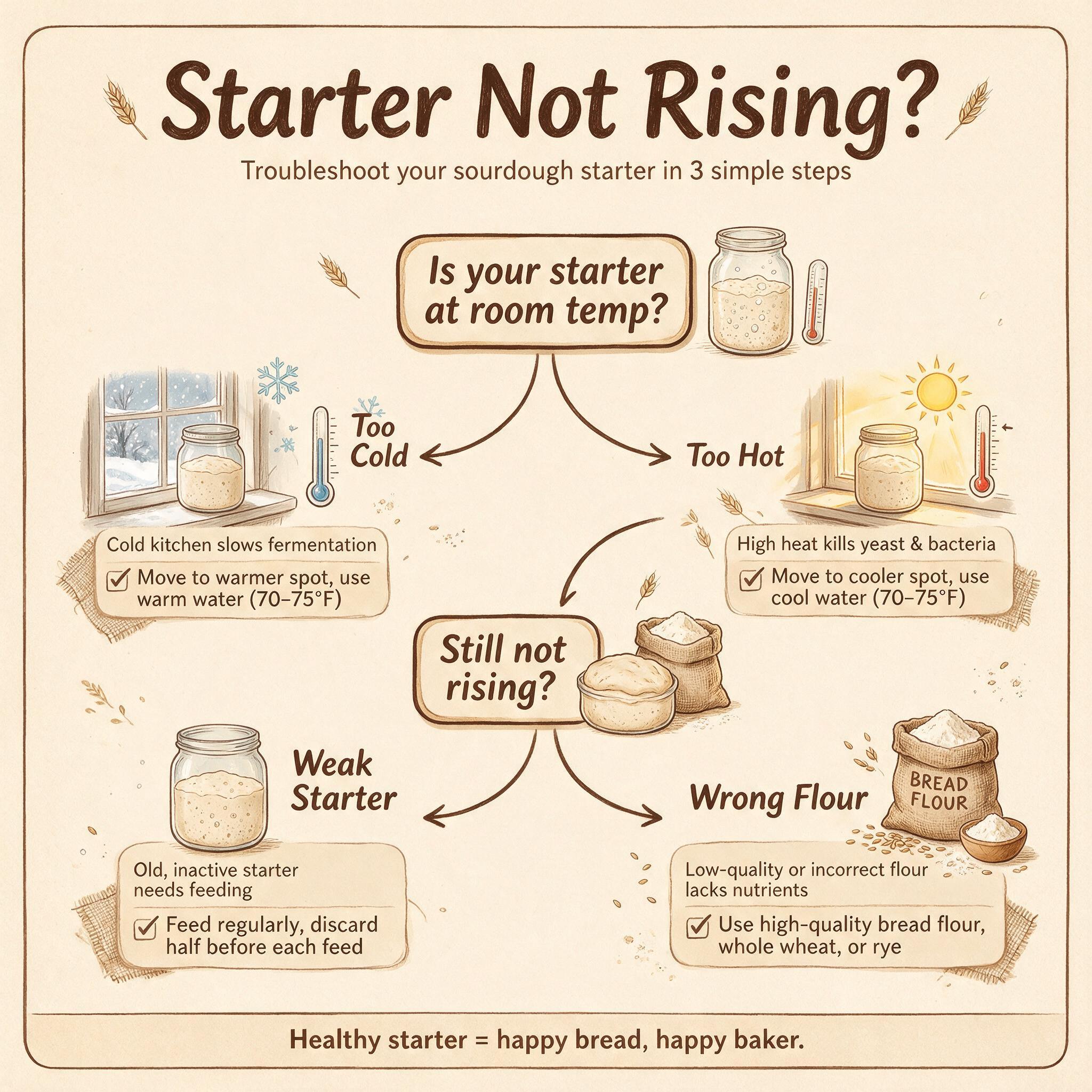
It's not rising enough after two weeks. Your starter might still be maturing. Ensure you're at least 2–3 weeks old, and consider feeding with a portion of whole wheat or rye flour once a week to boost microbial activity. Whole grains carry more wild yeast and nutrients than refined white flour.
Routine B: Weekly Refrigerator Feeding (The Realistic Standard)
Feeding frequency: Once per week in the refrigerator
Best for: Most home bakers who bake 1–2 times per week — which is, I suspect, most of you reading this
This is the routine I recommend to nearly every beginner. It's practical, low-effort, and perfectly healthy for your starter. Your starter lives dormant in the fridge between weekly feedings, and you give it a head start (one or two room-temperature feedings) before each bake day.
How It Works
- Feed normally — discard most of the starter, keep about 50g, then add equal parts flour and water by weight (e.g., 50g starter + 50g flour + 50g water).
- Place it in the refrigerator. Seal the jar loosely so gases can escape but contaminants can't get in.
- Once per week: Take it out, discard most of it again, feed with fresh flour and water, then immediately return to the fridge.
Reactivating Before Baking
This is the planning piece that catches people off guard. When you take your starter out of the fridge and want to bake, it needs time to wake up. Feed it at room temperature (1:1:1 ratio) and wait for peak — this takes 4 to 8 hours depending on your kitchen. If it's been in the fridge a while or feels sluggish, you may need two feedings spaced 4–6 hours apart before it's fully active.
Think of it like waking up from a nap versus waking up from sleep. One feeding gets it moving; two get it singing.
Why This Routine Works So Well
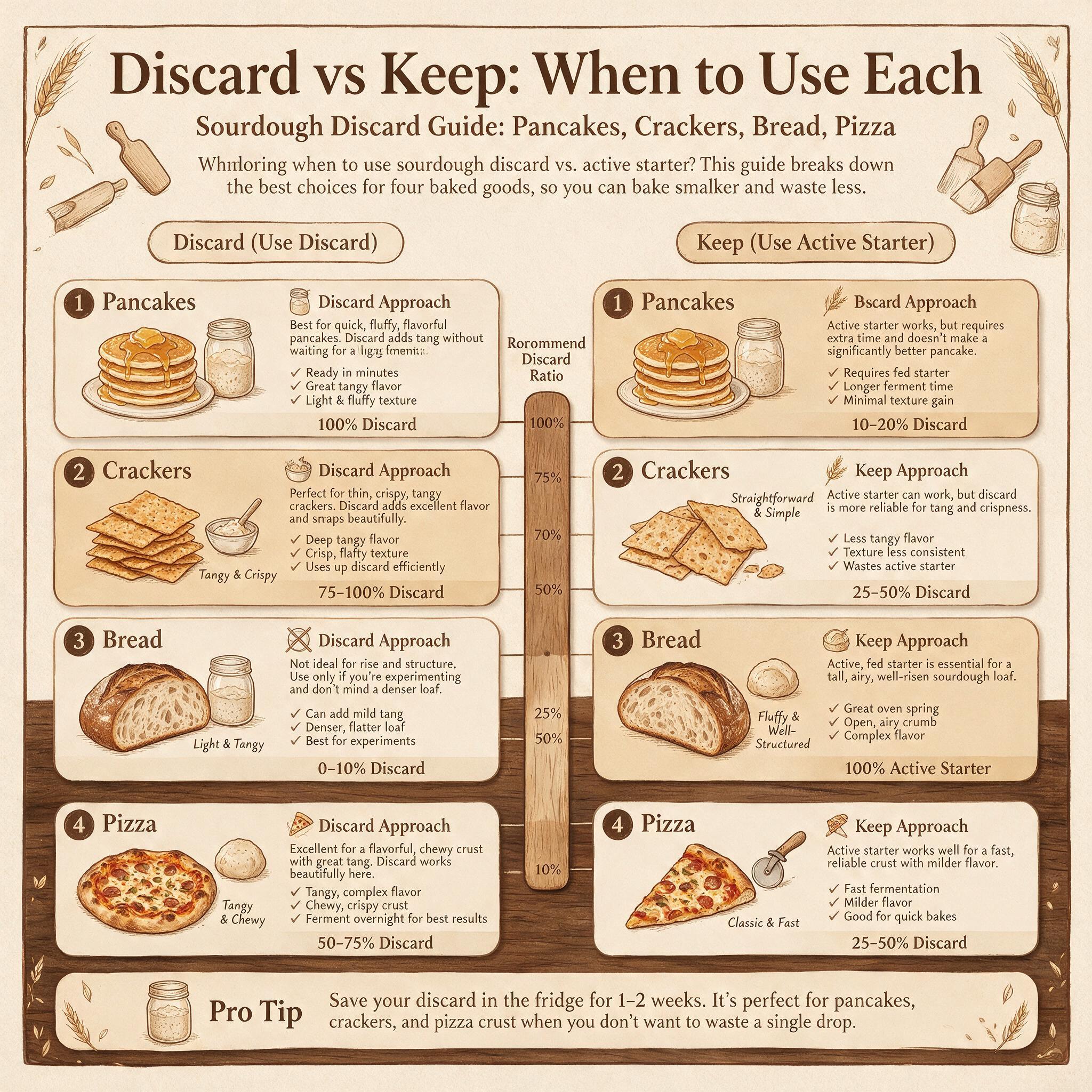
It keeps sourdough feeling like a hobby rather than a second job. You spend maybe 10 minutes once a week on the starter, and you can bake whenever your schedule allows — you just plan for that reactivation window before bake day. The discard volume is low (roughly 100–300g per week), which is manageable whether you're feeding it to animals or using it in discard recipes.
Troubleshooting This Routine
It takes forever to activate from the fridge. Feed twice before baking: the first feed wakes up the culture, and the second (4–6 hours later) brings it to peak activity. Don't try to bake off a single feeding — your bread won't have enough leavening power.
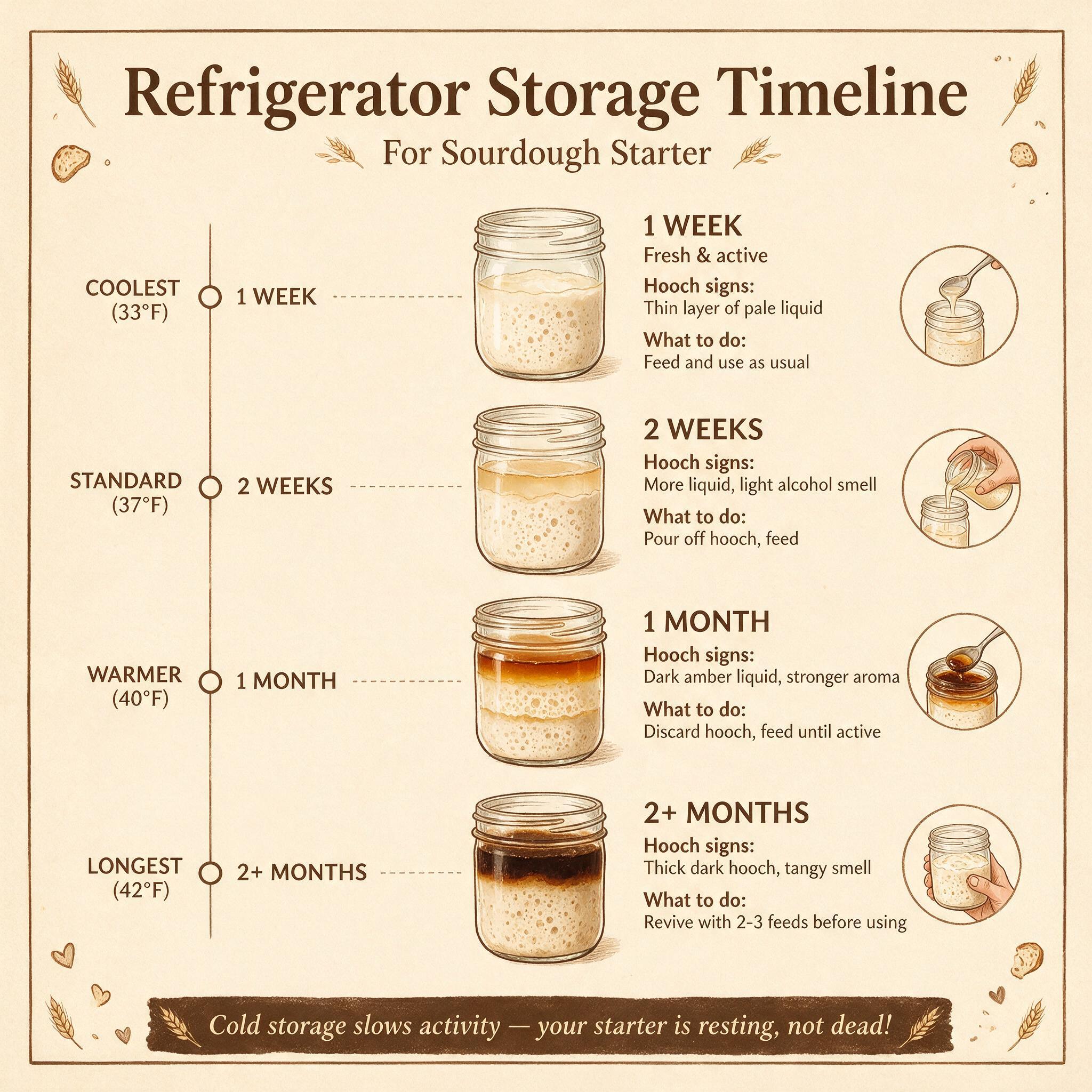
There's dark liquid on top (hooch). This is normal when the starter goes longer than a week between feedings, or if the fridge is particularly cold and slow-acting. Pour it off (it adds tanginess if you leave it in), discard most of the starter, and feed normally. Hooch isn't harmful — it's just alcohol from fermentation.
It smells very sour or alcoholic after coming out of the fridge. Totally normal for a cold-dormant starter. Feed once or twice at room temperature before baking, and the smell will mellow with each fresh feeding. If you use it past peak, that sourness translates into tangier bread — which some bakers prefer!
Routine C: Stiff Levain (Lievito Madre) at 50% Hydration
Hydration: ~45–50% (bread-dough-like consistency, not pourable)
Feeding frequency: Daily or twice daily during active use; weekly in fridge for storage
Best for: Artisan bakers making enriched Italian breads — panettone, colomba, pandoro
This one's a bit different from the liquid starters most people maintain. A stiff levain is a dense dough ball that you knead rather than stir. It's been used in Italy for centuries, and it produces the cleanest, mildest flavor profile of any sourdough starter — which is exactly what you want when your bread is loaded with butter, sugar, and egg yolks.
How It Works
- Maintain your starter as a stiff dough ball at roughly 50% hydration (for every 100g of flour, use about 45–50g water).
- Feed daily during active use: Take 100g of mature starter → add 100g flour + 45g water → mix and knead until smooth → shape into a tight ball.
- Store tightly wrapped in an airtight container, or submerged in water to prevent drying out (a traditional Italian technique).
- Peak time: At 76°F / 24°C, expect 12–16 hours for peak rise — much slower than liquid starters because the dense dough restricts gas expansion.
Why Stiff Levain Is Special
Liquid starters produce a tangier, more acidic flavor because the moisture allows acetic acid (that sharp vinegar-like compound) to develop freely. In a stiff starter, lactic acid dominates — which is smoother and milder, almost sweet. For enriched breads where you're balancing butter, sugar, and orange zest, that mild profile lets the richness shine without competing with sourness.
Troubleshooting This Routine
The surface dries out during storage. Wrap it tightly in plastic wrap or keep it submerged in water. Stiff starters dry out faster than liquid ones because the exposed surface area is concentrated — a ball of dough rather than a spread-out puddle.
It takes too long to peak for my schedule. Stiff starters are inherently slow, especially at cooler temperatures. Keep your kitchen at 76°F+ (24°C+) during fermentation, or use a proofing box if you have one. At lower temperatures, peak can stretch beyond 16 hours.
It's not rising actively enough. During active use periods, feed consistently every day. Stiff levain is less forgiving of missed feedings than liquid starters — it needs regular fuel to maintain vigor.
Routine D: The Minimalist Fridge (Low-Maintenance Weekly)
Feeding frequency: Once per week in the refrigerator
Flour ratio: Reduced amounts to minimize discard
Best for: Casual bakers who want a healthy starter without weekly fuss — or anyone who's burned out on routine A
This is essentially Routine B dialed down. The core principle: cold temperature slows fermentation, so your starter uses its food more slowly. Instead of feeding every day on the counter, you feed once per week in the fridge with modest amounts of flour and water.
How It Works
- Keep a small amount of starter — about 30–50g — in the refrigerator.
- Feed once per week with reduced amounts. For example: 30g starter + 60g flour + 30g water (a 1:2:1 ratio). This uses less flour and produces far less discard than Routine B.
- Reactivate before baking the same way as Routine B — one or two room-temperature feedings at peak timing.
Why I Like This Approach
If you bake once a week (or even twice), this is often more starter than your fridge holds between bakes. By keeping smaller amounts and feeding with reduced ratios, you're using far less flour and producing minimal discard — maybe 50–150g per week versus several hundred for the daily routine.
It's also the easiest routine to forget about. The starter sits in the fridge doing its own thing while you live your life. When bake day arrives, you give it a head start and move on with your morning.
Troubleshooting This Routine
It takes longer to peak than a daily-fed starter. That's expected — the reduced feeding ratio means less food available for rapid growth. Give it an extra hour or two past the standard 4–8 hour window, and trust that it'll get there.
You forgot about it for three weeks. No panic. Take it out, discard most of it, feed with fresh flour and water, and wait. It may take a couple of days of consistent feeding to fully revive — but it will come back. Sourdough starters are remarkably resilient. I've seen starters revive after months in the fridge (though they smell something fierce).
How to Choose Your Routine
Here's a quick comparison to help you decide:
| Feature | Daily RT Feeding | Weekly Fridge | Stiff Levain | Minimalist Fridge |
|---|---|---|---|---|
| Feeding frequency | 1–2x/day at room temp | 1x/week in fridge | 1–2x/day (or weekly fridge) | 1x/week in fridge |
| Peak time after feeding | 4–8 hours | 4–8 hours (after reactivation) | 12–16 hours | 4–8 hours (after reactivation) |
| Weekly discard volume | High (200–500g+) | Low (~100–300g) | Moderate (~150–400g) | Minimal (~50–150g) |
| Best for | Daily/very frequent bakers | 1–2x/week bakers | Enriched bread specialists | Casual bakers, minimal effort |
My recommendation? If you're new to sourdough or baking less than daily, start with the weekly fridge routine (Routine B). It's the most forgiving, requires the least planning, and keeps your starter perfectly healthy. Once you're comfortable with the rhythm, you can experiment with other approaches.
Seasonal Adjustments: Summer vs. Winter
Your kitchen temperature changes with the seasons, and so does your starter's behavior. Here's how to adapt:
Summer (or any warm kitchen above 78°F / 26°C)
Your starter peaks faster — maybe 3 hours instead of 6 at room temperature. This means you need to feed more frequently or use a higher feeding ratio to stretch the peak window. Some bakers switch to fridge storage between bakes during hot months, only bringing it out when ready to bake. If you keep your starter on the counter, consider feeding right before bed with cold water so it peaks in the morning rather than collapsing by lunchtime.
Winter (or any cool kitchen below 70°F / 21°C)
Your starter peaks slower and may stay at peak longer between feedings. Room-temperature storage might work fine for several days without feeding — though I'd still recommend feeding daily if you're baking regularly. Cold kitchens also mean slower reactivation from the fridge, so plan an extra few hours when waking up a refrigerated starter in January versus July.
Universal Truths Across All Routines
No matter which routine you choose, these principles always apply:
The less frequently you feed, the longer it takes to get ready for baking. Whether you're on weekly fridge or daily room-temp feeding, this is non-negotiable. Plan your reactivation window accordingly — don't take a cold starter out of the fridge and expect it to be bake-ready in two hours.
Always use your starter at peak (or before peak) for leavening power. If you want maximum rise in your bread, feed your starter and use it when it's doubled, bubbly, and domed. Use it past peak if you prefer tangier, more sour bread — the acid-producing bacteria take over as the culture ages between feedings.
A fridge starter needs 1–3 room-temperature feedings to fully reactivate. One feeding wakes it up; a second (4–6 hours later) brings it to full strength. Don't skip the second feeding if your starter feels sluggish — your bread will thank you.
Starter age matters. A brand-new starter (under 2–3 weeks) produces less sour flavor regardless of routine. The acid-producing bacteria need time to establish their population. Be patient during those first few weeks.
Whole grain feedings boost activity in any routine. Feeding your starter with rye or whole wheat flour once a week adds nutrients and wild yeast that white flour alone can't provide. I do this even with my white-flour starters — a tablespoon of rye per feeding is all it takes to notice the difference.
FAQ
Can I switch between routines?
Absolutely. You can keep your starter on the counter for a week, then move it to the fridge for a vacation, and bring it back once you return. Just plan for that reactivation period when you change routines. Many bakers rotate between daily RT feeding during baking season and weekly fridge storage in off-seasons.
How much discard should I expect per week?
Daily room-temperature feeding: 200–500g+. Weekly fridge (Routine B): roughly 100–300g. Minimalist fridge (Routine D): about 50–150g. Stiff levain sits in the middle at around 150–400g. These are rough estimates — your actual discard depends on how much starter you keep and your feeding ratios.
Is hooch bad?
No. That dark liquid on top is just alcohol from fermentation. It means the starter went a bit longer than ideal between feedings, but it's perfectly healthy. Pour it off if you want milder flavor (it adds tang if left in), then discard most and feed normally.
How do I know when my starter is at peak?
Look for these signs: the starter has doubled or tripled in volume, the surface is domed (not flat or collapsed), there are plenty of bubbles throughout, and it passes the float test — a small spoonful dropped into water should float. If you're unsure, err on the side of using it earlier rather than later for maximum rise.
Can I maintain two starters with different routines?
Yes! Some bakers keep one liquid starter at room temperature for bread baking and a stiff levain in the fridge for panettone season. They don't interfere with each other as long as they're stored separately and labeled clearly.
Closing Thoughts
Sourdough is deeply personal — what works in my kitchen might need tweaking in yours, and that's the beauty of it. There's no single "correct" way to maintain a starter. The daily counter routine gives you predictability; the weekly fridge approach gives you flexibility; stiff levain opens up a world of enriched breads; the minimalist approach proves you don't need much to keep things going.
Pay attention to how your starter behaves. Take notes if that helps you — I keep a simple log of feeding times, room temperature, and peak behavior. Over time, you'll develop an intuition for your own bread that no recipe can teach. Your starter will start telling you what it needs through its smell, its rise, the bubbles on its surface.
And when it doesn't go perfectly — and some days won't — don't panic. A sluggish starter means longer fermentation, not a lost loaf. An over-fermented one makes tangier bread, which many bakers actually prefer. Sourdough forgives more than most techniques do.
Happy baking!
Related Posts
Keep going with these related guides.