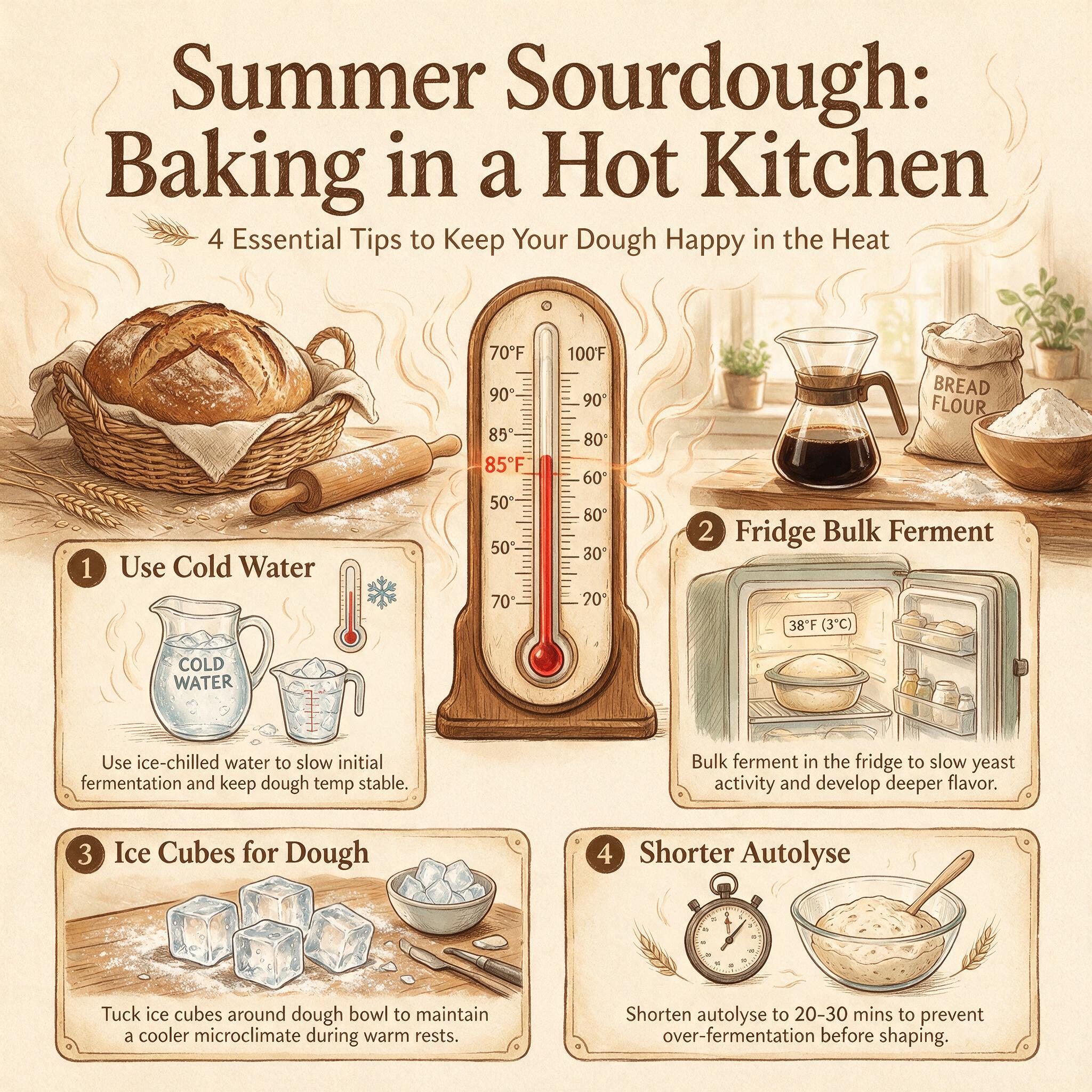
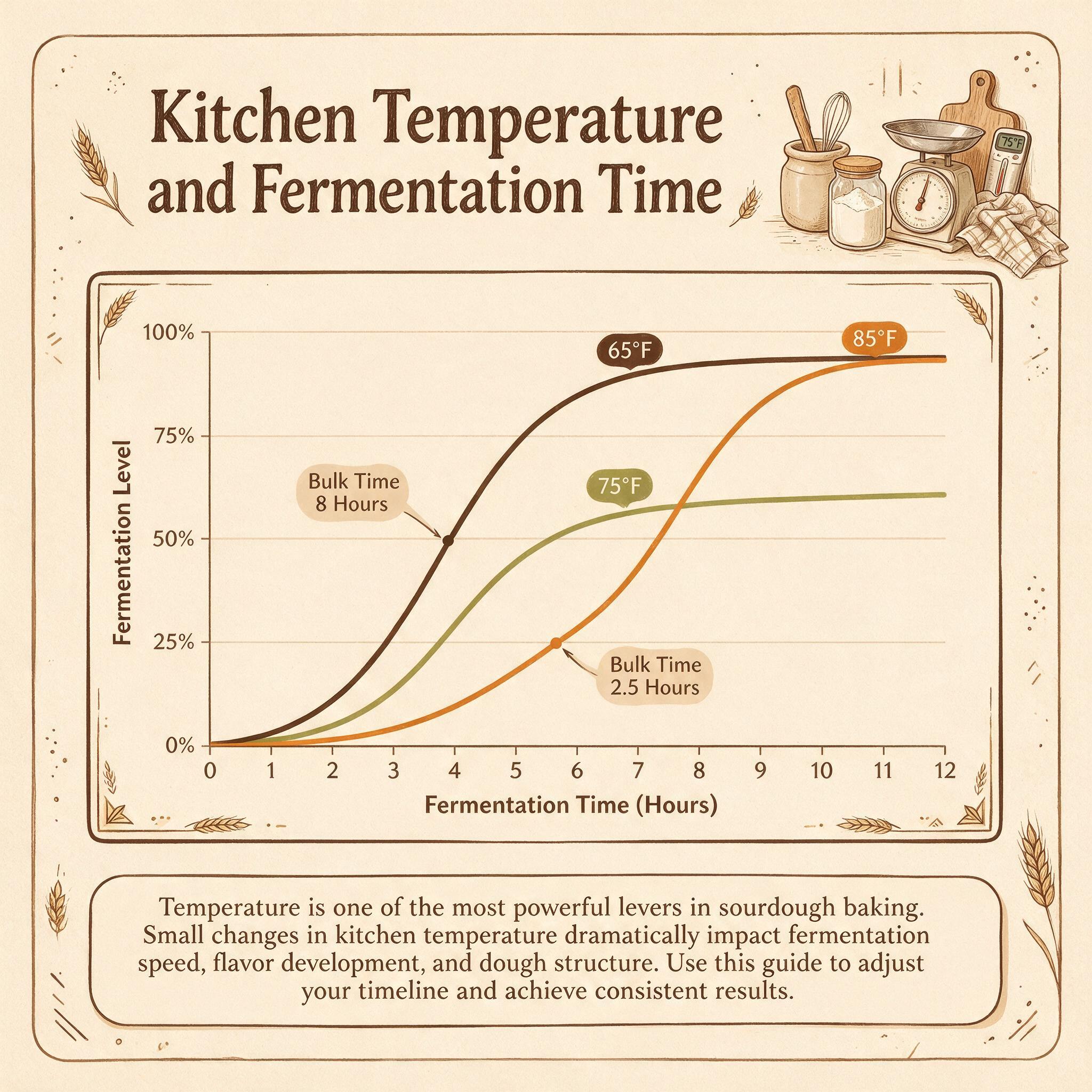
There's something almost magical about sourdough — flour, water, salt, time, and a living starter. That's it. Four ingredients that transform into the most rewarding bread you'll ever bake from scratch. But there's one variable that can turn that magic into frustration come summer: heat. A dough that takes six hours at 75°F might only need three at 85°F. Your starter peaks and collapses before you wake up. Bulk fermentation finishes in half the expected time. Nothing is broken — fermentation is just moving faster.
If you've ever opened your bowl to find your dough already over-proofed, or woken up to a flat disc instead of an airy loaf, this guide is for you. I'm going to share the strategies that have helped me bake consistently through July and August — not by fighting the heat, but by working with it.
What You'll Learn
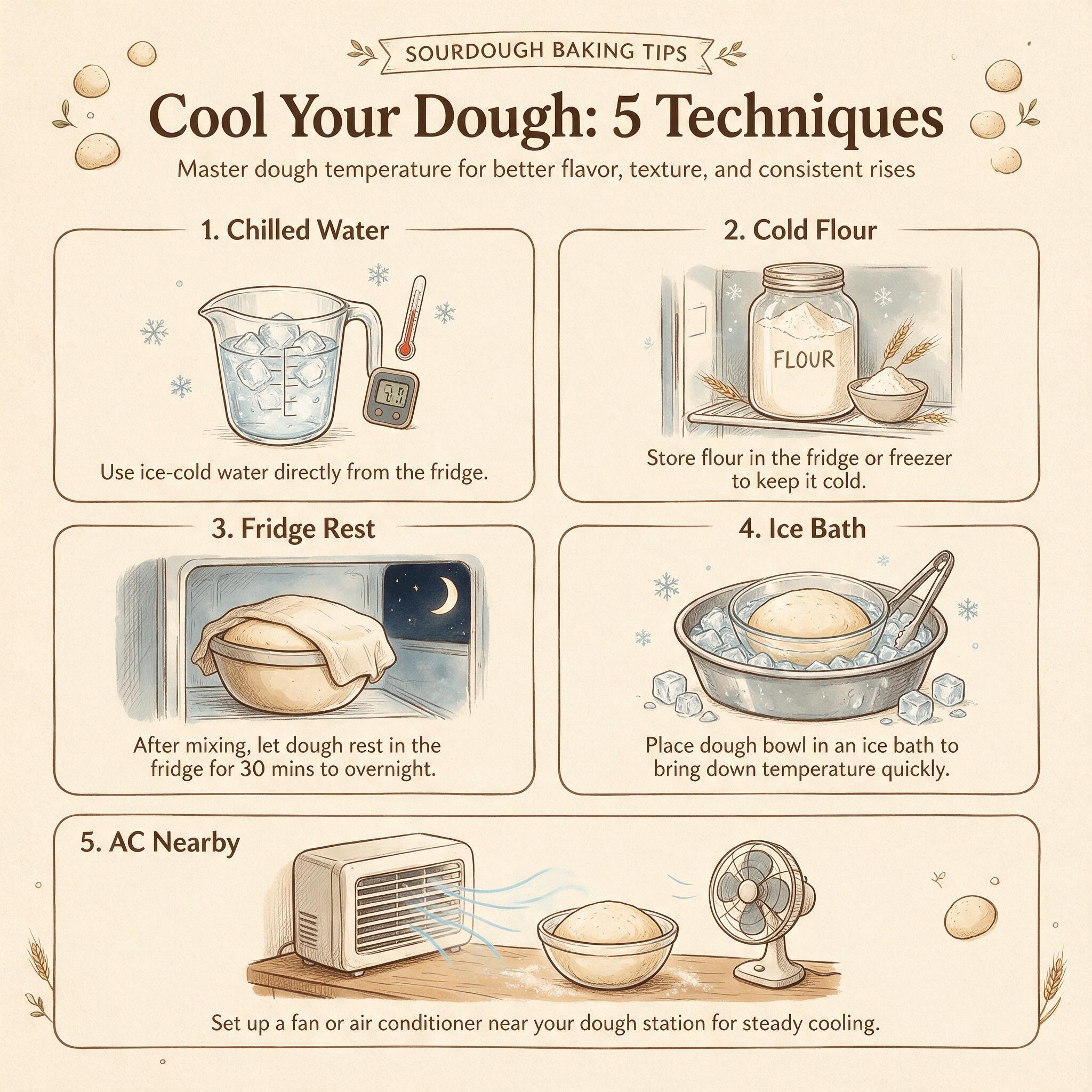
Summer sourdough comes down to one thing: temperature control. Once you understand how heat affects fermentation speed, everything else falls into place. You'll learn how to cool your dough at mixing, adjust your starter for hot weather, time your bakes around the day's heat, and know exactly what a properly fermented summer dough should look like — because in summer, you need to watch the dough, not the clock.
By the end of this post, you'll have a practical game plan for every stage of your bake, from mixing water temperature to final proof timing. Let's get into it.
The Rule That Changes Everything
Here's the single most important thing to understand about summer sourdough: for every 10°F increase in dough temperature above 75°F (24°C), fermentation roughly doubles in speed.
This means recipe timelines from spring completely fall apart in summer. Your starter peaks before you wake up. Bulk finishes in half the expected time. It's not a bad starter — it's just hot, and yeast eats faster when it's warm.
The good news? Once you know this rule, every adjustment you make has a clear purpose. You're not guessing anymore. You're managing temperature.
Cooling Your Dough at Mix
Your first line of defense starts the moment you add water to flour. The temperature of your mixing water sets your Final Dough Temperature (FDT) — also called Desired Dough Temperature, or DDT — and that's the single biggest lever you have for controlling fermentation speed.
Use Fridge-Cold Water
For most summer bakes, pull out a measuring cup of water straight from the refrigerator: 40–50°F (4–10°C). This alone can drop your dough temperature by 10–15 degrees compared to room-temperature water.
On truly hot days — when your kitchen sits at 85°F or above — take it further. Add a few ice cubes to your mixing water, or use a mix of cold water and crushed ice. Some bakers even chill their flour in the fridge for 30 minutes before mixing. Cool flour + cool water = cooler dough from the start.
Target an FDT of 75–78°F (24–26°C)
Aim for a final dough temperature in the 75–78°F range. This gives you a comfortable fermentation window — not so warm that everything races through, and not so cool that flavor development stalls.
If your kitchen is already very warm — say 30°C (86°F) or higher — you might accept an FDT of around 27°C / 81°F. The dough will still ferment fast, but it'll be manageable. You're not trying to create a winter kitchen; you're just taking what control you can at the mixing stage.
Want the Math? Here's How It Works
If you want to get precise with your DDT calculation:
Water temperature = (3 × target FDT) − (room temp + flour temp + friction factor)For example, if your kitchen is 30°C and you want a 25°C dough: Water = (3 × 25) − (30 + 30 + ~3 friction) = ~14°C. That's fridge-cold water with maybe an ice cube or two.
You don't need to do this math every time — most bakers find that fridge-cold water works well enough as a starting point and adjust from there. But if you're the type who likes precision, it's satisfying to see the numbers line up.
Adjusting Your Starter for Summer Heat
Your starter is more active in warm weather, which means its behavior changes. If it normally peaks at 6 hours at room temperature, it might peak at just 3 in a hot kitchen. That creates two problems: catching your starter at peak, and managing the speed of your entire bake.
Use a Higher Feeding Ratio
One approach is to feed your starter with a higher ratio — something like 1:5:5 (starter : flour : water) instead of your usual 1:1:1. The extra food stretches out the peak time, giving you a wider window to use it at its best. This works especially well if you feed at bedtime and bake the next morning.
The Fridge-Until-Bake-Day Method
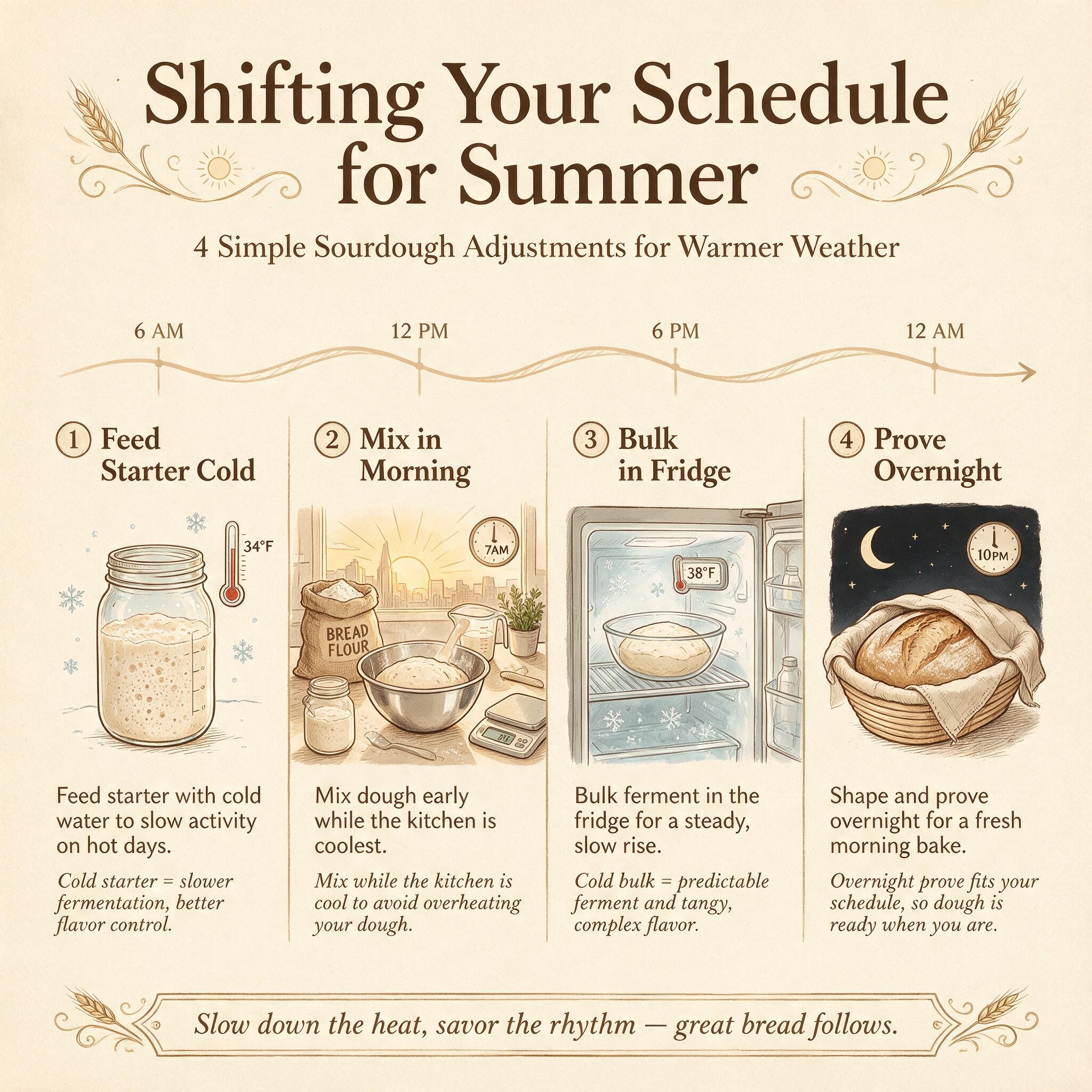
Another strategy that I find very reliable: keep your starter in the fridge until you're ready to bake. Feed it with cold water right before bed using a 1:5:5 ratio. By the next morning — roughly 8 hours later — it's perfectly ripe and ready to use. This eliminates the frantic timing game of trying to catch a starter at peak when everything moves so fast in summer heat.
Reduce Your Starter Percentage
When you build your levain, consider using less starter than your recipe calls for. If a recipe says 100g starter, try 50–75g instead. Less starter means fewer organisms competing for food, which slows the overall fermentation pace. You still get fully fermented dough — it just takes longer, which is exactly what you want in summer.
This is one of my favorite adjustments because it's simple and effective. I use it almost every time I bake in July or August.
Shorter Bulk Times & Early Fridge Transition
In winter, you might do a full 6–8 hour room-temperature bulk. In summer, expect 3–4 hours — sometimes less. The key is learning to recognize when your dough is done rather than relying on a timer.
What a Done Dough Looks Like in Summer
Watch for these signs:
- •50–75% volume increase from its original size (not the 100% you might see in winter)
- •A domed surface, not flat or collapsed
- •Large bubbles visible on top of the dough, with smaller bubbles along the sides
- •The dough jiggles like set custard when you gently shake the bowl
- •It pulls away from the edges of the bowl slightly
Watch for Overproofing Too
Summer doughs can go from perfect to over-proofed quickly. Signs your bulk has gone too long:
- •Dough feels slack and sticky instead of airy and bouncy
- •A strong vinegar smell (more acetic acid than lactic)
- •Large, irregular bubbles throughout — the structure is breaking down
The Cold Bulk Strategy
Here's a technique I've been using more often in summer: do 1–2 hours of room-temperature bulk with your stretch and folds, then move the dough directly to the fridge for the remainder. The cold slows fermentation to a manageable pace. You're essentially doing a "cold bulk" — flavor develops similarly, just at a slower rate.
The trade-off is that you lose the benefit of shaping from cold (which some bakers prefer for scoring), but in very warm kitchens, it's worth it. Your loaf will be better shaped and less likely to over-proof before the oven is even preheated.
Timing Your Bake Around the Heat
When you bake matters just as much as how you mix or ferment. The ambient temperature of your kitchen during proofing and baking affects everything.
Early Morning Is Gold
Before 8 AM is my preferred window for summer baking. Here's why: the oven runs while the house is still cool from the night. By the time the kitchen heats up, your bread is done and the oven is off. You're not adding heat to an already hot space during the most critical phase of baking.
If early morning doesn't fit your schedule, after dinner works well too — kitchens have cooled down from daytime heat, and you get a longer window before overnight temperatures drop.
Find the Coolest Spot in Your Home

Not every room is the same temperature. If you're proofing dough during the day, move it to whichever spot runs coolest:
- •A basement or lower floor
- •An air-conditioned bedroom
- •The tile floor (it stays cooler than carpet)
- •Interior rooms away from sun-facing windows
Temperature matters more than location — a cool interior room beats a sunny basement. Check your dough's temperature with an infrared thermometer if you have one, or just trust your hand. If the spot feels warm to the touch, it'll speed up fermentation.
Lighter Loaves for Summer Heat
Summer doesn't just affect timing — it can change how you think about what kind of loaf you're making. Some bakers prefer slightly lighter, more manageable loaves during hot months, and there are practical reasons for that.
Slightly Lower Hydration
Some summer bakers reduce their hydration by 2–3% compared to their winter recipes. Higher-hydration doughs degrade faster during warm fermentation — they become slackier, harder to shape, and more prone to over-proofing. A marginally tighter dough holds its shape better through a fast bulk.
This doesn't mean dry bread. We're talking about small adjustments — maybe 72% hydration instead of 75%. The crumb will still be open and tender, just with a bit more structure during those rapid summer hours.
Fewer Folds for Faster Doughs
In winter, you might do three rounds of stretch and folds. In summer, with bulk times compressed to 3–4 hours, two rounds may be sufficient. Or even one set of coil folds if the dough is moving very fast.
The key principle: match your fold frequency to your fermentation speed. You're not trying to build maximum strength — you just need enough structure to hold shape during a fast bulk and rise well in the oven. Overworking a dough that's already moving quickly can degas it unnecessarily.
Skip the Cold Proof for Same-Day Baking
When everything is moving fast, an overnight cold proof might push your dough over the edge. For same-day baking in extreme heat:
- •Bulk ferment at room temperature
- •Shape and bake the same day
- •Or do a shorter 8–10 hour fridge rest instead of the usual 12–16 hours
This prevents overproofing when both bulk and final proof are accelerated by warm temperatures. You're not losing much flavor — you're gaining control.
Why Summer Can Actually Be Great for Sourdough
Once you adjust your approach, summer brings some real advantages:
- •Your starter is at its most vigorous and reliable. No struggling with sluggish cultures or weak rises.
- •Fermentation is more consistent day-to-day. Less daily variation means fewer surprises.
- •Warmer proofing produces better oven spring and more open crumb structure — some of the best loaves I've ever baked came from July and August, once I stopped fighting the heat and started working with it.
There's a certain satisfaction to baking in summer that winter doesn't offer. Everything moves faster. Your starter is buzzing. The dough jiggles perfectly after just a few hours. It's sourdough at full energy.
Troubleshooting: Common Summer Sourdough Problems
My Dough Over-Proofed Before I Could Shape It
This is the most common summer issue, and it usually means one of two things: your dough started too warm, or you used too much starter. Next time, start with fridge-cold water and reduce your starter percentage to 50–75g. If your kitchen stays above 80°F, try moving to the fridge after just 1 hour of room-temperature bulk.
My Loaf Spread Flat in the Oven
Summer heat can weaken dough structure if fermentation runs too long. Check that your bulk didn't go past the domed, jiggly stage. Also consider a slightly lower hydration (reduce by 2–3%) and fewer fold sets. A tighter dough handles fast fermentation better.
My Starter Peaks Too Fast to Catch
If your starter peaks in under 4 hours at room temperature, switch to fridge storage until bake day. Feed it with cold water using a 1:5:5 ratio before bed — by morning, roughly 8 hours later, it'll be perfectly ripe. This is far more reliable than trying to time a fast peak.
My Bread Tastes Sharper Than Usual in Summer
Warm fermentation produces more acetic acid (the vinegar-like sourness) relative to lactic acid (the smoother, yogurt-like tang). If you prefer milder sourness, shorten your bulk or chill the dough earlier. A shorter cold proof also helps — try 8 hours instead of 12.
My Dough Feels Fine at First but Gets Slacky During Bulk
This happens when fermentation outpaces gluten development. Try these adjustments: use cooler water at mix, reduce starter percentage, do your folds more aggressively (but not more frequently), and move to the fridge earlier if bulk is running longer than 3 hours.
FAQ
Can I still bake sourdough in an apartment with no AC?
Yes — you just need to be strategic about cooling at mix time. Use fridge-cold water, chill your flour for 30 minutes before mixing, and consider the cold bulk method (1–2 hours room temp, then straight to the fridge). A basement unit or window air conditioner in one room can also serve as your proofing zone.
Should I use less starter every time I bake in summer?
Not necessarily — it depends on your kitchen temperature and how fast you want things to move. As a starting point, try reducing from 100g to 75g and see how the dough behaves. Adjust up or down based on results. The goal is control, not minimalism.
How do I know if my water is cold enough?
For most summer bakes, fridge-cold water (40–50°F / 4–10°C) is perfect. If your kitchen sits above 85°F, add ice cubes to the mix or target a slightly cooler FDT. You don't need an instant-read thermometer for mixing water — just grab it straight from the fridge and trust that it's cold enough as a starting point.
Can I bake sourdough in the middle of a hot day?
You can, but it's harder. The ambient heat will speed up your final proof significantly. If you must bake midday, do a shorter bulk (2–3 hours), shape quickly, and move to the fridge for a rapid 4–6 hour proof before baking. It won't be your best loaf, but it'll still be good bread.
Does summer sourdough taste different?
Warmer fermentation does shift the flavor profile slightly toward more acetic acid, which reads as sharper or tangier sourness. If you prefer a milder flavor, shorten your bulk or chill earlier. But many bakers actually enjoy the brighter tang that summer produces — it's just different, not worse.
Closing Thoughts
Summer sourdough is fundamentally about one thing: paying attention to what your dough is telling you. The clock becomes less reliable than your eyes and hands. A dough that needs 6 hours in March might be done in 3 in July — and both are completely normal.
Start with fridge-cold water at mix, reduce your starter percentage if things feel rushed, move the dough to the fridge earlier when needed, and bake before 8 AM or after dinner when possible. These adjustments compound into a very different experience from winter baking — but not necessarily worse. Some of my favorite loaves have come from summer bakes where everything just clicked.
The beauty of sourdough is that there's no single correct way to do anything. What works in my kitchen might need tweaking in yours, and that's the point. Pay attention to how your dough behaves during different seasons. Take notes if that helps you. Trust your eyes more than any timer or recipe. Over time, you'll develop an intuition for your own bread that no guide can teach — summer included.
Happy baking!
Sources & Further Reading
Reference books:
- •Raymond Calvel, The Taste of Bread (translated by Ronald L. Wirtz), Springer, 2001 — Springer Link — the DDT/FDT formula and the underlying temperature × fermentation-rate relationship come from Calvel's original framework
- •Jeffrey Hamelman, Bread: A Baker's Book of Techniques and Recipes, 2nd ed., Wiley — bulk-fermentation timing and temperature management
Primary literature (peer-reviewed):
- •Gänzle M.G., "Enzymatic and bacterial conversions during sourdough fermentation," Food Microbiology, 2014 — temperature-driven shifts in microbial succession and acid production
Practitioner resources (named home-baking references):
- •The Sourdough Journey — thesourdoughjourney.com — the Q15 rule of thumb (fermentation rate roughly doubles per 15°F increase) and the bulk-fermentation timing tables at common summer kitchen temperatures
- •King Arthur Baking — kingarthurbaking.com — practical water-temperature adjustments for summer baking
Where attribution is widely-attributed but not primary-sourced here: the "every 10°F doubles fermentation speed" rule is a practitioner-level synthesis of yeast metabolism kinetics (typical Q10 values for Saccharomyces and related species fall in the 1.5–2.5 range, depending on the temperature window). The "roughly doubles" phrasing in this post is the conservative end of that range. For microbial Q10 values across the full sourdough consortium (yeast + LAB + AAB), the literature is more nuanced — different organisms have different temperature optima, and the apparent Q10 of sourdough fermentation as a whole is a weighted average. The Sourdough Journey's "Q15" framing (doubling per 15°F) is a useful approximation that works in the home-baking temperature range.