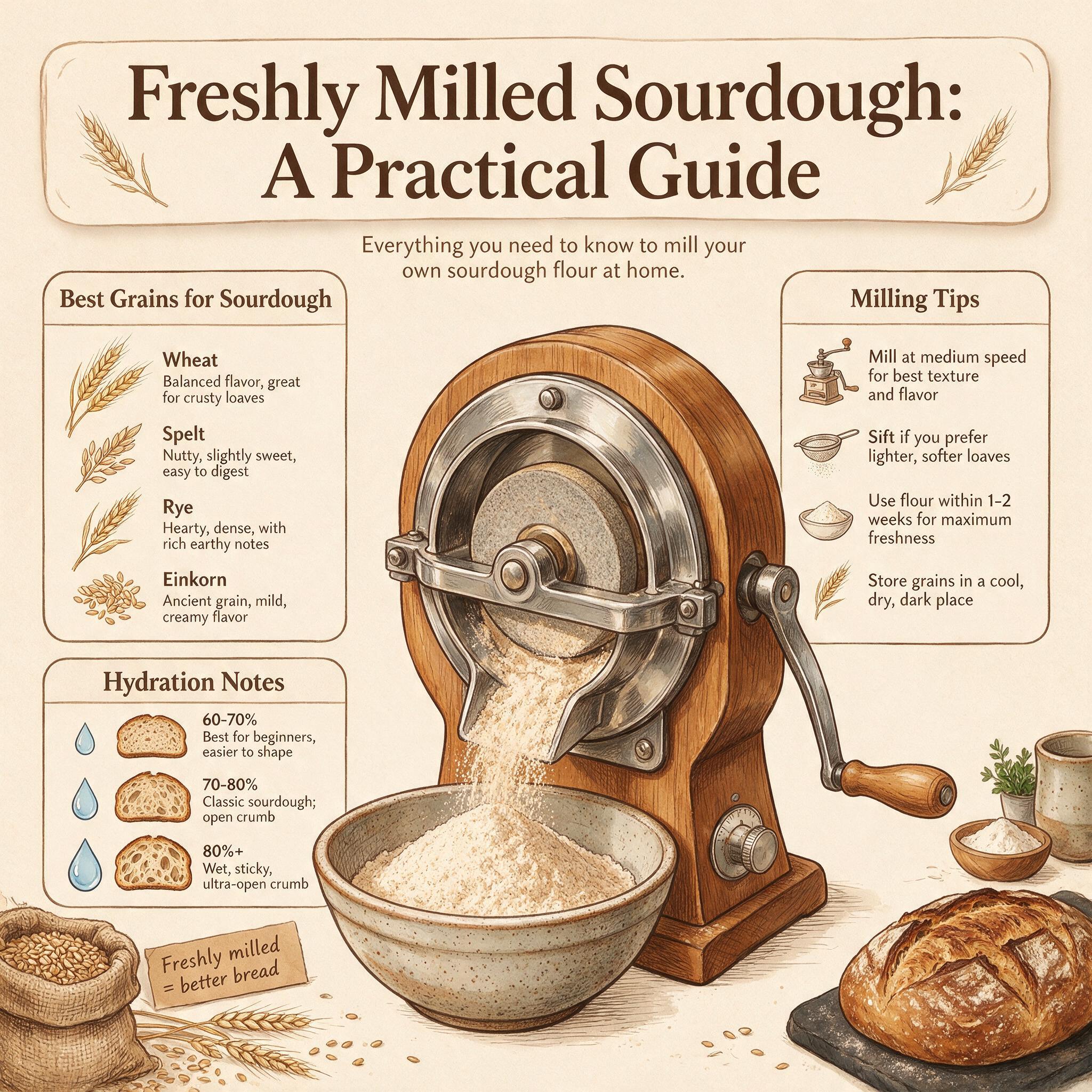
Freshly milled flour is having a moment. Home grain mills have become increasingly accessible (NutriMill Classic runs around $280), and bakers who mill their own wheat are discovering something that every miller already knows: freshly ground flour behaves very differently from store-bought. It produces dough with more character, more nutrition, and a flavor depth that supermarket flour simply can't match.
But freshly milled sourdough comes with its own learning curve. The flour is thirstier — it absorbs more water than you're used to. It has a shorter shelf life — the germ's oils go rancid faster than you expect. And if you're going 100% freshly milled, without any commercial flour insurance, the technique demands more attention than a standard white loaf.
This guide covers the learning curve: hydration adjustments for fresh-milled flour, why shelf life matters more than you think, sifting vs. whole grain, and how to get good oven spring with 100% freshly milled flour. It's the practical guide I wish I'd had when I started milling.
What Makes Fresh-Milled Flour Different
The Thirst Factor
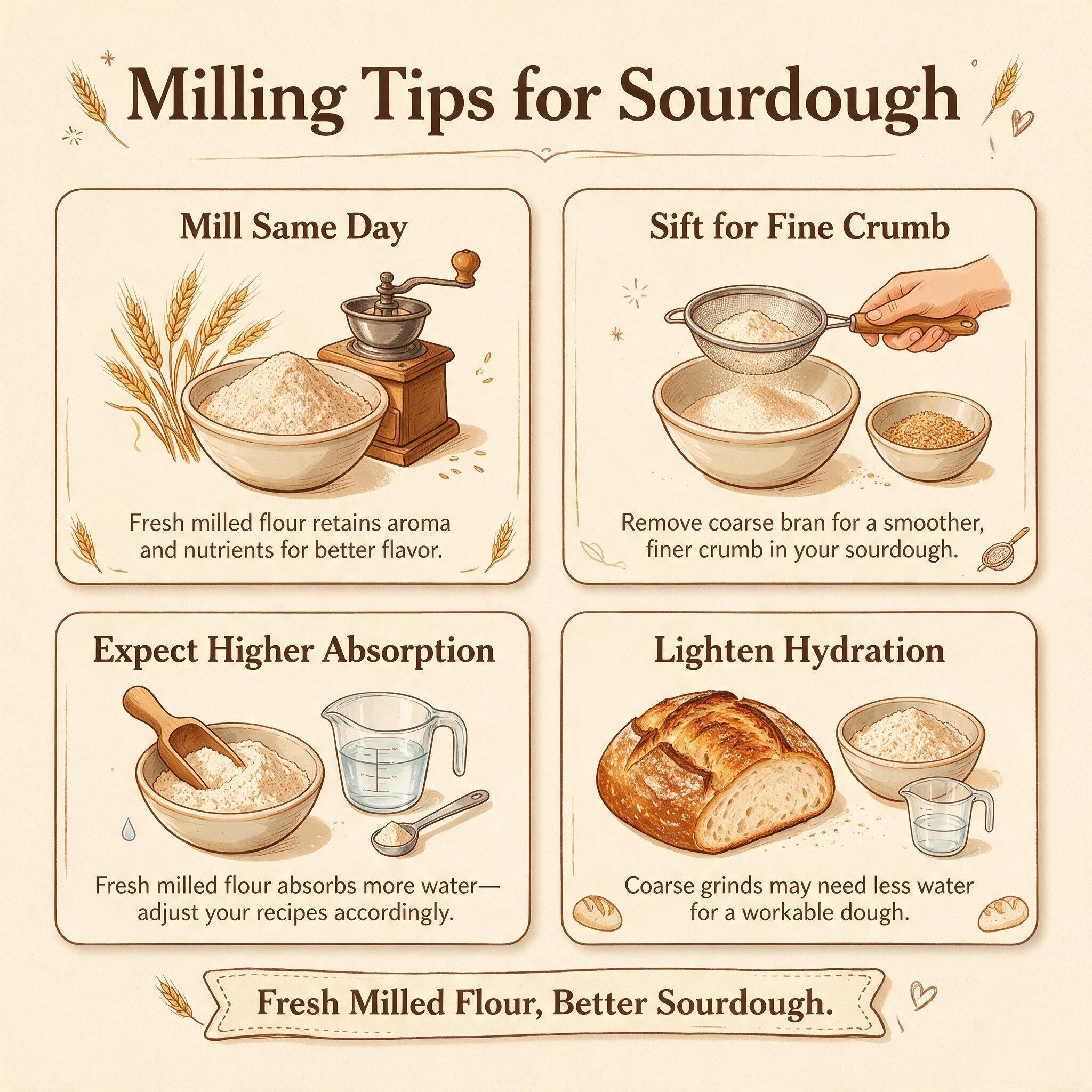
Freshly milled flour absorbs significantly more water than store-bought flour. This is partly because the germ and bran haven't had time to oxidize and dry out, and partly because the flour particles haven't been sitting in a bag for weeks absorbing ambient moisture. Expect to add 3–5% more water than your standard recipe when using freshly milled flour.
The first time I milled and tried to use it at my usual hydration, my dough felt like concrete. I added water gradually and eventually hit the right consistency — but the lesson stuck: freshly milled flour is thirstier, and your hands (not a recipe) tell you when it's right.
Shorter Shelf Life
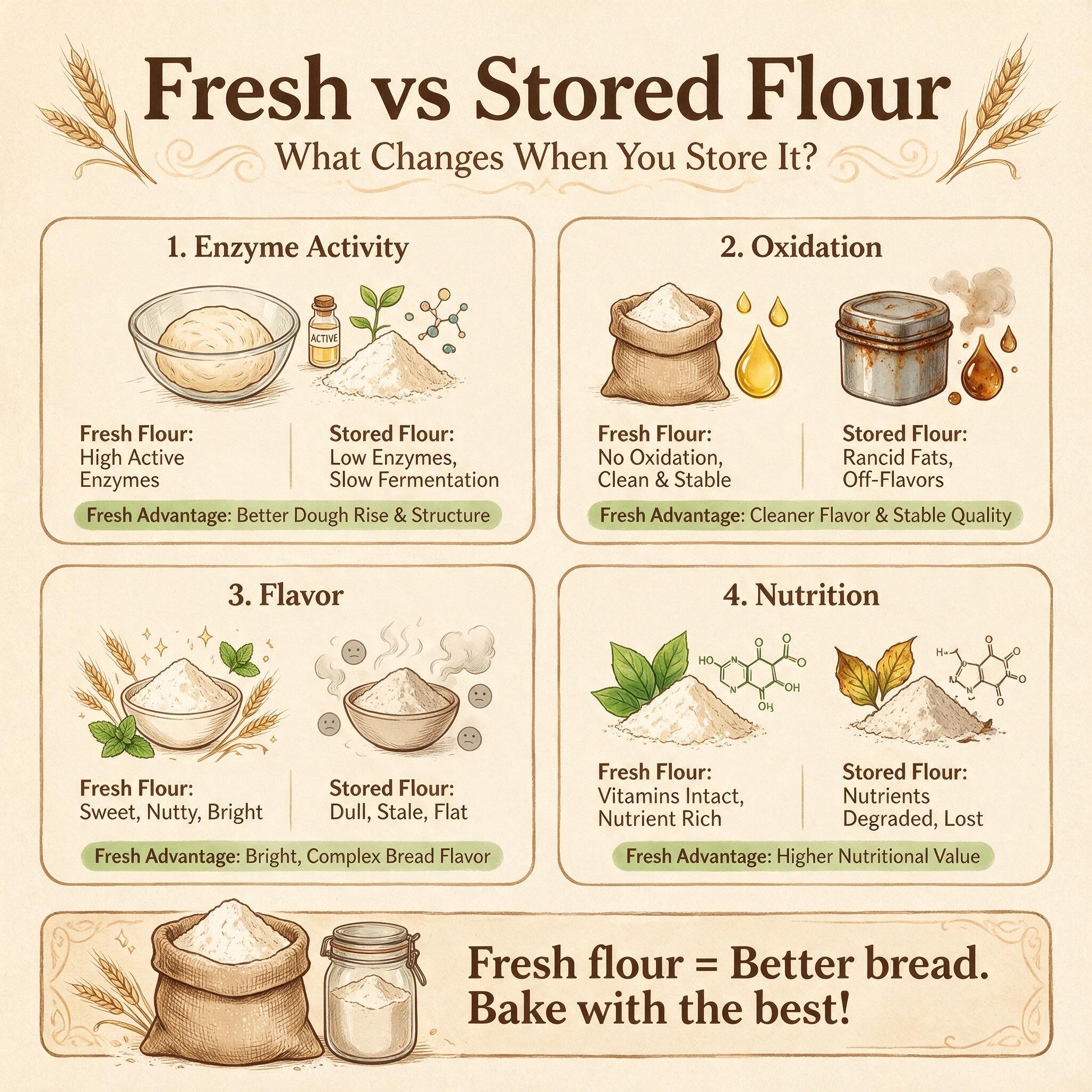
Whole grain flour contains germ — the wheat kernel's embryo, which is rich in oils. These oils are what give fresh-milled flour its nutty, complex flavor. But oils go rancid quickly when exposed to air and warmth. Store-bought whole wheat flour has been degermed or stabilized (heat-treated) to prevent this. Fresh-milled flour has not.
Practical shelf life:
- •Room temperature: 1–3 days before noticeable flavor decline
- •Refrigerator: Up to 2 weeks
- •Freezer: 3–6 months (best quality); up to 1 year still usable
My approach: Mill what I need for each bake. If I'm baking on Saturday, I mill on Friday or Saturday morning. I never mill more than a week's worth of flour and store it in the freezer until I'm ready to use it. Some bakers freeze their wheat berries indefinitely and mill directly from frozen — the flour is cold enough that it doesn't warm up enough to go rancid during the brief milling process.
Higher Nutrient Content
Freshly milled whole grain flour retains the germ and bran — the parts of the wheat kernel that contain most of the nutrition. Commercial whole wheat flour has been stripped of some nutrients during processing. Fresh milling preserves vitamin E, B vitamins, minerals, and antioxidants that store-bought flour loses over time. This doesn't affect baking behavior significantly, but it's part of why many bakers who mill swear by it.
Hydration: The Biggest Adjustment
The number one challenge when switching to freshly milled flour is hydration. Here's why it absorbs more water:
Bran absorbs water slowly and competitively. The bran component of whole wheat absorbs water much more slowly than endosperm flour, competing with gluten development for available moisture. This means your dough won't feel right at mix time — give it at least 60 minutes before judging.
Pentosans (arabinoxylans) increase water binding. Freshly milled flour has more water-extractable arabinoxylans (WEAX) that increase dramatically during fermentation — from around 4.5 mg/g to nearly 8 mg/g after a few hours. This ongoing water-binding activity explains why whole grain doughs often feel slack mid-fermentation even though they seemed right at mix time.
The 60-Minute Rule
The most important tip for freshly milled flour: never judge dough feel at mix time. Wait at least 60 minutes — ideally after your autolyse. During the rest, bran absorbs water, pentosans hydrate, and the dough transforms. A stiff-feeling dough at mix time becomes smooth and workable after an hour.
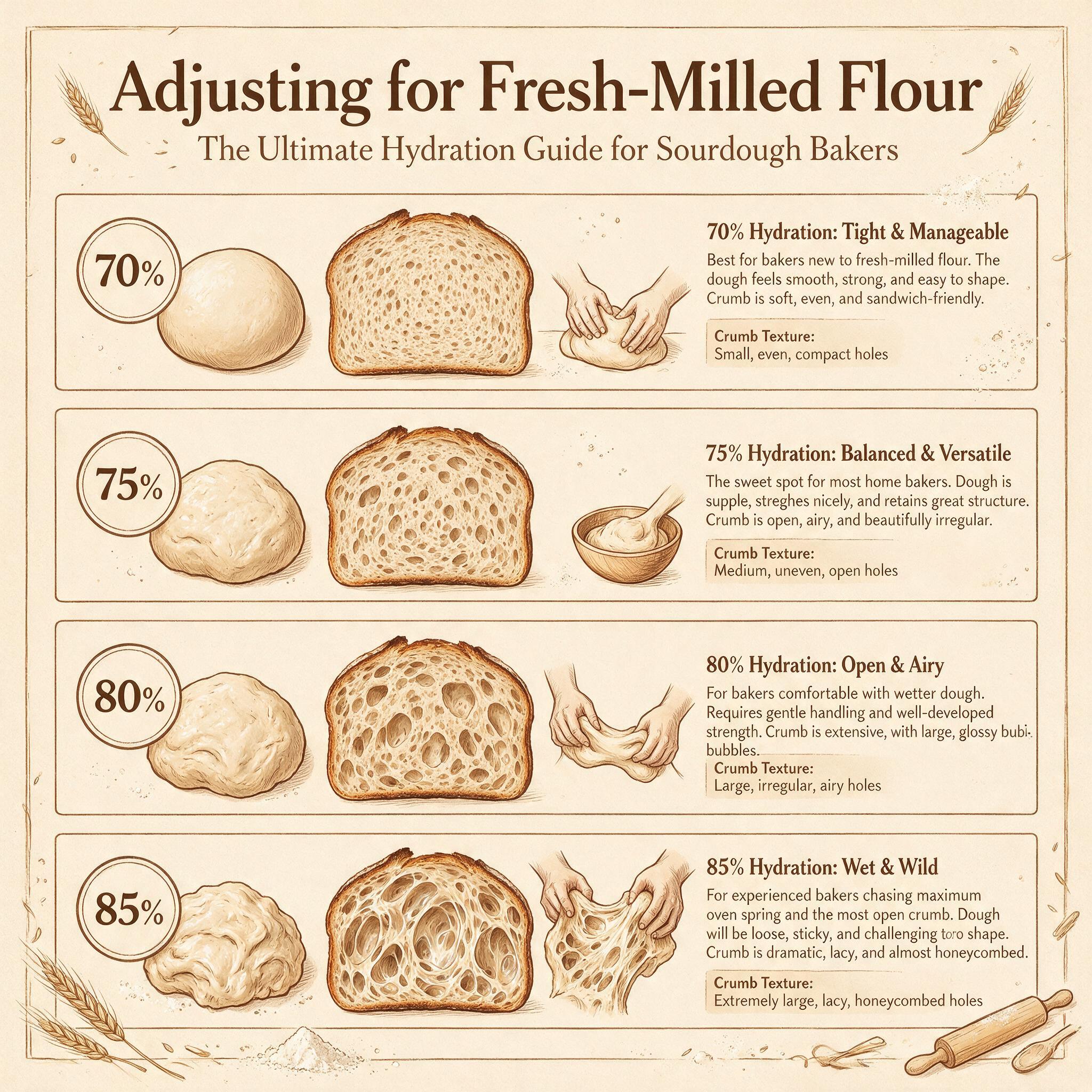
Hydration Adjustments by Percentage
For 100% freshly milled flour, expect to use 85–90% hydration at minimum — and even higher may be needed depending on your grain variety and milling fineness.
Warm Water Helps
Use warm water (77–80°F / 25–27°C) for mixing freshly milled flour to speed hydration. This is especially helpful for 100% fresh-milled loaves where the bran takes time to fully absorb. Room temperature water works fine for lower percentages.
Sifting vs. Whole Grain: The Bolting Question
This is where technique diverges. Some bakers use 100% freshly milled whole grain flour; others sift out the bran and germ for a lighter result. Both approaches work — they produce different bread.
Whole Grain (No Sifting)
Using all of the freshly milled flour — germ, bran, and endosperm — produces the most nutritious bread with the strongest freshly milled flavor. The trade-off is denser crumb, shorter shelf life, and more demanding technique. This is the traditional approach and the one that rewards patience most.
Best for: Experienced bakers who want maximum nutrition and authentic flavor, or who are committed to the whole grain journey.
Sifting / Bolting (Removing Some Bran)
Sifting out a portion of the bran (typically 10–20% of the flour weight) produces lighter bread that's easier to work with while retaining most of the fresh-milled flavor. This is Maurizio Leo's approach for his 100% whole wheat sourdough: he sifts out roughly 13% of the bran, adds the sifted flour back, and the result is lighter without losing the whole grain character.
How to sift:
- Mill your flour as usual
- Sift through a fine mesh sieve or flour sifter
- Weigh the sifted flour vs. the removed bran
- Use the sifted flour for your main dough, add the bran back in small amounts if desired (or save for another use)
Best for: Bakers transitioning from white flour to whole grain, or anyone who wants a lighter crumb with fresh-milled flavor.
The Scald Technique
A traditional technique for whole grain baking: scald the bran with boiling water before adding it to the dough. This partially gelatinizes the bran, making it softer and less likely to cut gluten strands. It also speeds hydration and extends shelf life slightly.
How to scald:
- Remove 10–20% of your freshly milled flour's bran
- Add an equal weight of boiling water to the bran (e.g., 30g bran + 30g boiling water)
- Stir until it forms a thick paste
- Cool to room temperature
- Add to your dough during mixing
Getting Good Oven Spring With 100% Fresh-Milled Flour
This is the hardest part. Whole grain doughs, especially with freshly milled flour, have less oven spring than white flour equivalents because:
- •Bran cuts gluten strands (physical disruption)
- •Pentosans bind water, reducing gluten flexibility
- •Lower functional gluten means weaker structure
But you can maximize oven spring with these techniques:
End Bulk Fermentation Earlier
Target 40–50% aliquot rise instead of the standard 60–75%. Whole grain doughs are weaker and have less structural reserve — pushing them further risks collapse. Better slightly under-proofed than over-proofed.
Build Extra Shaping Tension
Tight surface tension is critical for whole grain doughs. Preshape, rest 20 minutes, then final shape firmly — the way you'd close a purse string. The extra tension compensates for weaker gluten structure.
Cold-Shaping
Shape whole grain dough when it's cold — straight from the fridge after a short cold proof (4–8 hours). Cold dough is firmer and easier to shape with tension, and it holds that tension better during the final proof.
Bake to Higher Internal Temperature
Whole grain doughs are denser and need slightly higher core temperatures to fully gelatinize starches. Bake to 207–210°F (97–99°C) instead of the standard 205°F. Underbaked whole wheat is notoriously gummy.
Sift and Scald
The combination of sifting (removing the coarser bran particles) and scalding (pre-hydrating what's left) produces the lightest result from freshly milled flour. Not zero effort, but dramatically better than using whole grain straight from the mill.
Grain Varieties: What to Mill
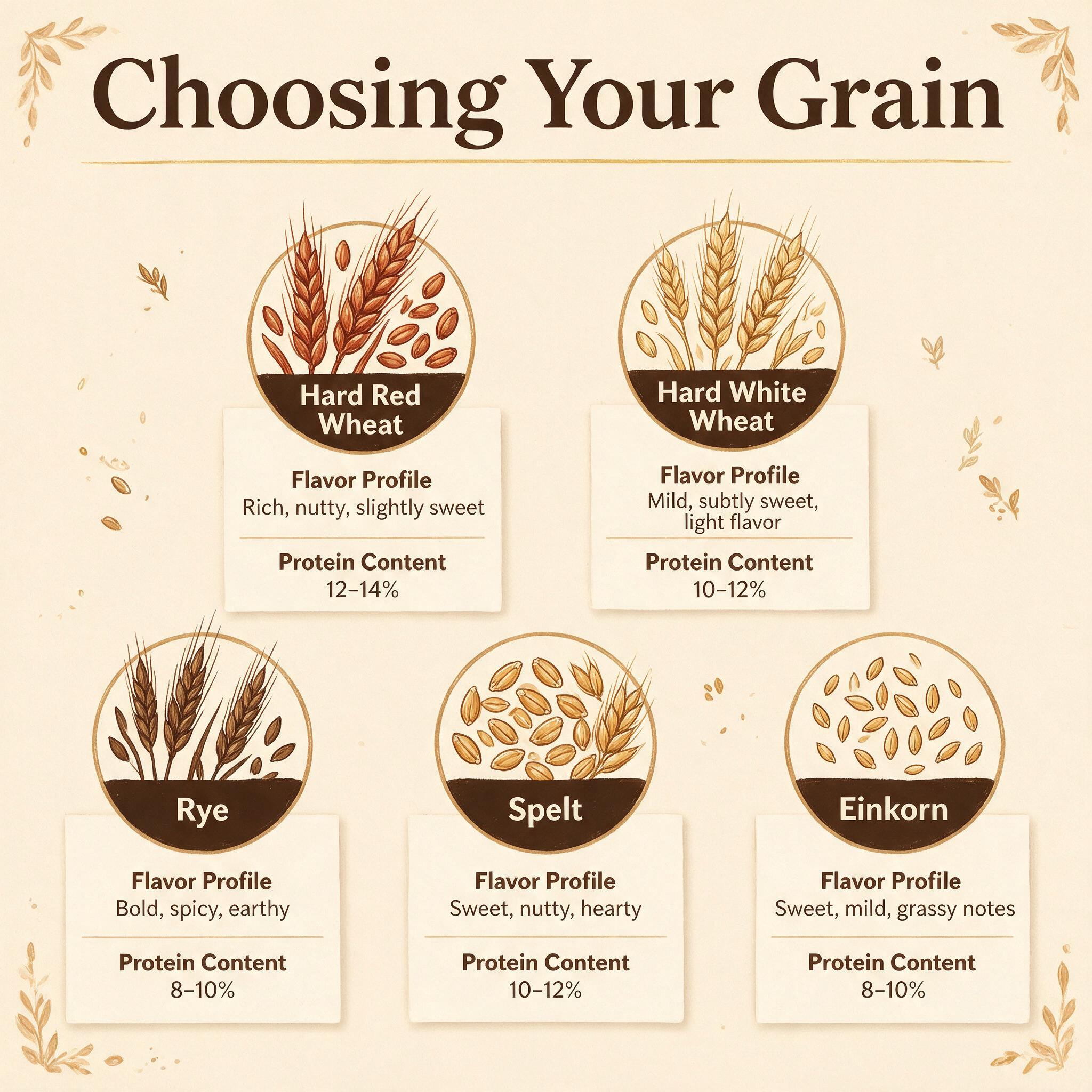
Different wheat varieties behave differently for sourdough:
| Variety | Characteristics | Best For |
|---|---|---|
| Hard red winter | High protein (12–14%), strong gluten | Standard sourdough, good rise |
| Hard white wheat | Moderate protein, milder flavor | Everyday bread, lighter flavor |
| Einkorn | Lower protein, ancient grain, nutty | Flatbreads, crackers, mild loaves |
| Spelt | Moderate protein, fragile gluten | Low-to-moderate hydration, flatbreads |
| Emmer | Ancient grain, earthy, moderate protein | Rustic breads, sourdough experimentation |
| Rye | Very different from wheat, no true gluten | Traditional rye bread (not sourdough loaf) |
Start with hard red winter or hard white wheat — these behave most like commercial bread flour and give you the gentlest learning curve. Once you're comfortable, experiment with einkorn, emmer, and spelt.
Fresh-Milled Sourdough Recipe Framework
Here's a starting point for a 100% freshly milled loaf:
| Ingredient | Amount | Notes |
|---|---|---|
| Freshly milled whole wheat flour | 450g | Mill fresh before baking |
| Water | 405g (90% hydration) | Adjust based on dough feel after 60 min |
| Active sourdough starter (ripe) | 90g (20%) | At peak — whole grain needs vigorous starter |
| Salt | 9g (2%) | |
| Warm water (optional) | For autolyse | Use 80°F water to speed hydration |
Process:
- Mill your flour fresh (freeze berries if not milling immediately)
- Mix flour and warm water (80°F), rest 60 minutes (autolyse)
- Add starter and salt, mix thoroughly
- Bulk ferment at 76–78°F: ~3–4 hours (watch aliquot jar — target 40–50% rise)
- Preshape, rest 20 minutes, final shape with firm tension
- Cold proof: 4–8 hours (not overnight — shorter than white flour)
- Bake in preheated Dutch oven at 500°F, lid on 20 min, lid off at 450°F
- Bake to 207–210°F internal temperature
Frequently Asked Questions
Do I need a grain mill?
Yes — unless you're buying freshly milled flour from a local mill, you can't do this. Grain mills range from ~$280 (NutriMill Classic) to $350+ (NutriMill Harvest). The investment is significant but mills last for decades with basic maintenance, and the flour quality difference is real.
What's the easiest grain to start with?
Hard white wheat — it has milder flavor, moderate protein, and behaves most like commercial bread flour. Hard red winter is slightly more challenging (stronger flavor, higher protein) but produces excellent results. Start with white wheat, then try red winter once you're comfortable.
How do I store wheat berries vs. flour?
Wheat berries store for years in airtight containers at room temperature (they're dried seeds — they're designed to last). Flour (even whole grain) has a shorter shelf life. Mill only what you need within 1–2 weeks, and freeze the flour for longer storage. Some bakers freeze wheat berries and mill directly from frozen — the flour comes out cold and stays fresh longer.
Can I mix freshly milled with store-bought flour?
Absolutely — and this is a great way to start. A 50/50 blend gives you fresh-milled flavor and nutrition with store-bought's reliability and shelf life. Work up to higher percentages as you develop technique.
Closing Thoughts
Freshly milled sourdough is one of the most rewarding rabbit holes in home baking. There's something fundamentally different about milling your own grain — the flavor is brighter, the bread feels more alive, and you understand the ingredient chain from seed to slice in a way that commercial flour can't provide.
My advice: start with a 50/50 blend of freshly milled and store-bought flour, get comfortable with the hydration adjustments, then gradually increase the fresh-milled percentage as you learn how your specific grain behaves. The jump from 50% to 75% to 100% is larger in technique than the jump from white to 50% fresh-milled — give yourself time at each level.
And mill fresh. The difference between flour milled an hour ago and flour milled a week ago is noticeable in the final bread. Freshness matters more than any other variable.
Happy baking!