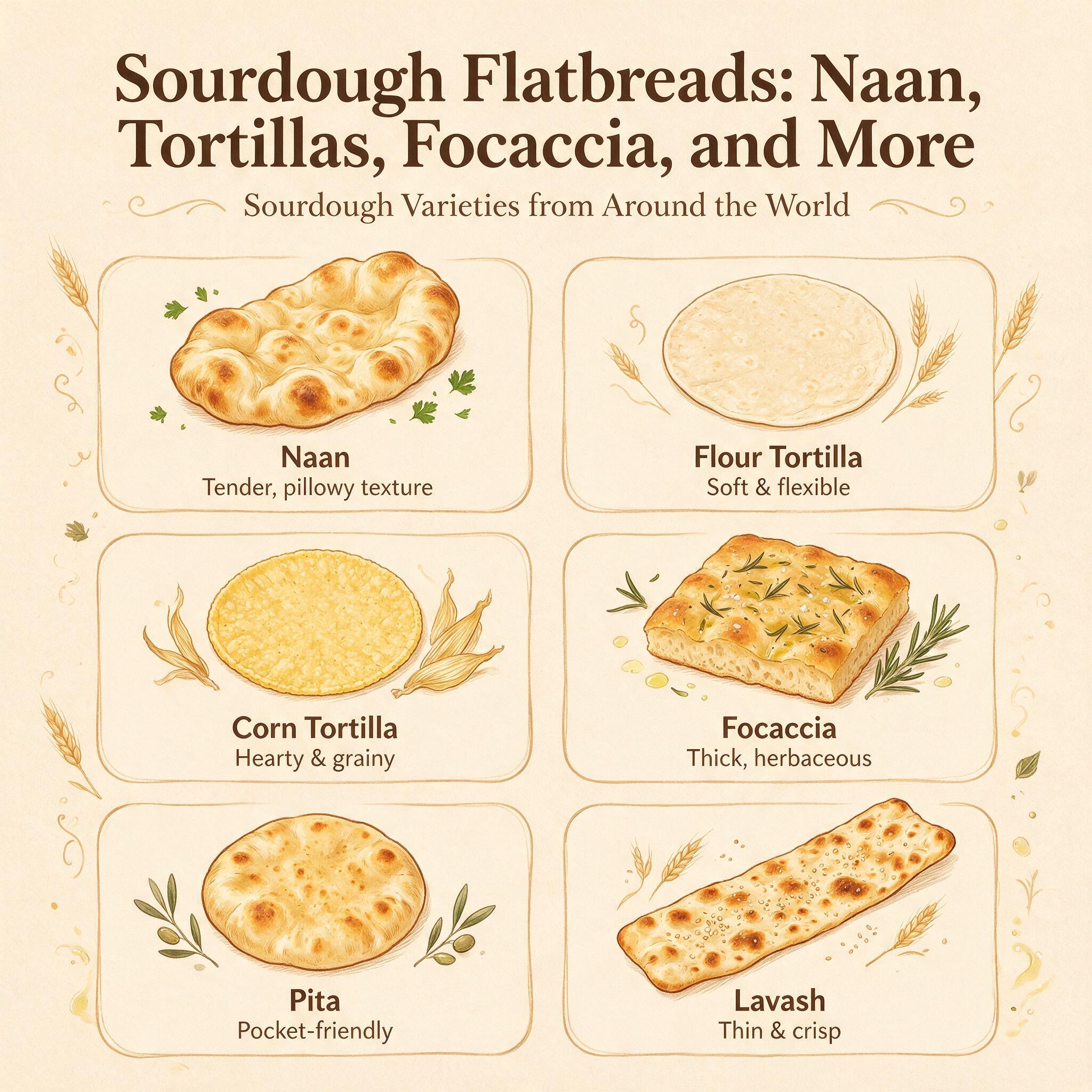
Sourdough isn't just for loaves. Some of the most satisfying things you can bake with a starter are flatbreads — no banneton required, no shaping tension to master, no overnight cold proof. Just mix, rest, and cook. They're the gateway recipes for people intimidated by loaf baking, and they're endlessly versatile once you know the framework.
The beauty of sourdough flatbreads is that they showcase your starter's tang without demanding the technical precision of a pulled hearth loaf. You're not fighting for an ear or managing open crumb — you're making bread that tastes incredible in 30 minutes of active work. Sourdough naan blisters like a dream in a hot cast iron skillet. Focaccia spreads into a sheet pan with olive oil pooling in every dimple. Tortillas puff dramatically as they cook. Lavash turns into crackly crackers. Each one is its own satisfying project.
This guide covers sourdough naan, tortillas, focaccia, and chapati-style flatbreads — the four most accessible sourdough flatbreads, with frameworks you can adapt to whatever flatbread you want to make.
What You'll Learn
By the end of this post, you'll understand:
- •The sourdough flatbread framework — one base formula, multiple outcomes
- •How to make sourdough naan that blisters and puffs
- •How to make sourdough tortillas that roll without cracking
- •How to make focaccia with pools of olive oil in every dimple
- •How to make chapati-style flatbreads for everyday eating
Let's get into the kitchen.
The Sourdough Flatbread Framework
Every sourdough flatbread starts from the same base — and then adapts based on what you're making:
Base formula:
- •300g bread flour (or a blend with whole wheat for nuttier flavor)
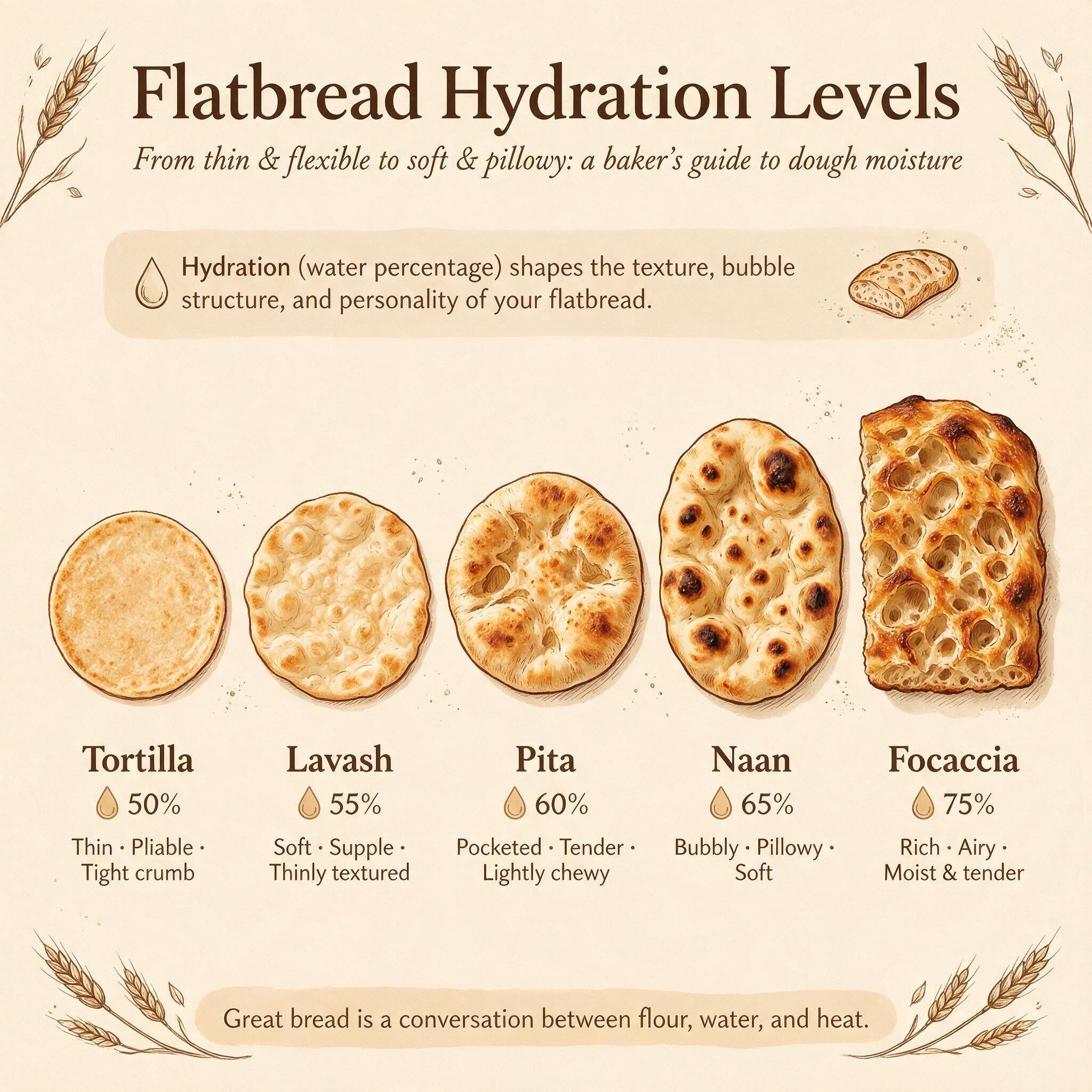
- •200g water (66% hydration — slightly stiffer than standard loaf dough)
- •60g active sourdough starter (20% at peak)
- •6g salt (2%)
From this base, you adjust:
- •Thicker flatbreads (naan, tortillas): Rest the dough 30 minutes, portion into 60–80g balls, roll thin, cook in hot dry skillet
- •Sheet pan breads (focaccia): Pour batter into oiled pan, dimple with olive oil, bake hot
- •Thin crackers (lavash): Roll as thin as possible, bake fast at high heat
- •Chapati-style: Cook on dry skillet, puff directly over flame
The Key Difference from Loaf Baking
Flatbreads don't need the same gluten development as loaves. You want a relaxed, extensible dough that's easy to roll thin — not a tight, structured ball that holds its shape in a banneton. This means:
- •Less mixing time
- •Shorter or no bulk fermentation
- •Dough is ready when it holds together (not when it doubles)
For most flatbreads, you can use discard from your daily starter maintenance — the tang adds complexity without needing active fermentation. For more pronounced sourness, use active starter at peak.
Sourdough Naan
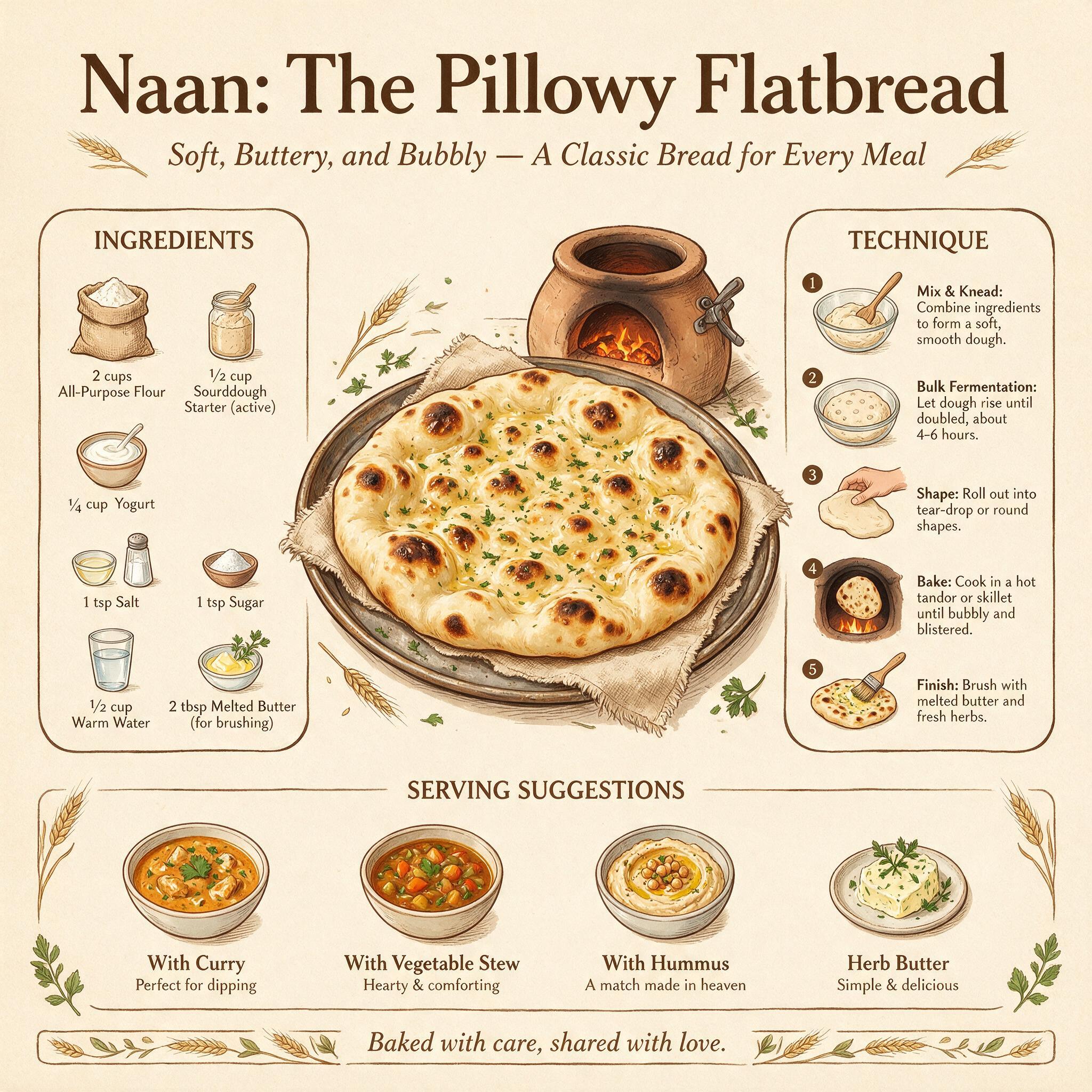
Naan is the most dramatic sourdough flatbread. It blisters in a hot skillet, puffs dramatically, and develops that characteristic charred bottom crust that's chewy and incredible with curries, kebabs, or just butter. The sourdough version adds a gentle tang that commercial yeast naan can't match.
The Formula
The yogurt adds tenderness and helps with browning. The sugar feeds Maillard reaction for that beautiful golden char.
Process
- Mix: Combine flour, water, starter, yogurt, sugar, and salt. Mix until a shaggy dough forms — don't over-mix. Cover and rest 30 minutes.
- Add fat: Drizzle melted butter over dough and fold through gently until incorporated.
- Bulk ferment: Let rise at room temperature for 2–4 hours (shorter if using discard, longer if using active starter). The dough should look puffy and bubbly, slightly increased in volume — not doubled.
- Portion: Divide into 6 balls (~90g each). Round each into a smooth ball.
- Roll: On a floured surface, roll each ball into an oval roughly ¼ inch thick. Thinner = crispier edges with more puff.
- Cook: Heat a cast iron skillet or tawa (flat Indian griddle) over high heat until screaming hot. Dry pan — no oil. Cook each naan 2–3 minutes per side until blistered, puffed, and golden brown spots appear on the bottom. The naan should puff dramatically — if it doesn't, press lightly with a spatula.
- Finish: Brush with melted butter immediately after removing from pan. Stack covered to keep soft.
Troubleshooting Naan
| Problem | Cause | Fix |
|---|---|---|
| Naan doesn't puff | Pan not hot enough OR dough too thick | Get pan screaming hot; roll thinner |
| Bottom burns before top cooks | Pan too hot OR cooking too long | Reduce heat slightly; flip more often |
| Naan sticks to pan | Insufficient flour on surface OR cold pan | Flour well; ensure pan is preheated |
| Flat and dense (no puff) | Insufficient fermentation OR cold dough | Let dough rise longer; cook immediately |
Sourdough Tortillas
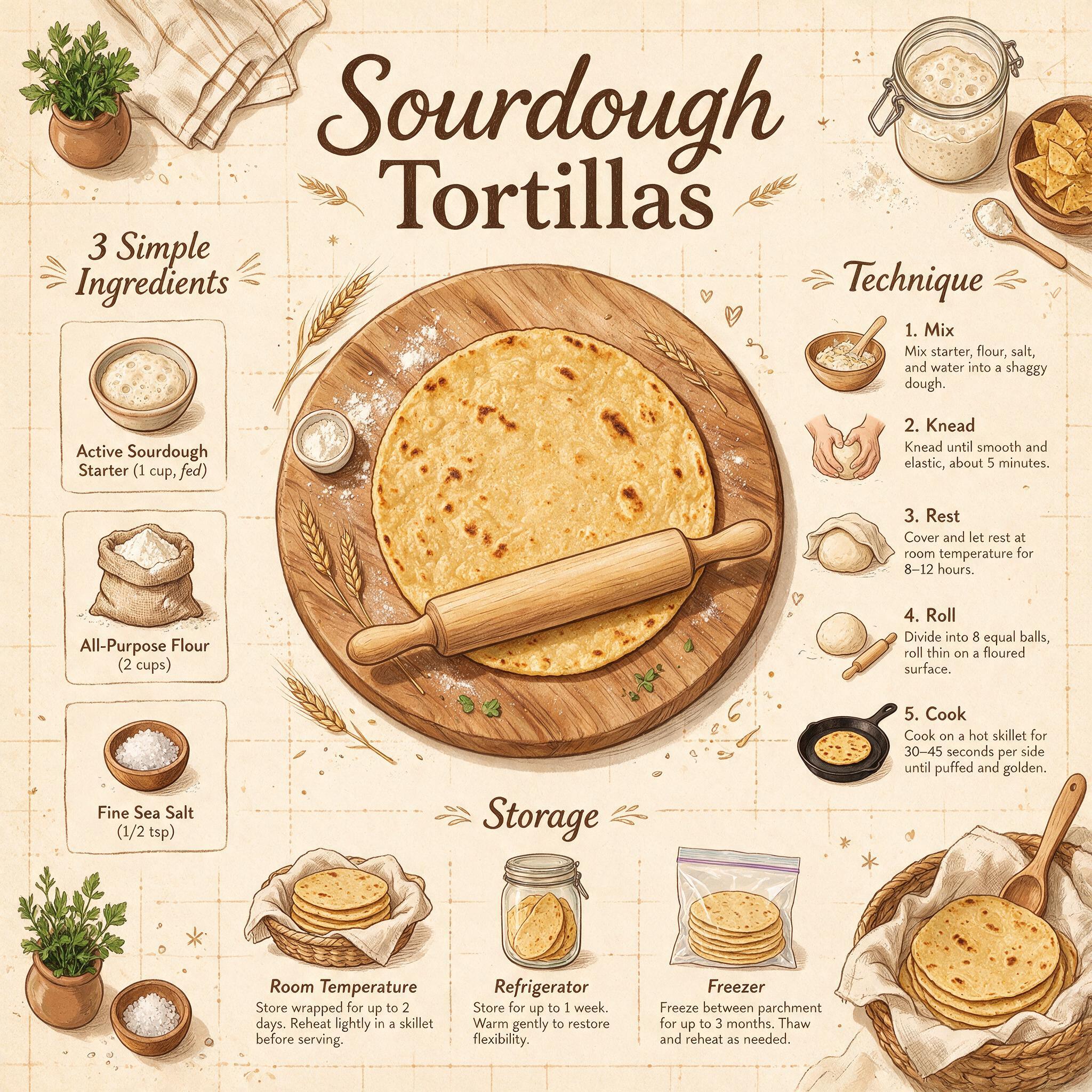
Sourdough tortillas are softer, more flavorful, and more interesting than commercial versions. They roll thin without cracking (unlike many GF tortillas), they puff on the comal, and the sourdough tang pairs perfectly with spicy food. They're also dead simple to make.
The Formula
The fat (lard or shortening) is what makes tortillas tender and pliable — don't skip it. The baking powder gives them a slight lift without commercial yeast.
Process
- Mix: Combine flour, water, starter, fat, salt, and baking powder. Mix until a smooth dough forms (2–3 minutes of kneading). The dough should feel slightly tacky but not sticky.
- Rest: Cover and rest 30 minutes. This relaxes the gluten so rolling is easy.
- Portion: Divide into 8 balls (~70g each). Round each into a smooth ball.
- Roll: On a lightly floured surface, roll each ball into a thin circle — thin enough to see light through it, roughly 1/8 inch thick. Uniform thickness matters more than perfect roundness.
- Cook: Heat a dry comal or cast iron skillet over medium-high heat. Cook each tortilla 1–2 minutes per side until lightly golden spots appear and the tortilla has puffed slightly. Don't overcook — tortillas continue cooking off-heat.
- Keep warm: Stack in a clean towel immediately — they'll steam themselves soft as they stack.
- Store: Refrigerate in an airtight bag for up to 5 days. Freeze for longer storage; toast directly from frozen.
The Puff Test
A good tortilla should puff on the comal (the steam inside makes it balloon). If yours don't puff, they're not ruined — they'll still taste fine. But a puffing tortilla has better texture: the interior steams and softens while the exterior sets, creating layers that separate when you bite in. To encourage puffing: make sure your pan is hot enough, press gently with a spatula around the edges during cooking, and roll thin.
Sourdough Focaccia
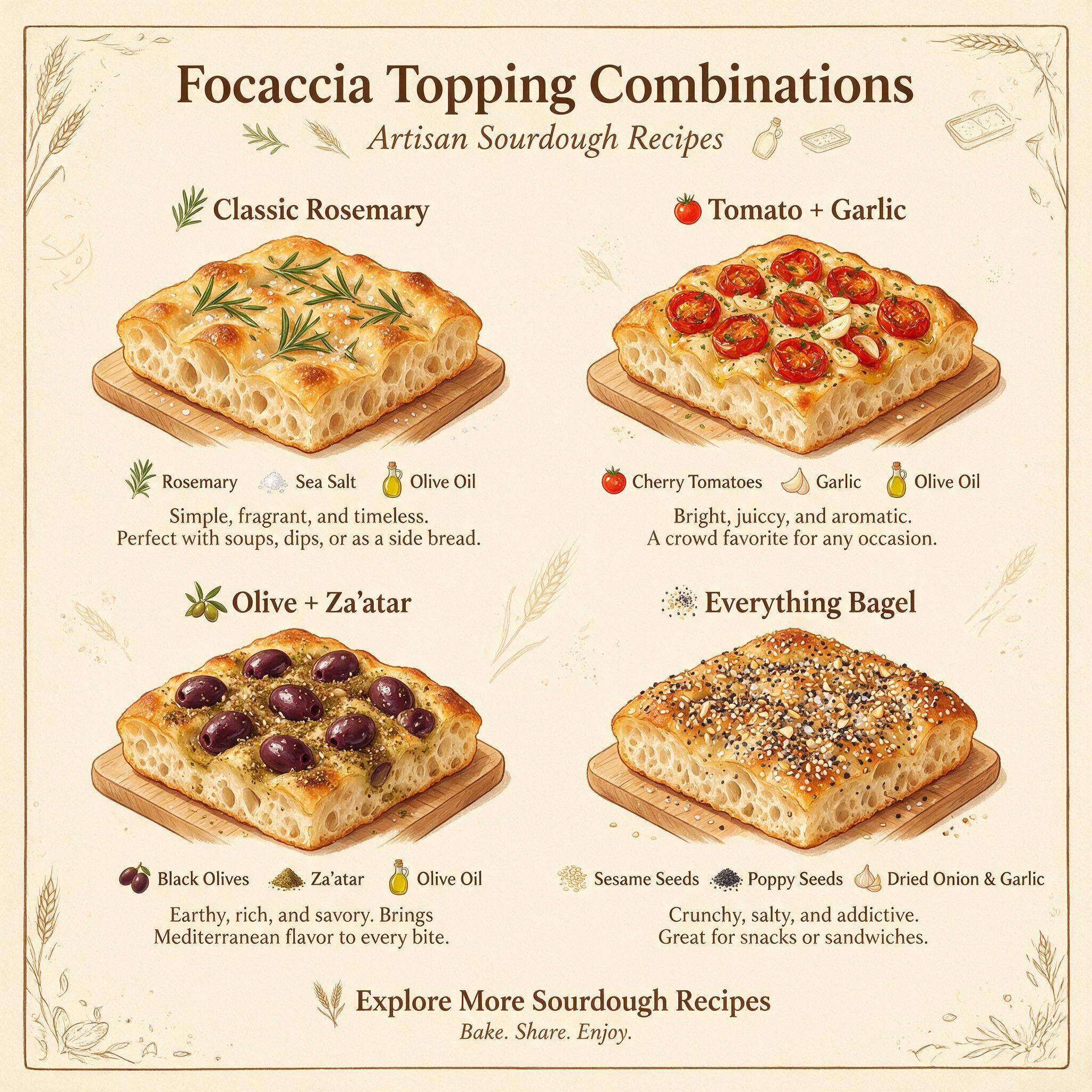
Focaccia is the most forgiving sourdough flatbread — it's essentially a wet dough poured into an oiled pan and dimpled with olive oil, then baked until golden. No shaping, no tension, no rolling. It's foolproof and spectacular.
The Formula
This is much wetter than standard dough — don't try to shape it. Pour and spread.
Process
- Mix: Combine flour, water, starter, and salt. Mix until no dry flour remains — a very wet, sticky batter.
- Autolyse: Rest 30 minutes.
- Bulk ferment: Cover and let rise at room temperature for 2–4 hours. The dough should look puffy and bubbly, with visible bubbles on the surface. It won't double dramatically — a 30–50% increase is normal.
- Pan prep: Pour 2–3 tablespoons of olive oil into a 9×13 inch baking pan. Pour the dough into the oiled pan. Gently stretch toward the edges — you don't need to reach them, just coax it a little.
- Cold proof (optional but recommended): Cover with plastic and refrigerate for 8–24 hours. Cold focaccia has better flavor and easier handling.
- Dimple: Remove from fridge 1 hour before baking. Drizzle with another 2–3 tablespoons of olive oil. Dimple the surface aggressively with your fingers — press all the way to the bottom of the pan. The oil pools in every dimple as it bakes.
- Top: Sprinkle with flaky sea salt and whatever herbs you like — rosemary, thyme, olives, cherry tomatoes, thinly sliced onion.
- Bake: 450°F (230°C) for 25–35 minutes until deeply golden on top and bottom. The bottom should be brown and crispy — check by lifting one corner with a spatula.
- Finish: Drizzle with more olive oil immediately after removing from oven. Cool in pan for 10 minutes, then remove to a rack.
What Makes Focaccia Exceptional
The olive oil is the star. Don't be shy — use good extra virgin olive oil generously. It pools in every dimple as it bakes, crisps the bottom, and makes every bite extraordinary. The sourdough adds a gentle tang that balances the richness of the oil perfectly.
Chapati-Style Sourdough Flatbreads
Chapati (also called roti) are the everyday flatbreads of South Asian cuisine — thin, soft, and cooked on a dry skillet. They puff with steam as they cook, develop char marks from direct flame contact, and are perfect for scooping dals, curries, or just eating with butter. The sourdough version adds complexity and a slight tang that works beautifully with South Asian flavors.
The Formula
Using whole wheat flour (atta) gives you the authentic nutty flavor and slightly grainy texture of traditional chapati. A 50/50 blend with bread flour is easier to roll and slightly more forgiving.
Process
- Mix: Combine flour, water, starter, and salt. Mix until a shaggy dough forms. Add ghee/oil and knead briefly until smooth.
- Rest: Cover and rest 30 minutes.
- Portion: Divide into 8 balls (~70g each). Round each smoothly.
- Roll: On a lightly floured surface, roll each ball thin — thinner than a tortilla, roughly 1/16 inch thick. The thinner you roll, the crispier the chapati.
- Cook dry skillet: Heat a cast iron skillet or tawa over medium-high heat. Cook each chapati dry (no oil) for 1–2 minutes per side until cooked through and light golden spots appear.
- Char (optional but traditional): Place the cooked chapati directly over a gas burner flame for a few seconds per side — it blisters and chars beautifully. This is optional but adds authentic smoky flavor.
- Wrap: Wrap cooked chapatis in a clean towel immediately — they'll steam soft as they stack.
Chapati vs. Puri
Chapati is cooked on a dry pan and stays soft (used as daily bread). Puri is deep-fried and puffs dramatically into a hollow ball (used for special occasions). You can make puri from the same dough — just fry in hot oil (375°F / 190°C) for 1–2 minutes per side until puffed and golden.
Common Flatbread Mistakes and Fixes
| Problem | Cause | Fix |
|---|---|---|
| Dough tears when rolling | Not rested enough | Rest dough 30 min to relax gluten |
| Bread sticks to pan or counter | Insufficient flour on surface | Flour generously; use bench scraper to release |
| Flatbread is tough or chewy | Overworked dough OR cooked too long | Mix minimally; cook faster at higher heat |
| Tortillas crack when rolling | Dough too dry OR not rested | Add water 1 tbsp at a time; rest longer |
| Focaccia is oily | Too much olive oil OR under-baked | Reduce oil by 1 tbsp; bake until deeply golden |
Frequently Asked Questions
Can I use discard for all flatbreads?
Yes — discard is perfect for flatbreads because you don't need active fermentation. The mild tang it adds is appropriate for most flatbread styles. For naan and focaccia where you want deeper flavor, active starter at peak produces more complex results. But discard works for all of them.
What's the best pan for cooking flatbreads?
For naan and tortillas: a well-seasoned cast iron skillet or carbon steel pan heated over high heat. These conduct heat best and develop the char you want. For chapati: a traditional tawa (flat Indian griddle) or any flat cast iron. For focaccia: a metal 9×13 inch baking pan.
Can I bake flatbreads in a regular oven instead of on the stovetop?
Naan and chapati are best on the stovetop (you want direct high heat contact for char and puff). Focaccia bakes in the oven at 450°F. Tortillas can be cooked on a comal or in an oven at very high heat (500°F on a preheated baking stone works).
How do I store flatbreads?
Tortillas: refrigerate in airtight bag for up to 5 days, freeze for 3 months. Focaccia: room temp 2 days, refrigerate 5 days, freeze 3 months. Naan and chapati: best fresh, but can be wrapped and refrigerated for 3 days — reheat in a dry skillet.
Closing Thoughts
Flatbreads are the most satisfying sourdough project for beginners because the results are immediate and forgiving. You mix, you rest, you cook. No bannetons, no overnight proofs, no worrying about whether your score opened. Just dough and heat and bread.
My personal favorites: sourdough naan for weekend dinners when I want that charred, blistered crust. Focaccia when I'm feeding a crowd — everyone loves dimples filled with olive oil and flaky salt. Tortillas for weekly meal prep because they store well and make lunch infinitely more interesting.
Start with one style that appeals to you, nail it twice, then expand. Within a month you'll have a flatbread repertoire that makes every day baking worth it.
Happy baking!