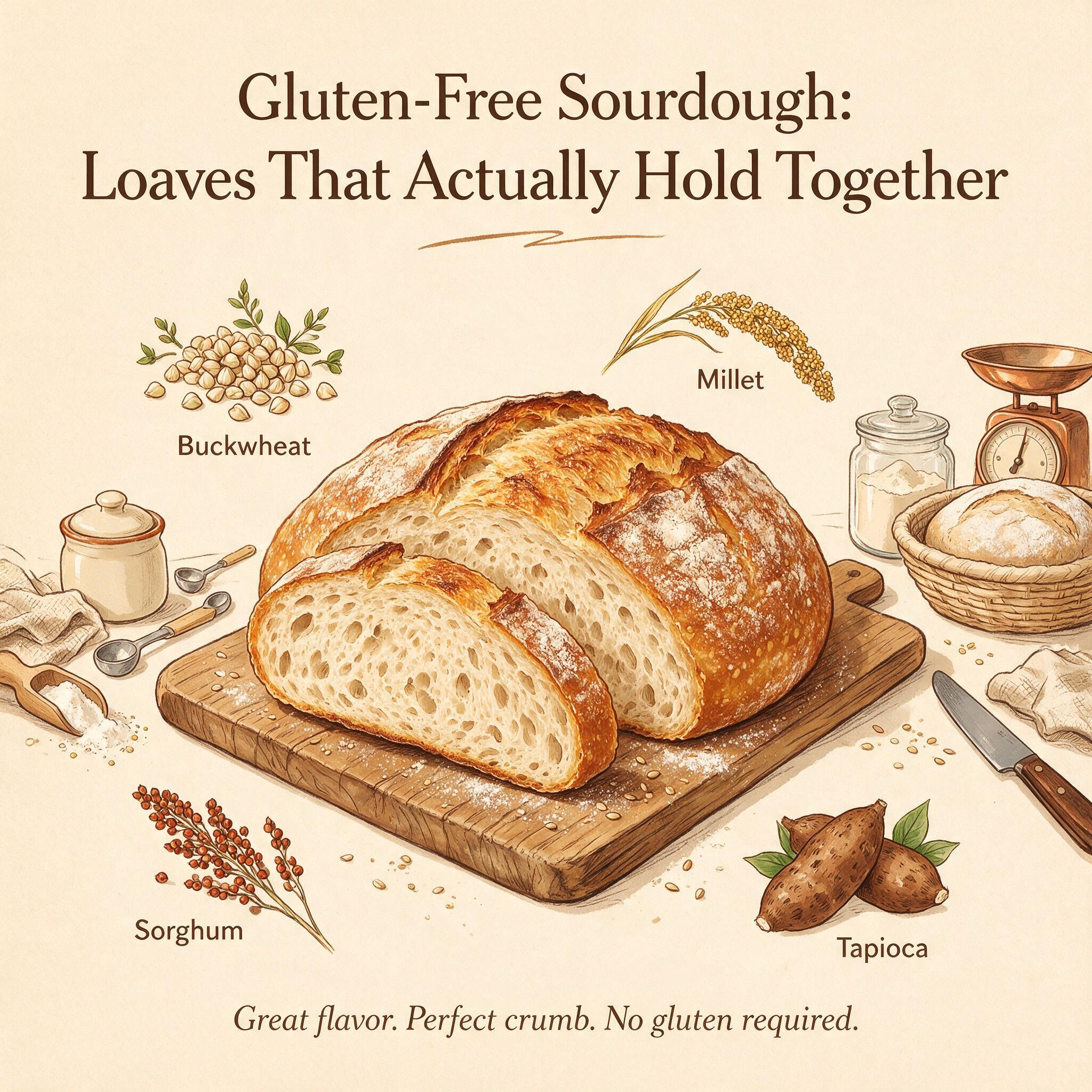
Gluten-free sourdough has a reputation problem. Most recipes you find online are really just "yogurt-culture batter breads" — they rise once, slice poorly, and fall apart the moment you put butter on them. They taste vaguely of sourdough because someone added a starter, but they're not actually sourdough bread in any meaningful sense.
The reality of GF sourdough baking is more demanding: you need starch blends to provide structure, protein binders to mimic gluten's elasticity, and a fermentation approach that works with rice flour and tapioca starch instead of wheat protein. The result — when done right — is genuinely excellent bread: light, tangy, with a soft crumb that holds together for sandwiches and toasts beautifully.
This guide covers why GF sourdough needs different ingredients than wheat, how to build a GF starter, practical recipe frameworks (not rigid formulas), and troubleshooting common GF baking failures.
What You'll Learn
By the end of this post, you'll understand:
- •Why standard GF flour blends don't work for sourdough and what does
- •The critical role of binders (xanthan gum and psyllium husk)
- •How a GF starter behaves differently from a wheat starter
- •A practical recipe framework that adapts to any GF flour blend
- •Troubleshooting for common GF sourdough problems
Let's build a GF sourdough that actually holds together.
Why GF Sourdough Is Harder Than Wheat Sourdough
Wheat flour contains gluten — two proteins (gliadin and glutenin) that form an elastic network when hydrated and mixed. This network traps gas from fermentation, gives dough its structure, and holds its shape during baking. Gluten is what makes wheat bread slice cleanly, hold toppings, and stay together in your hands.
GF flours contain no gluten, which means:
- •No protein network to trap fermentation gas
- •No elastic dough that holds shape during proofing
- •No structure to support oven spring without cracking
You can't substitute wheat flour 1:1 with any GF flour and get bread. You need a system that replaces what gluten does: starch for lightness, protein binders for structure, and careful fermentation management to work with those systems rather than against them.
The GF Flour System: Starch Blends + Binders
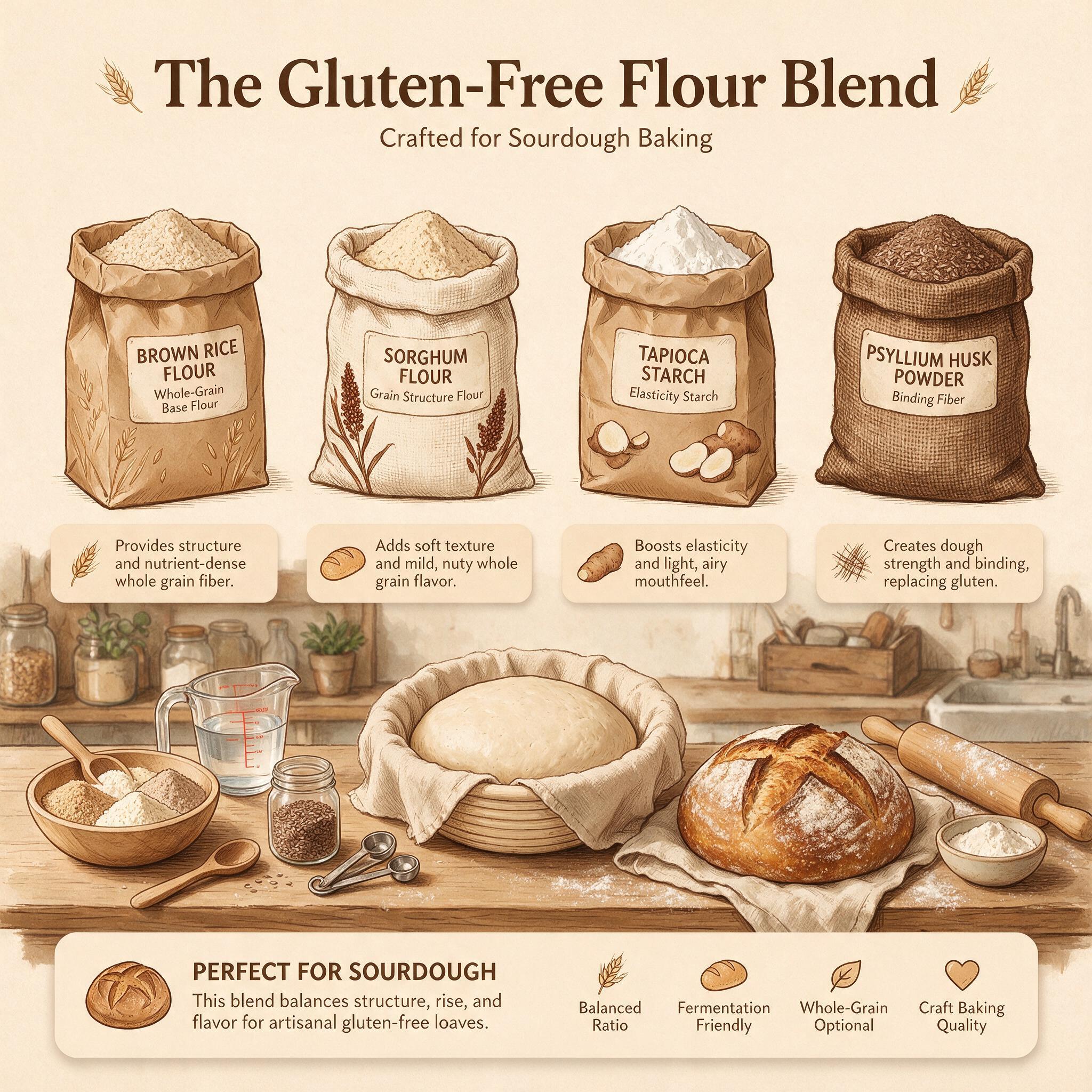
The Starch Blend
No single GF flour produces good sourdough bread. You need a blend of starches and flours that work together:
The reliable baseline blend (confirmed by multiple GF baking sources):
- •60% white rice flour — neutral flavor, widely available, provides bulk
- •20% tapioca starch — creates lightness and chew (what GF bread needs for structure)
- •20% potato starch — adds moisture retention and soft crumb
This blend scales 1:1 with wheat flour recipes — if your wheat recipe calls for 500g flour, use 500g of this blend. The hydration needs are different (GF blends absorb water differently than wheat), but the weight ratio is a reliable starting point.
Other workable flours to consider:
- •Sorghum flour (20–30% of blend): nutty flavor, good protein content, improves structure
- •Buckwheat flour (10–20%): strong flavor, excellent for sourdough tang, adds complexity
- •Oat flour (10–20%): sweet, mild, improves texture
- •Almond flour (10–15%): moist, dense, adds richness — works best in small amounts
The Binder: Xanthan Gum or Psyllium Husk
Binders are what makes GF bread hold together. Without one, your loaf will be a crumbly mess regardless of how good your fermentation is.
Xanthan gum (most common):
- •Use ½ to 1 teaspoon per cup of flour blend
- •Creates elasticity that mimics gluten
- •Works well in most GF breads
- •Side effect: can produce a slightly gummy texture at higher doses
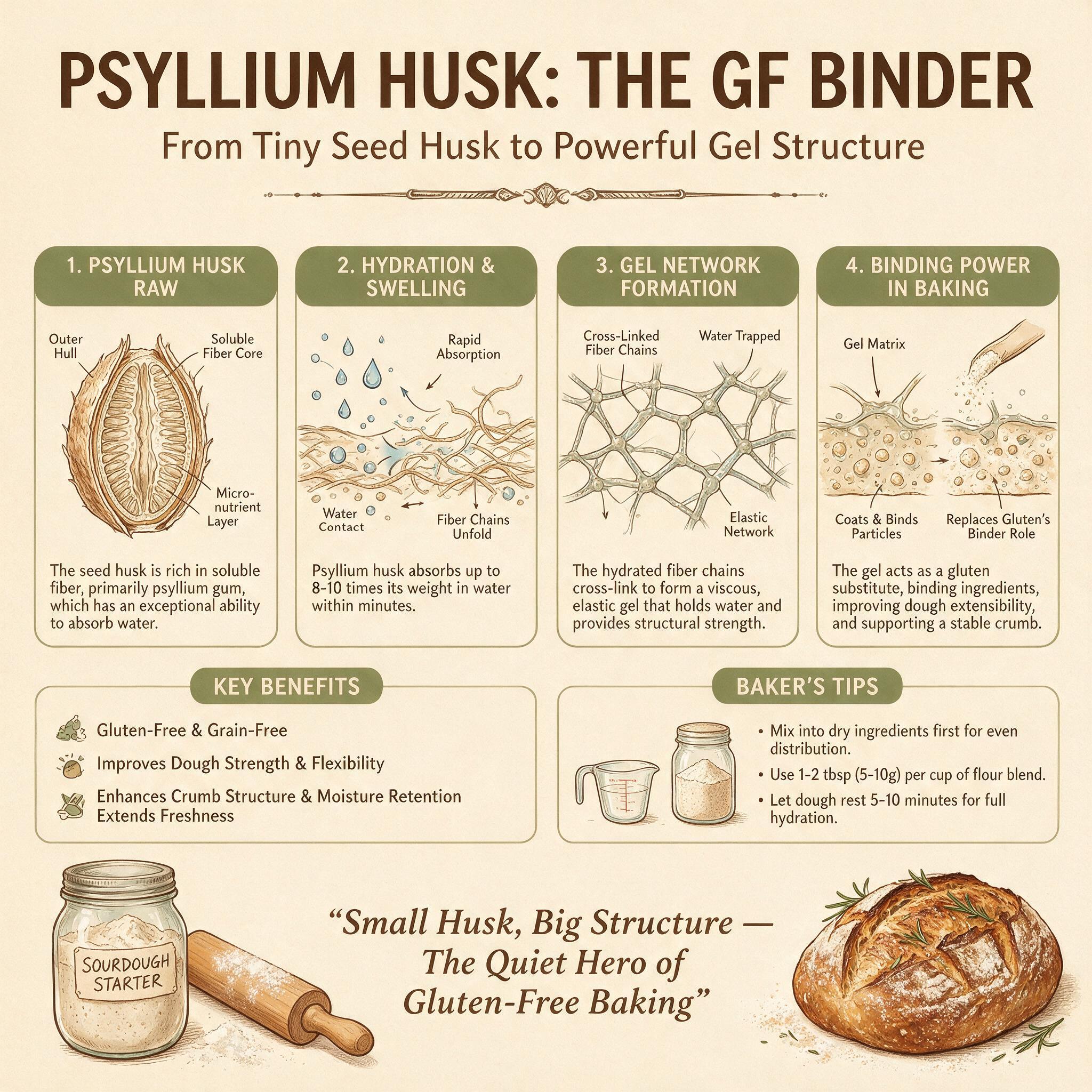
Psyllium husk (my preference):
- •Use 1–2 tablespoons per cup of flour blend
- •Creates a gel that holds structure and moisture
- •Produces better texture than xanthan gum — more bread-like, less gummy
- •At too-low doses (<12g per 320g flour): crumb crumbles
- •At too-high doses (>18g per 320g flour): rubbery, dense
Golden ratio for psyllium: 12–18g per 320g total flour weight (~4–6% by weight). This is the range where crumb holds together without becoming rubbery.
The GF Sourdough Starter
Building a GF Starter
Build a GF starter the same way you'd build a wheat starter — equal parts flour and water, fed daily, tracked over 10–14 days. But use your GF flour blend for feeding, not wheat flour.
Key difference: A GF starter won't behave like a wheat starter. It won't double dramatically. It will bubble, rise slightly, and smell tangy — but the volume increase is subtler because there's no gluten to trap gas and push the culture upward.
Readiness signs for GF starter:
- •Bubbles appear consistently within 12–24 hours of feeding
- •Pleasant sour aroma (not rotting or acetone)
- •Slight rise above the starting mark (even 20–30% is fine)
- •Peaks at roughly the same time after each feeding
Using Your GF Starter
A GF starter ferments slightly differently from a wheat starter:
- •Fermentation is faster at the same temperature (GF starches are more readily available to bacteria)
- •Peak window is narrower — once your GF starter peaks, it falls faster
- •Riper is better — use your GF starter at peak activity for maximum leavening power
Use your GF starter at 20–25% of total flour weight (slightly higher than wheat sourdough). For a 500g-flour GF loaf, use 100–125g of active starter.
The GF Sourdough Recipe Framework
GF sourdough doesn't have rigid formulas — it has frameworks that you adapt based on your specific flour blend's absorption. Every GF flour blend behaves differently; your job is to learn how yours absorbs water and adjust accordingly.
Base Formula (Starting Point)
| Ingredient | Amount | Notes |
|---|---|---|
| GF flour blend | 400–500g | Use the starch blend above or your preferred blend |
| Water | 400–450g | GF blends need more water than wheat — start at 85–90% hydration |
| Active GF starter | 100–125g | 20–25% of flour weight |
| Salt | 8–10g | 2% of flour weight |
| Psyllium husk | 12–15g | Or 1 tsp xanthan gum |
| Fat (optional) | 20–30g | Olive oil or melted butter for richness and shelf life |
Hydration Reality Check
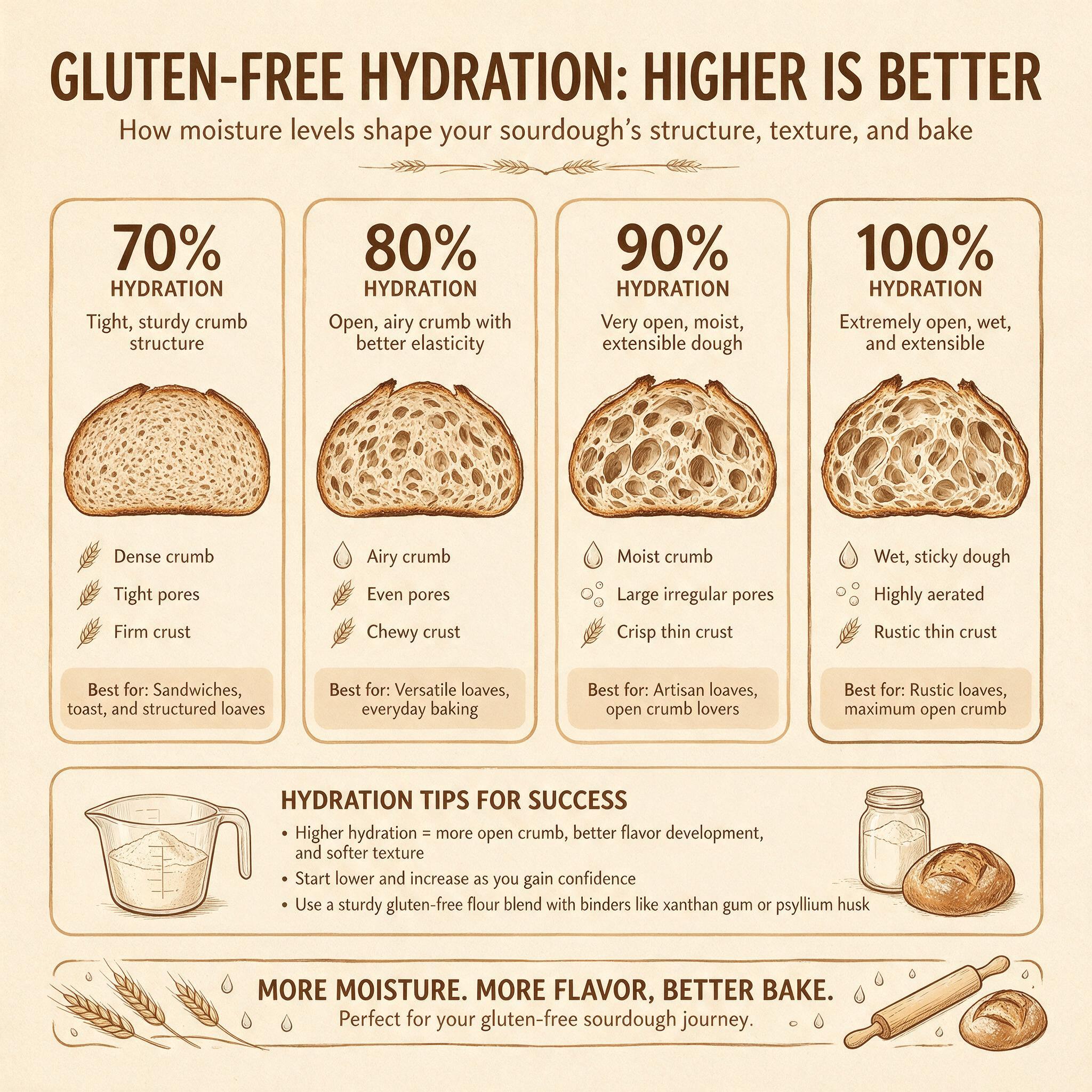
GF blends absorb water differently from wheat. Most GF flour blends feel "thirstier" than wheat flour — they need more water to reach the same dough consistency. Start your water at roughly 85–90% of flour weight and adjust from there:
- •Pourable batter (like thick pancake batter): 85–88% hydration — easier to work with, less rise
- •Thick, scoopable dough (like thick oatmeal): 90–95% hydration — more structure, better crumb
- •Firm dough (like wheat sourdough): 95–100%+ hydration — hardest to work with but best structure
For your first GF sourdough, start at 88–90% hydration and adjust based on results.
The Autolyse
Unlike wheat sourdough, an autolyse with GF flour is less about gluten development (since there's no gluten) and more about hydrating the psyllium and starches fully. Rest your flour + water + psyllium mixture for 30–60 minutes before adding starter and salt. This allows the psyllium to form its gel and the starches to absorb water fully — skipping this step leads to dry, uneven crumb.
Mixing and Proofing
- Mix: Combine flour, water, and psyllium. Autolyse 30–60 minutes.
- Add starter: Fold in active starter at peak. The batter should bubble visibly within 30–60 minutes.
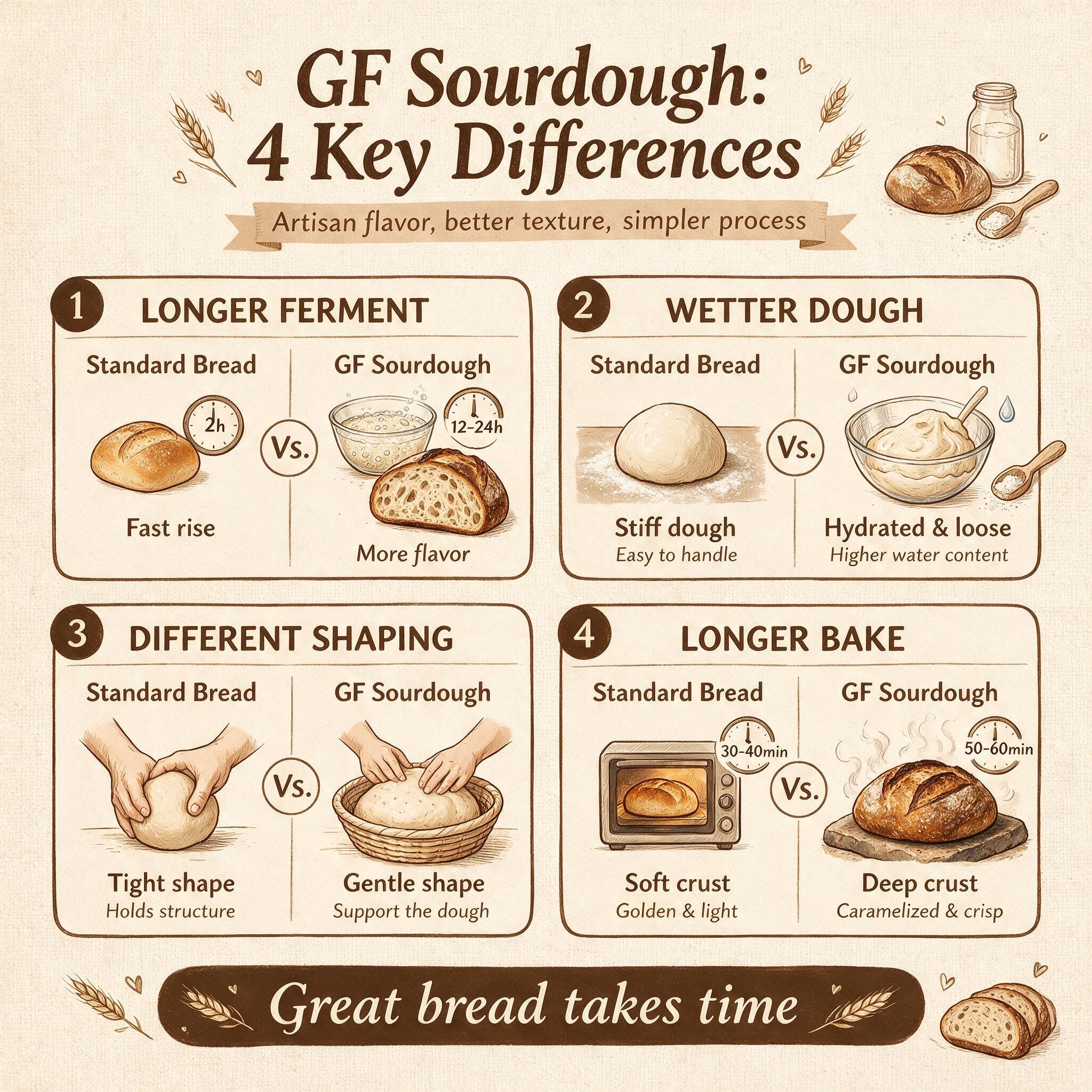
- Bulk ferment: Let rise at room temperature (76–78°F / 24–26°C is ideal). GF sourdough ferments faster than wheat — expect 2–4 hours for bulk, not 4–6.
- Shape: Pour into a loaf pan lined with parchment paper. Don't try to shape GF dough like wheat — it's a batter that goes into a pan.
- Final proof: 30–60 minutes at room temperature until batter looks domed and bubbly on top.
- Bake: 400°F / 205°C for 45–55 minutes until internal temperature reaches 200–205°F.
Troubleshooting: Common GF Sourdough Problems
| Problem | Cause | Fix |
|---|---|---|
| Dense, flat loaf | Under-fermented OR too-low hydration | Extend bulk; increase water by 5–10% |
| Crumbly, falling apart | Too little binder | Increase psyllium to 15–18g per 320g flour |
| Gummy, rubbery texture | Too much binder OR under-baked | Reduce psyllium; bake to 200°F internal |
| Sunken top after baking | Over-fermented OR too much water | Shorten bulk; reduce water by 5% |
| Gritty texture | Coarse rice flour OR coarse starch | Use fine-milled rice flour; sift starches |
| No sour tang | Insufficient fermentation OR starter not active enough | Extend bulk; use starter at peak; feed more frequently |
The Most Common Mistake: Slicing Too Early
GF sourdough must cool completely before slicing — at minimum two hours out of the oven, ideally four. The starches need time to set and gelatinize fully during cooling. Slicing a GF loaf while warm produces gummy, sticky crumb that falls apart. Wheat bread is forgiving; GF bread is not. Wait. Then wait some more.
Frequently Asked Questions
Can I use wheat sourdough starter for GF bread?
Technically yes, but it won't perform the same way. A wheat starter ferments wheat starches and proteins; a GF starter ferments rice, tapioca, and other GF starches. Using wheat starter on GF flour may produce less rise and different flavor than using a dedicated GF starter. For best results, maintain a separate GF starter fed with your GF flour blend.
Does GF sourdough have the same flavor as wheat sourdough?
It's tangy and complex, but different. The sourness comes from the same lactic and acetic acid bacteria, so the basic character is similar. But GF sourdough has a different base flavor — often slightly sweet or nutty from rice flour, with less of the wheat-forward complexity. Adding buckwheat or sorghum to your blend deepens the flavor profile significantly.
How do I store GF sourdough?
GF sourdough doesn't last as long as wheat sourdough — it stales faster because there's no gluten to retain moisture. Wrap tightly in plastic and store at room temperature for 2 days. Freeze for longer storage (slice before freezing for best results). GF bread also toasts beautifully from frozen — toast directly from frozen at medium-high heat.
Closing Thoughts
GF sourdough baking is harder than wheat sourdough baking — there's no getting around that. Without gluten, you're building structure from scratch using starches, binders, and careful fermentation management. But when it works, it's genuinely excellent bread: light, tangy, soft, and completely different from the gummy rice-bread abominations you find in most grocery stores.
My approach: start with the starch blend framework above, get your psyllium ratio right (12–18g per 320g flour), and learn how your specific blend absorbs water over two or three bakes. GF sourdough rewards patience and iteration — each loaf teaches you something about your blend's behavior that no recipe can anticipate.
The goal isn't to replicate wheat sourdough exactly. It's to make the best possible GF sourdough — bread that's worth eating because it's good, not because it's a close-enough approximation. That standard is achievable, and it's worth the effort.
Happy baking!