
Most sourdough bakers only know one type of levain — a wet, 100%-hydration mix of starter, flour, and water that they build the morning (or night before) baking. It's reliable, it works, and for most people, it produces perfectly good bread. But if you've ever wondered why some bakers talk about "stiff levains" or "double starters" like they're a secret weapon — there's a reason.
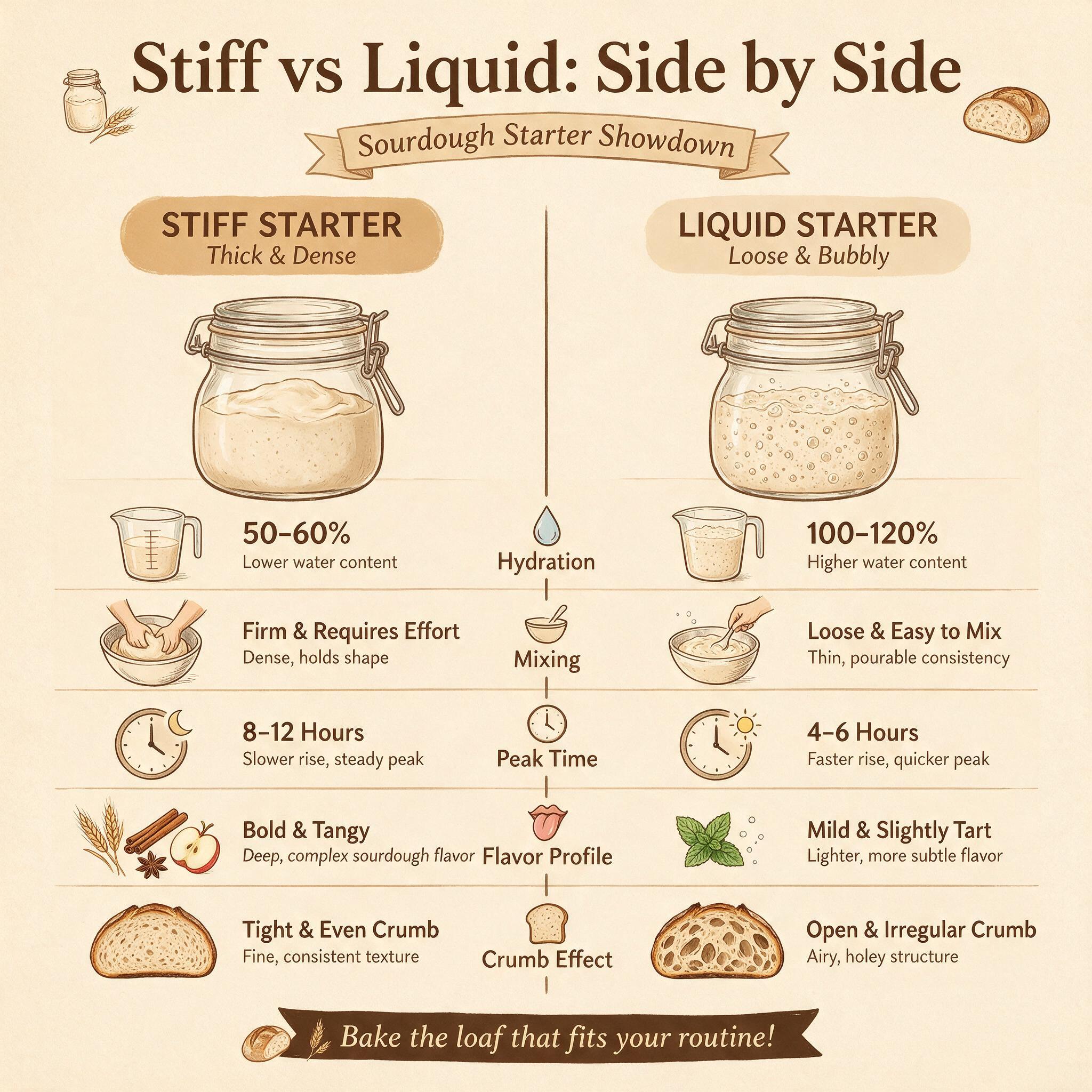
A stiff levain (30–50% hydration) behaves very differently from a liquid one. It ferments slower, develops more complex flavor, and produces a distinctly different acid profile. The tradition goes back centuries in Italian baking as lievito madre — a solid dough culture maintained alongside liquid starters. Understanding both gives you two distinct tools for shaping the character of your bread.
This handbook covers liquid levain (80–100% hydration — fast, acidic), stiff levain/double starter (30–50% hydration — slower, more complex flavor), how to maintain each, when to use which, and the lievito madre tradition from Italian baking.
What You'll Learn
By the end of this post, you'll understand:
- •The difference between liquid and stiff levains — not just in texture but in bacterial behavior
- •How hydration affects acid production (and therefore flavor)
- •Step-by-step building instructions for each type
- •When to use which levain based on the bread you want to make
- •How to maintain both types, including the Italian lievito madre tradition
Let's break down what makes these cultures different and how to put that knowledge to work.
Liquid Levain (80–100% Hydration): The Standard Approach
What It Is
A liquid levain is what most sourdough bakers use every day — a mix of active starter, flour, and water at 80–100% hydration. It's wet, bubbly, pourable (at 100%), and ferments relatively quickly. This is your baseline sourdough culture for everyday bread.
Bacterial Behavior
At high hydration, the environment is more anaerobic (less oxygen), which favors lactic acid-producing bacteria — the smooth, creamy acids that give mild sourdough its rounded character. Fermentation moves fast because water allows bacteria to move and feed freely. The result: quick rise, clean flavor, predictable timing.
Building a Liquid Levain
Timing: Build 4–6 hours before you plan to mix your dough (for room-temp levain) or the night before for an overnight build.
Ratio: Use ripe starter at 1:2:2 or 1:3:3 (starter:flour:water by weight). For example, 20g starter + 40g flour + 40g water at 100% hydration.
Process:
- Mix starter, flour, and water thoroughly until no dry bits remain
- Cover loosely and let sit at room temperature (75–78°F / 24–26°C)
- Wait for it to peak — doubled in volume, full of bubbles, pleasant sour aroma, loosened consistency
- Use immediately at peak activity
Key tip: The levain is ready when it has risen noticeably and scattered bubbles are visible throughout the surface. It should smell pleasantly sour, not aggressively acidic. If it smells vinegary or has hooch forming on top, it's past peak — you can still use it but expect more tang in your bread.
Stiff Levain (30–50% Hydration): The Complex Option
What It Is
A stiff levain is a dense, dough-like culture at much lower hydration than the typical wet starter. At 40% hydration, for example, you'd mix 1 part starter with 2 parts flour and less than 1 part water — it looks more like a firm ball of dough than a pourable culture.
Maurizio Leo uses stiff levains regularly, particularly for whole wheat breads, where the denser culture produces deeper flavor development without overwhelming tang. The lievito madre tradition from Italian baking takes this to an extreme — maintaining a solid dough culture at around 30–40% hydration that ferments over days rather than hours.
Bacterial Behavior
Lower hydration means more air pockets between flour particles, allowing oxygen penetration. Acetic acid bacteria gain advantage in these conditions, producing more vinegary compounds. The denser environment also slows bacterial metabolism, giving acetic-producing pathways more time to establish. Result: slower fermentation, more complex flavor profile with a sharper tang component alongside the lactic creaminess.
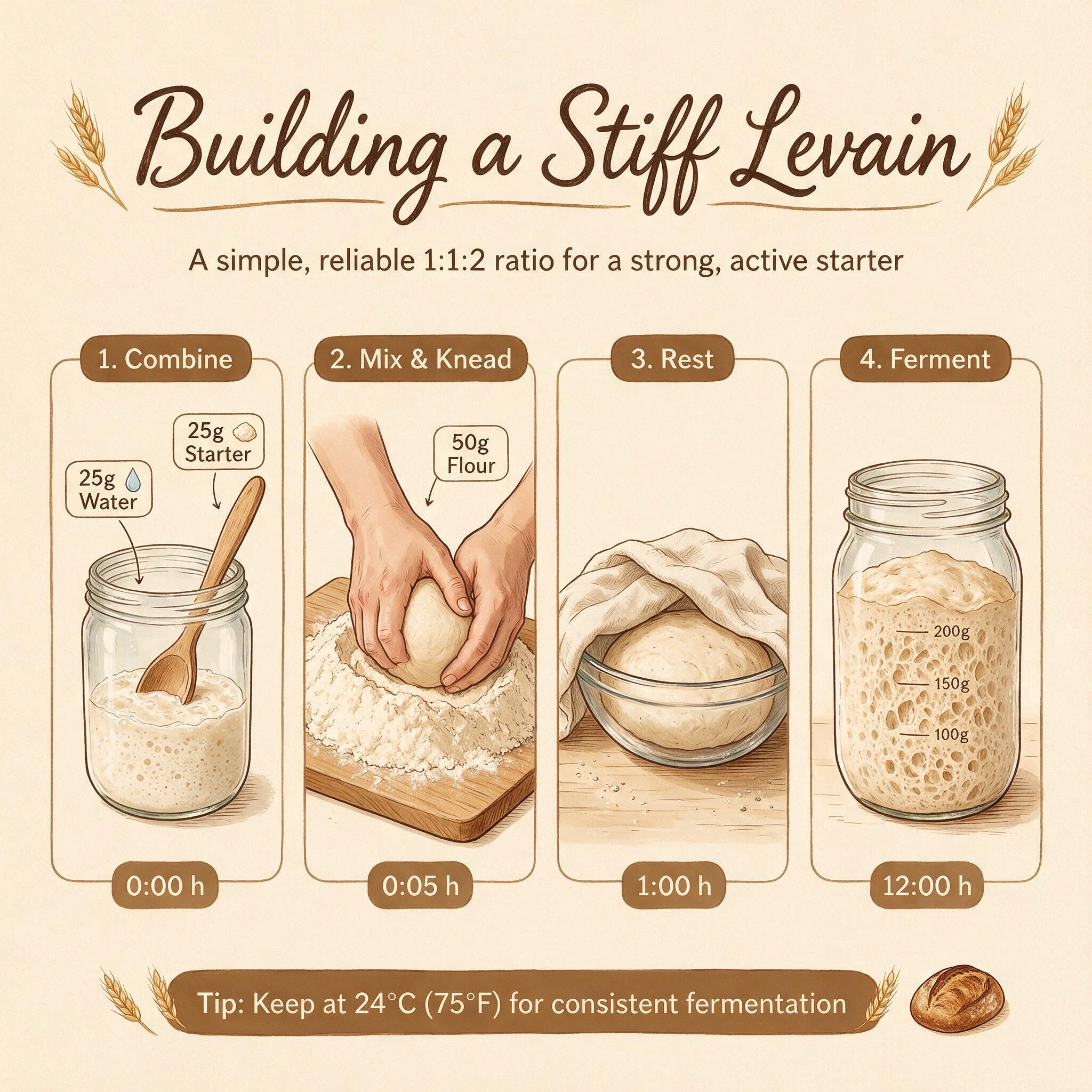
Building a Stiff Levain
Timing: Build 6–12 hours before mixing your dough (stiff levains take longer to peak than liquid ones).
Ratio: Use ripe starter at 1:3:1 or 1:4:1.5 (starter:flour:water by weight). For example, 20g starter + 60g flour + 20–30g water. Mix until a firm dough ball forms — it should hold its shape when pressed but be pliable enough to work with.
Process:
- Mix starter and flour thoroughly, then gradually add water while kneading
- Form into a smooth ball — it should feel like firm playdough, not dry or crumbly
- Cover tightly (oxygen exposure matters at low hydration) and let sit at room temperature
- Wait for visible activity — small bubbles forming within the dough mass, slight expansion, loosened surface
Key tip: Stiff levains don't double in volume the way liquid ones do. Instead, watch for internal bubbling (poke gently to check), slight increase in size, and a more complex aroma that combines sour with fruity or wine-like notes. This takes longer than liquid — expect 6–12 hours at room temperature rather than 4–6.
Liquid vs. Stiff: Side-by-Side Comparison
| Factor | Liquid Levain (100%) | Stiff Levain (35–40%) |
|---|---|---|
| Fermentation speed | Fast (4–6 hours to peak) | Slow (6–12+ hours to peak) |
| Acid profile | Lactic-dominant, milder tang | More acetic, sharper complexity |
| Flavor contribution | Clean sourdough character | Deeper, more complex flavor |
| Texture of culture | Pourable/bubbly | Firm dough ball |
| Best for | Everyday white breads | Whole wheat, high-hydration loaves, special occasion breads |
| Oven spring impact | Standard | Slightly less (denser starter adds weight) |
When to Use Which
Use liquid levain when:
- •Baking everyday white or mixed-grain loaves
- •You want predictable timing and reliable rise
- •Mild-to-moderate sourness is preferred
- •You're baking on a tight schedule
Use stiff levain when:
- •Baking whole wheat or high-percentage WW breads (Maurizio's go-to for 100% WW)
- •You want deeper, more complex flavor development
- •You have time to build overnight and don't need quick turnaround
- •You're making a special occasion loaf where flavor is the priority
The Lievito Madre Tradition: Italian Double Starter
The most extreme form of stiff levain is Italy's lievito madre — a solid dough culture maintained alongside liquid starter. This isn't just a building technique; it's an entire cultural tradition with centuries of history.
How It Works
A lievito madre is maintained as a firm dough ball at roughly 30–40% hydration. Instead of feeding flour and water to a liquid culture, bakers periodically knead small pieces of the solid starter with fresh flour and minimal water, forming new dough balls that continue fermenting over days or even weeks.
The process:
- Take a piece of existing lievito madre (typically 50–200g)
- Knead in fresh flour and just enough water to form a firm dough
- Shape into a ball, place in a sealed container, and let rest at cool room temperature or refrigerated
- Repeat every few days to weekly depending on usage
Why It's Different from Stiff Levain
A stiff levain is built fresh each time you bake — it's a one-time culture for a single loaf. A lievito madre is a permanent, long-lived culture that accumulates flavor over months and years of continuous maintenance. Experienced Italian bakers maintain madri that have been fed continuously for decades, sometimes generations.
The flavor complexity is extraordinary — deeply layered sourness with notes of fruit, wine, and earth that develop through repeated fermentation cycles. It's the sourdough equivalent of a well-seasoned cast iron pan or a mother-in-law vinegar.
Practical Tips for Home Bakers
- •Start small: maintain 100g of stiff starter in the fridge, fed weekly
- •Use it as a flavor booster — replace 10–20% of your liquid levain with lievito madre for added complexity
- •Don't expect bakery-level results on day one; the culture needs time to establish and stabilize
- •Store in a clean glass jar at refrigerator temperature, feeding every 7–10 days
Stiff Levain for Whole Wheat: A Special Case
Maurizio Leo's signature use of stiff levain is with 100% whole wheat bread. Here's why it works so well:
Whole wheat ferments faster than white flour — the bran and germ provide extra nutrients that feed starter aggressively. A liquid levain can over-ferment before you're ready to mix, leaving no buffer time. Stiff levain ferments more slowly, giving you a wider window of peak activity to work with.
Stiff levain adds complexity without overwhelming sourness. Whole wheat already has higher sour potential (more ash content = more bacterial food). A stiff levain deepens flavor while maintaining balance — the acetic acid from lower hydration complements the natural tang of whole grain without making it aggressively sour.
Building a stiff levain for WW bread:
- 20g ripe starter + 60g whole wheat flour + 24g water (40% hydration)
- Mix into firm dough, cover, rest at room temperature 8–10 hours
- Use when bubbles are visible within the dough and it has a complex, wine-like aroma
- Incorporate directly into your WW dough mix
Maintenance Routines for Each Type

Liquid Starter (Daily/Weekly Feeding)
For frequent bakers (3–5x per week): Keep at room temperature, feed 1:1:1 ratio every 12 hours. This keeps the culture in constant peak activity — ideal if you bake daily or near-daily.
For weekly bakers: Feed once daily at room temperature, then refrigerate after final feeding. Revive with two feedings (12 hours apart) before baking.
For infrequent bakers: Store in fridge, feed once a week. Remove 24–48 hours before baking and build levain as described above.
Stiff Starter / Lievito Madre
Weekly maintenance: Take your stiff starter ball out of the fridge, knead with fresh flour and minimal water (1:3:0.5 ratio), reform into a ball, return to fridge. This keeps it alive between bakes.
Between bakes: If you're not baking for several days, the stiff culture can sit in the fridge indefinitely — fed weekly or even every 10–14 days at cool temperatures. Unlike liquid starters that go flat and develop hooch, a well-maintained stiff starter stays active and pliable for weeks.
Long-term storage: A lievito madre ball can be dried (flour-dried on parchment) and stored in an airtight container for months. Rehydrate with water before reviving — it'll come back to life, though it may take 2–3 feedings to regain full vigor.
Troubleshooting: When Your Levain Doesn't Behave

Stiff Levain Isn't Bubbling After 10 Hours
Likely cause: Temperature too low or starter wasn't active enough when you built it. Stiff levains are more sensitive to starter activity than liquid ones because the dense environment slows bacterial movement.
Fix: Build with a more vigorous starter (one that has just doubled). Place in a warmer spot (78–80°F / 26–27°C) and give it another 4–6 hours. If still no bubbles after 14 hours, your starter may need rebuilding — feed daily for 3–5 days at 1:1:1 ratio before trying again.
Liquid Levain Peaked Too Early (Before You're Ready to Mix)
Likely cause: Kitchen is warmer than expected or you used too much ripe starter in the build. At high hydration, fermentation moves fast and the window of peak activity can be narrow — sometimes only 1–2 hours.
Fix: Use less ripe starter in your build (reduce ratio to 1:3:3 instead of 1:2:2). Or build earlier so peak coincides with your mixing time. If it peaks too early, you can refrigerate the levain for up to 4 hours — cold slows fermentation and extends the usable window.
Stiff Levain Dried Out in the Jar
Likely cause: Not covered tightly enough or stored at warm temperature without sufficient moisture retention. Low-hydration cultures lose surface moisture quickly if exposed to air.
Fix: Cover with plastic wrap pressed directly against the dough surface, then seal in an airtight container. If the top has dried into a crust, cut it off — the interior is likely fine. Knead in a few grams of water before feeding to rehydrate slightly.
Frequently Asked Questions
Can I substitute stiff levain for liquid levain in any recipe?
Yes, but expect timing adjustments. Stiff levain ferments slower and adds more acetic acid (sharper tang). You may need 1–2 extra hours of bulk fermentation to compensate for the slower build, and your bread will taste slightly tangier than with an equivalent liquid levain. Start by substituting 50% stiff for 50% liquid on a test loaf to see how it affects flavor in your kitchen.
Do I need both types of levain?
Not at all. Most bakers use only liquid levain and produce excellent bread. Stiff levain is an additional tool — useful when you want deeper flavor, are baking whole wheat, or have a slow schedule that benefits from extended peak activity. Think of it as adding another dimension to your sourdough toolkit rather than replacing what you already do.
Can I maintain a stiff starter long-term like lievito madre?
Yes. The process is straightforward: maintain 100–200g of firm dough (35–40% hydration) in the fridge, fed weekly with fresh flour and minimal water. Over months, it will develop complexity similar to a liquid culture maintained at room temperature — just slower, deeper, and more layered. Many bakers start this way simply because it's convenient: one jar in the fridge that needs feeding once a week instead of daily.
Does stiff levain affect oven spring?
Slightly less than liquid levain, because the denser starter adds weight without contributing as much gas production during bulk fermentation. The difference is usually marginal (maybe 5–10% less rise) but noticeable if you're comparing side by side. If maximum oven spring is your priority, stick with liquid levain. If flavor depth matters more, stiff levain is worth the small trade-off.
Closing Thoughts
Liquid and stiff levains aren't competing approaches — they're complementary tools for different goals. Liquid levain gives you speed, reliability, and clean sourdough character. Stiff levain gives you depth, complexity, and a wider peak window for slow-fermenting doughs like whole wheat.
My personal approach: I use liquid levain for everyday breads (white or mixed-grain loaves on weeknights) because it's fast and predictable. When I want something special — a 100% WW loaf on the weekend, or a bread where flavor is the main event — I build a stiff levain overnight and let it do its slow work. Having both in my toolkit means I'm never limited by time or flavor profile.
You don't need to master both at once. Start with liquid levain (you're probably already using it). Bake 10–20 loaves at that level until shaping feels automatic. Then try building a stiff levain for your next whole wheat bake — just one experiment, no commitment required. You'll taste the difference immediately.
Happy baking!