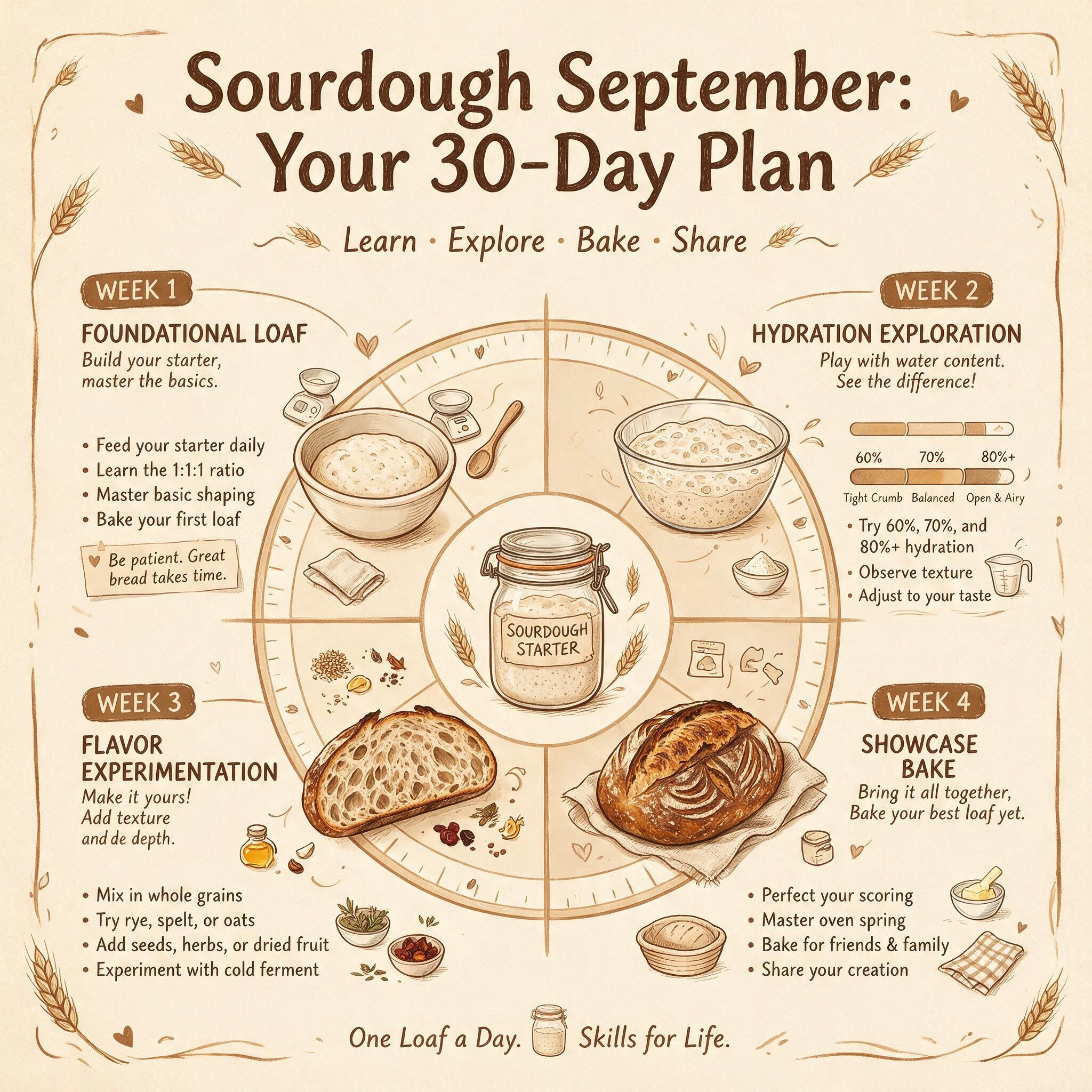
Published July 7 — eight weeks before the September 1 kickoff. This is your prep plan. The campaign runs September 1–30, but the bakers who get the most out of it start feeding their starters, choosing their flour, and dialing in their recipes in August. That's what this post is for.
Sourdough September is an annual, month-long campaign coordinated by the Real Bread Campaign (part of the charity Sustain) and supported by bakers, mills, and home ovens in dozens of countries. It runs the entire month of September and exists to celebrate naturally leavened bread and the people who bake it.
The campaign has three quiet goals that align perfectly with what The Crumb Lab is about:
- •Revive traditional bread-making. Sourdough is the original leavening. Before commercial yeast existed, every loaf was a sourdough loaf. The campaign reminds us that the technique isn't a trend — it's the default.
- •Promote natural, simple ingredients. Flour, water, salt, time. No dough conditioners, no enzymes, no shortcuts. Just four ingredients doing what they've done for thousands of years.
- •Support small, independent bakeries. The Real Bread Campaign maintains a free Real Bread Map so people can find bakeries in their area that bake with natural leavening. If you have one nearby, September is the month to visit, support, and learn.
You don't need to register or sign up to participate. The campaign is a permission slip: spend the month baking. That's it. We've made it easy by giving you a 30-day plan.
The 30-Day Plan at a Glance
The plan is structured as four weeks, one focus per week, plus a kickoff and a finale:
| Week | Focus | Bakes | Goal |
|---|---|---|---|
| 0 (Sep 1) | Starter checkup | 1 discard bake | Get your starter peak-ready |
| 1 | Foundational loaf | 1 boule | Nail a single, repeatable recipe |
| 2 | Hydration | 2 loaves (65%, 78%) | Understand water by feel |
| 3 | Flavor | 1 flavored loaf + 1 enriched dough | Move beyond plain white |
| 4 (Sep 28–30) | The showcase bake | 1 statement loaf | Apply everything |
Total: 5 loaves, plus 2 discard bakes and 1 enriched dough. Seven bakes across thirty days. That's about two bakes a week — sustainable for a working baker.
We'll publish a deep-dive post for each of these weeks throughout August, so by September 1 you have the full playbook. Bookmark this page.
Week 0 — Starter Checkup (September 1)
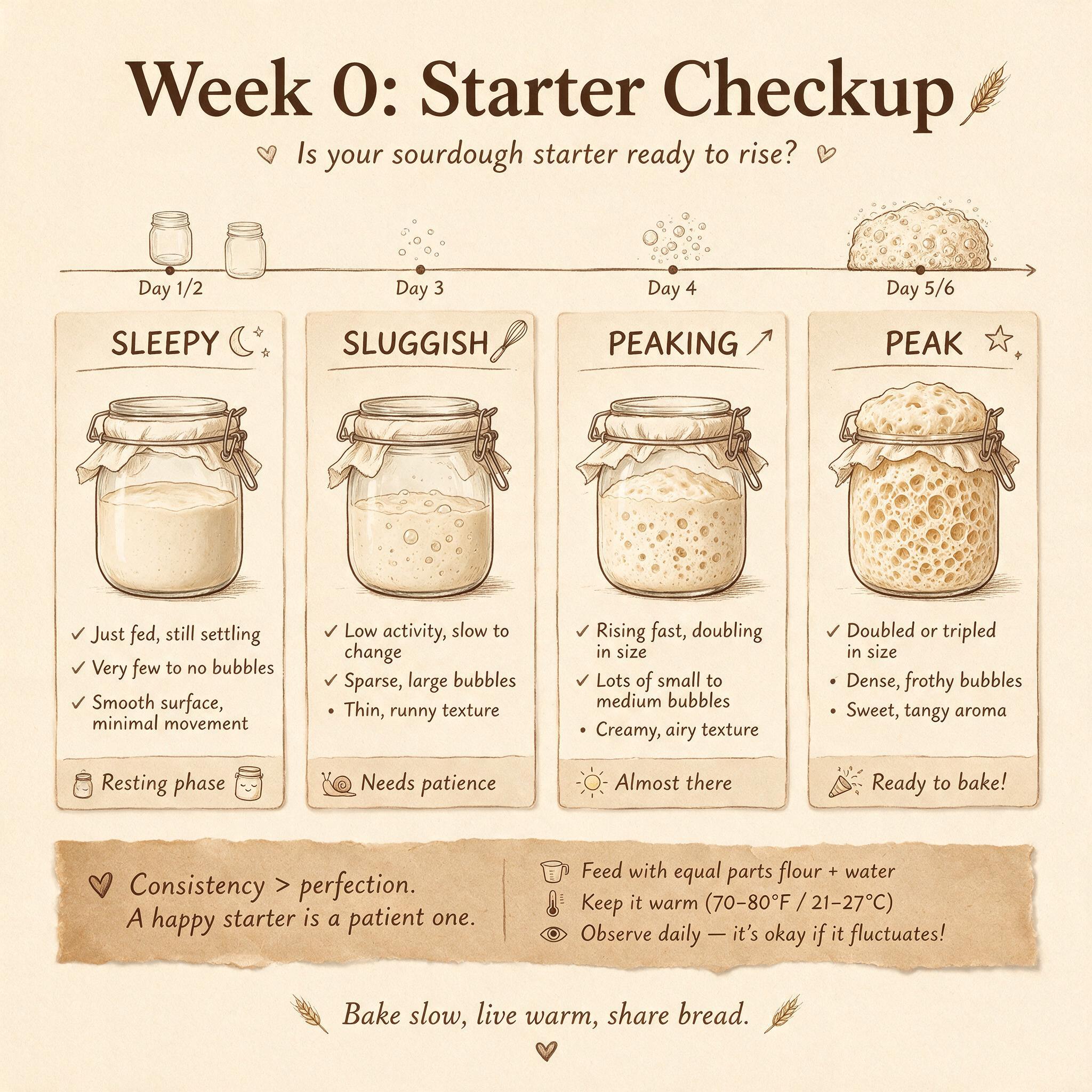
If your starter has been languishing in the back of the fridge since spring, this is the week to wake it up. The good news: a neglected starter is not a dead starter. It just needs a few feedings to come back to life.
The 7-Day Wake-Up Routine
| Day | Feeding Ratio | Notes |
|---|---|---|
| Sep 1 | 1:5:5 (1 part starter, 5 parts flour, 5 parts water) | First feed. Expect a long lag. |
| Sep 2 | 1:5:5 | Should see some bubbles by evening. |
| Sep 3 | 1:4:4 | Starter is now active. Smell should be yogurty, not acetone. |
| Sep 4 | 1:3:3 | Discard half before feeding. |
| Sep 5 | 1:2:2 | Now you're building strength. |
| Sep 6 | 1:1:1 | Tight ratio for max activity. |
| Sep 7 | 1:1:1 | Starter should double in 4–6 hours. Ready to bake. |
If your starter is already active and you bake weekly, skip the wake-up. Just do a 1:1:1 feeding the night before your first bake.
The Discard Bake (Sep 1)
You'll generate about 200g of discard over the wake-up week. Don't throw it away — bake these Sourdough Discard Crackers on day 1:
- •200g discard
- •50g olive oil
- •30g everything bagel seasoning
- •Pinch of salt
- •Roll thin between two sheets of parchment. Bake at 375°F (190°C) for 15 minutes, until golden and snapping.
That's your reward for showing up.
Week 1 — The Foundational Loaf (Sep 7–13)
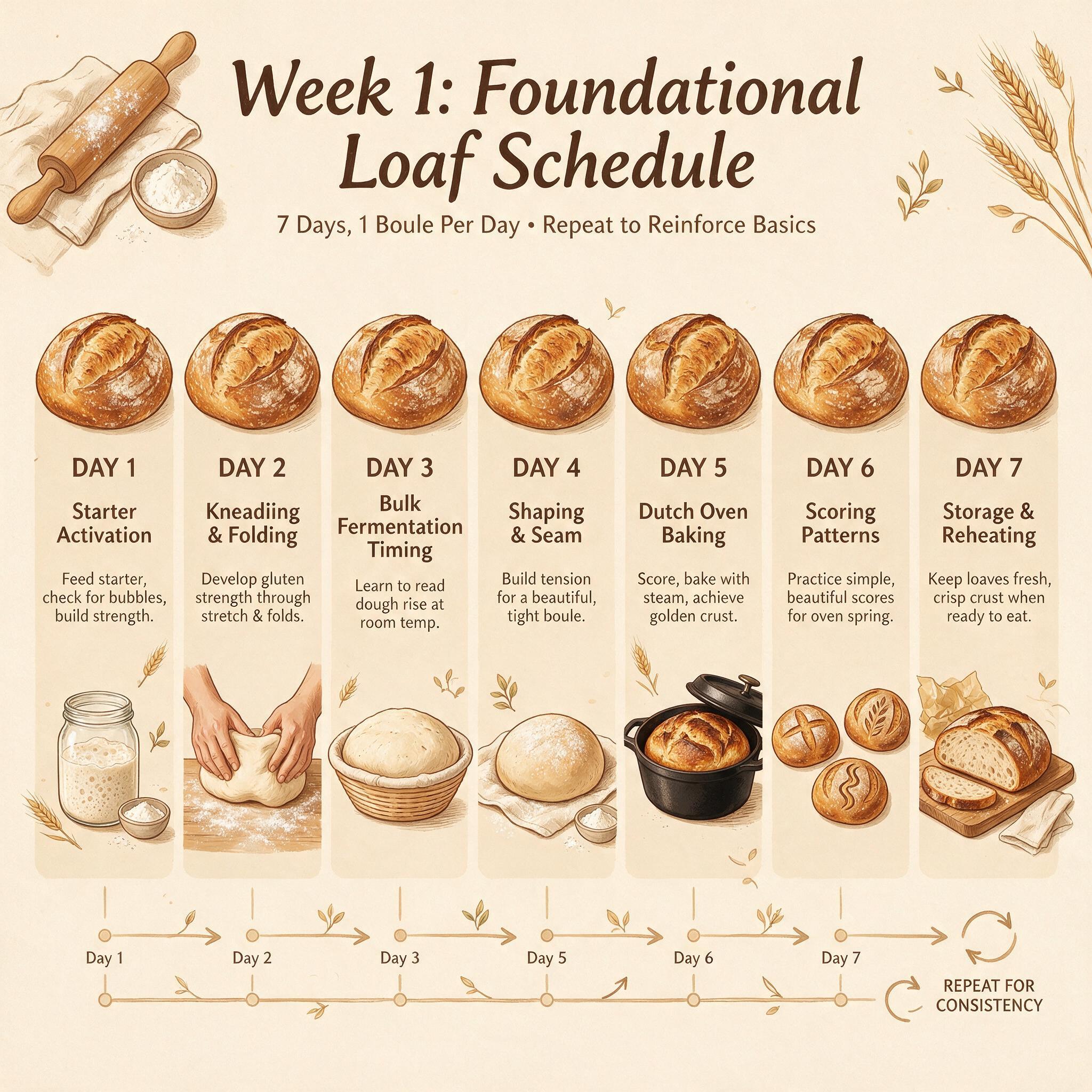
Pick one recipe. Bake it. Then bake it again. The whole point of week one is repetition. You're not chasing perfection — you're building a recipe you can do in your sleep.
The Recipe: 70% Hydration Country Loaf
- •400g bread flour
- •50g whole wheat flour
- •315g water (70% hydration)
- •100g active starter
- •9g salt
Method (one sentence each): Autolyse 30 min. Mix in starter and salt. Bulk ferment 4–5 hours at 75°F with 4 sets of stretch-and-folds. Pre-shape, rest 20 min, final shape into a banneton. Cold proof 12–16 hours. Bake at 500°F in a Dutch oven, 20 min covered + 20 min uncovered.
Bake it on Sep 7. Bake it again on Sep 10 or 11. By the second bake, you'll know what the dough is supposed to feel like at every stage. That muscle memory is the foundation of every loaf that comes after.
Week 2 — Hydration Exploration (Sep 14–20)
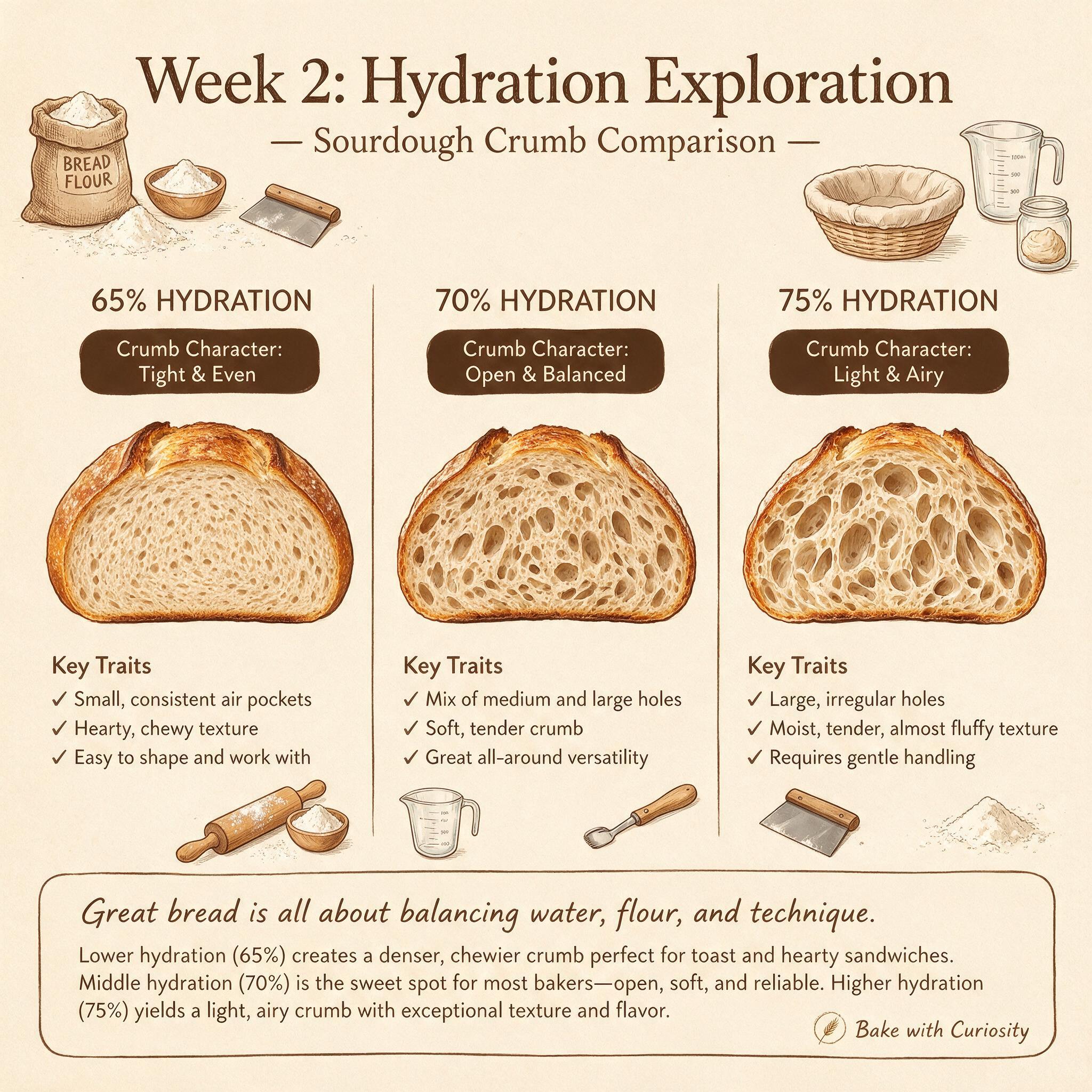
Now that you have a baseline, the only variable we're going to change is water. Same flour, same starter, same timing — just two different hydration levels, side by side.
The Comparison: 65% vs 78%
| Bake | Hydration | What You'll Learn |
|---|---|---|
| Sep 14 | 65% (293g water) | A tighter, easier-to-shape dough. Open crumb at the cost of less oven spring. |
| Sep 17 | 78% (351g water) | A slack, glossy dough. Harder to handle. Bigger holes, thinner walls. |
Bake them within three days of each other. Slice both at the same age. The side-by-side crumb comparison is the most direct lesson hydration has to offer. You'll see the difference in the bowl, on the counter, and most clearly in the slice.
Pro tip: The 78% loaf will feel like it's fighting you. That's normal. Wet dough wants to flow. Your job is to give it just enough structure with shaping to hold a form during baking. Lamination (folding the dough over itself in a clear, oiled square pan) before bulk fermentation is your friend for high-hydration doughs.
Week 3 — Flavor (Sep 21–27)
By week three, you have a dough that behaves predictably. Now we're going to put stuff in it.
Bake #1: A Herb and Cheese Loaf (Sep 21)
- •400g bread flour
- •300g water (75% hydration)
- •100g active starter
- •9g salt
- •80g grated sharp cheddar
- •15g fresh rosemary, chopped
- •10g fresh thyme leaves
- •Black pepper to taste
Add the cheese and herbs during the second set of stretch-and-folds, when the dough has built enough structure to hold the mix-ins. Cold proof and bake as usual. Slice thin — the cheese sets up as it cools.
Bake #2: Enriched Brioche-Style Sourdough (Sep 24)
This is the one that teaches you enrichment. The dough is softer, slower, and richer:
- •300g bread flour
- •100g whole wheat flour
- •200g whole milk (cold)
- •80g water
- •60g sugar
- •60g softened butter
- •2 eggs
- •100g active starter
- •8g salt
Longer autolyse (60 min) to soften the bran. Add butter and eggs after the starter has built initial structure. Bulk ferment 6–8 hours — enriched doughs are slower. Shape into a loaf pan, cold proof overnight, bake at 375°F for 35–40 minutes. The crumb is yellow, tender, and rich. This is what "sourdough can be a sandwich bread" looks like.
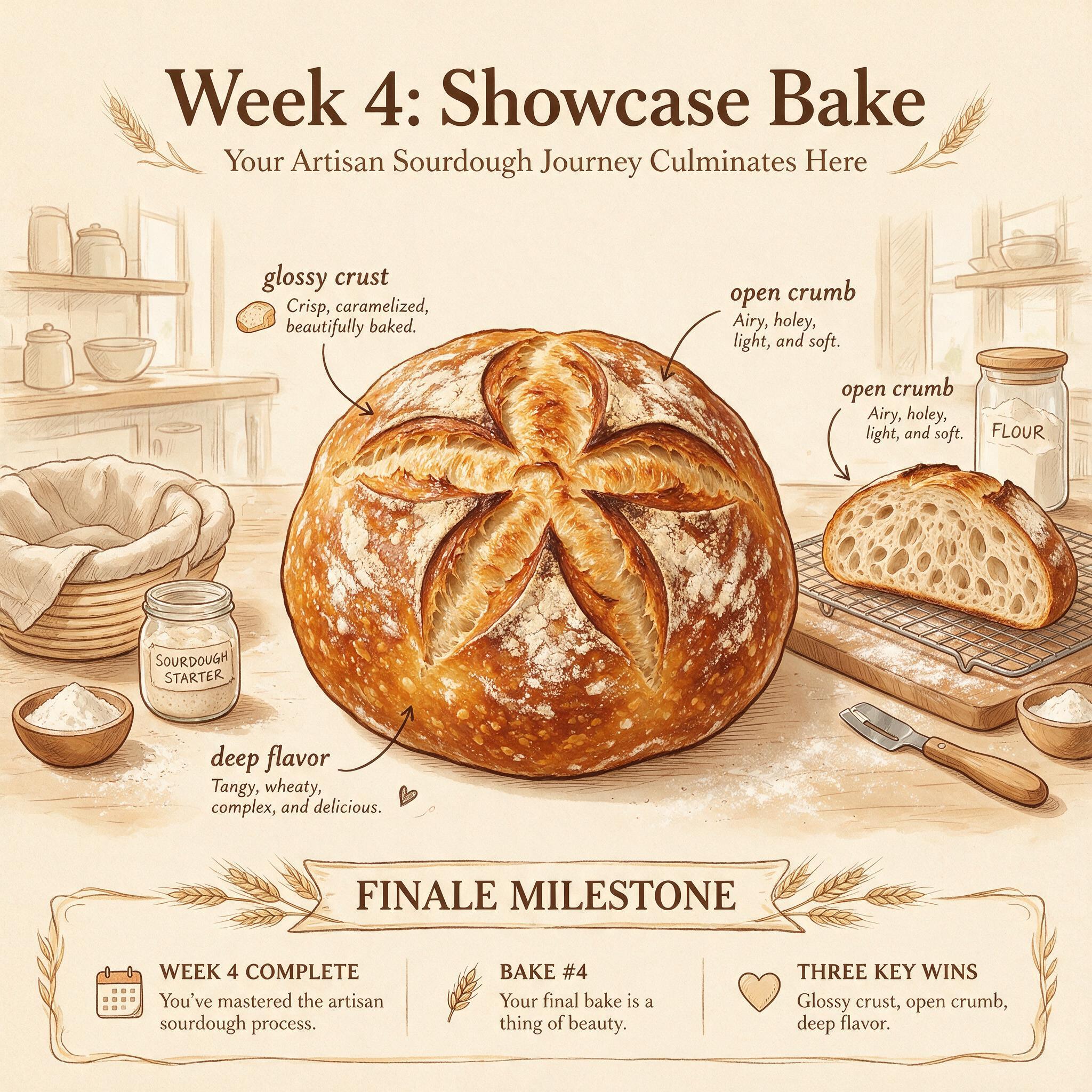
Week 4 — The Showcase Bake (Sep 28–30)
The campaign ends on September 30. Save your best bake for last.
The 80% Hydration, Long-Fermented Boule
- •450g bread flour
- •50g rye flour
- •400g water (80% hydration)
- •100g active starter
- •10g salt
- •5g diastatic malt powder (optional, for crust color)
Method: Cold autolyse overnight in the fridge (12 hours). Mix in starter, then salt after 30 minutes. Bulk ferment 6 hours at 72°F with lamination at the 45-minute mark and one coil fold every hour after. Pre-shape, bench rest 25 min, final shape into a heavily rice-floured banneton. Cold proof 24 hours. Bake straight from the fridge at 500°F, 25 min covered + 25 min uncovered.
Why this loaf: The long cold autolyse, the 24-hour cold proof, and the 80% hydration are three advanced techniques that don't always play nicely together. After thirty days of practice, you'll have the timing intuition to make them work. This is the loaf that should sit on the counter, cool completely, get photographed, and become your new signature.
Share it. Tag it. Sourdough September is a community thing, and a beautiful loaf deserves to be seen.
Community Rituals for the Month
Sourdough September isn't just about baking. It's about connecting with other bakers. Here are two small rituals we recommend:
The First-Bake Photo
On September 7, after your first foundational loaf comes out of the oven, take a photo. Post it. Tag #SourdoughSeptember and #TheCrumbLab. The hashtag is the campaign's main social thread — your photo joins thousands of others from bakers around the world. We will be re-sharing our favorites throughout the month.
The Real Bread Map Visit
The Real Bread Campaign maintains a free map of bakeries that bake with natural leavening. Find your nearest entry, visit once during September, and buy a loaf. Then come home and try to reverse-engineer it. What flour did they use? How dark is the crust? What's the crumb like? Comparison is the fastest way to learn.
Frequently Asked
Do I have to register for Sourdough September?
No. The campaign is open and free. The Real Bread Campaign welcomes everyone from first-time bakers to professional millers. The hashtag is your ticket in.
I'm a complete beginner. Is this plan too advanced?
No. The plan starts in week 0 with starter checkup and ends in week 4 with a recipe that requires everything you've learned. If you only complete weeks 0 and 1, you will have baked a loaf and developed a starter. That alone is a successful Sourdough September.
What if I can't bake every week?
That's fine. The plan is a menu, not a syllabus. Pick the bakes that interest you most. Skip the ones that don't. The campaign is about the spirit, not the schedule. Three bakes in September is more than zero.
Can I substitute all-purpose flour for bread flour?
You can, but the result will be different. Bread flour has more protein, which builds a stronger gluten network. If you only have all-purpose, use it — your crumb will be slightly more delicate and your oven spring a bit lower. It's a fine bread either way.
What if my starter is brand new?
If your starter is less than two weeks old, hold off on the plan. Let it mature through September. Read our Sourdough Starter Maintenance guide for a 14-day starter-ripening schedule, and start this plan in October. The plan will be here when you're ready.
The Crumb Lab's Pledge
We're going to publish a deep-dive post for each of the four weeks throughout August, so by September 1 you have the full playbook. Bookmark this page — we'll link the weekly posts here as they go live.
We're also going to bake all seven loaves ourselves, document the journey, and share the crumb-by-crumb results. If you bake along, tag us. We want to see your September 7 boule when it comes out of the oven, your September 14 hydration comparison sliced side by side, and your September 30 showcase photographed and tagged.
Eight weeks from today, the campaign starts. If you bake along from now, you'll arrive at September 1 with a starter at peak, a foundational recipe dialed in, and the muscle memory to actually enjoy the month instead of scrambling through it.
Welcome to the prep. See you in September.
Sources & Further Reading
This post is mostly a plan, not a research piece — but it does make a few claims about origins, technique, and what's "well-attributed in the field." Here's what's behind them:
On Sourdough September itself:
- •The Real Bread Campaign, run by the charity Sustain (UK), launched Sourdough September in 2013 — Sustain announcement, August 2013
- •Chris Young has coordinated the Real Bread Campaign since March 2009 and is the originator of Sourdough September — Sustain profile
On the four weekly bakes:
- •Week 1 (the 70% hydration country loaf): the deep-dive companion post at
/2026-07-07-the-70-hydration-country-loaf-week-1-of-sourdough-september.htmlcarries the full citations for the hydration science and the DDT framework - •Weeks 2–4: hydration, flavor/enrichment, and long-fermented showcase techniques are well-attributed in the home-baking literature (Sourdough Journey, King Arthur, The Perfect Loaf, local bakery practice) but each specific recipe value here is the author's working recipe, not a primary-sourced rule
Where attribution is widely-attributed but not primary-sourced: the "Q15 rule" of fermentation rate (every 15°F doubles yeast activity); the 2% salt-by-flour convention; the 12–16 hour cold-proof window. These are flagged honestly so you can treat them as a working baseline, not a law.