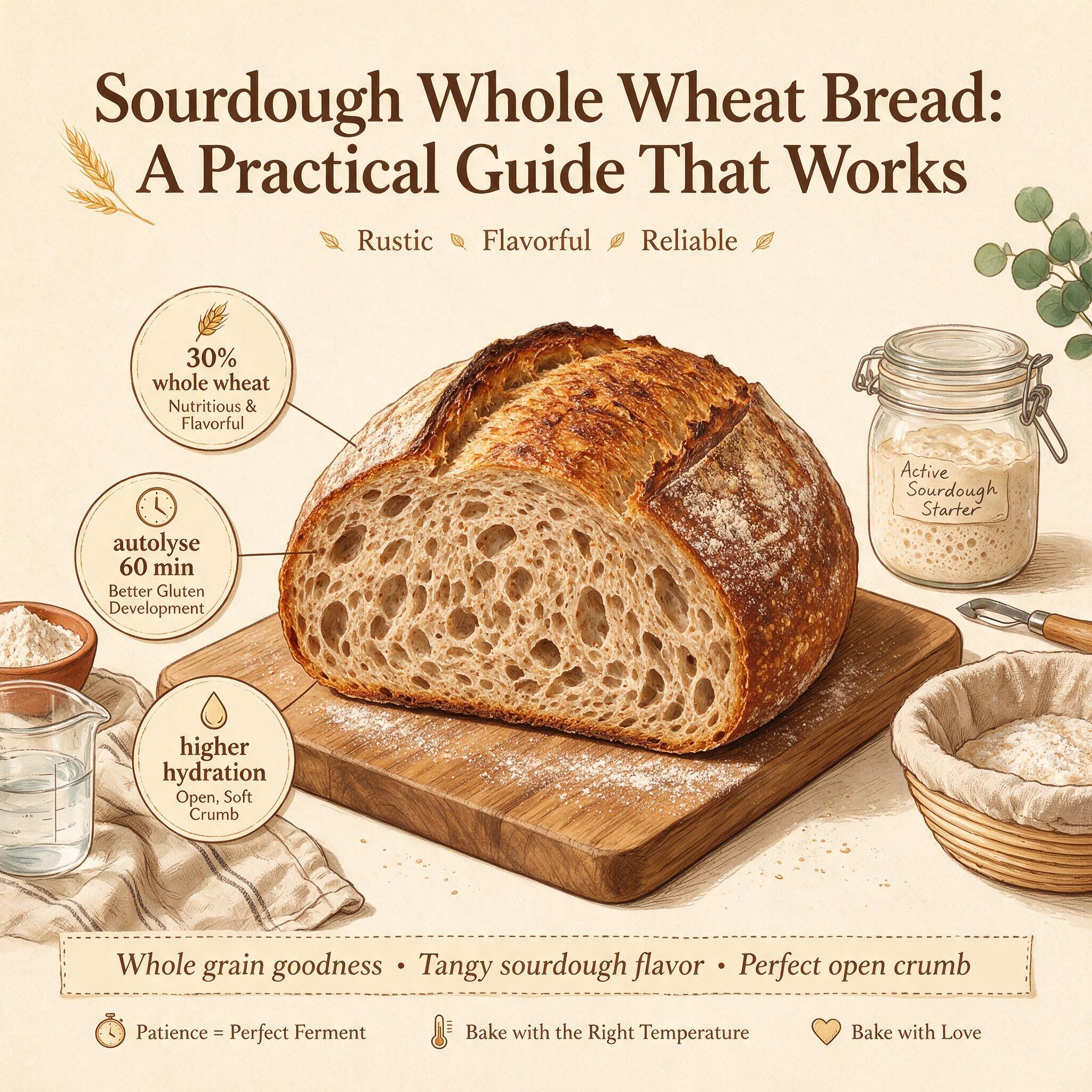
Whole wheat sourdough is notoriously difficult. You've probably tried it — followed a white flour recipe, swapped in whole wheat, and ended up with a dense, flat loaf that barely rose. You blamed yourself. You thought maybe you under-proofed or didn't fold enough. But the problem wasn't your technique. It was that whole wheat flour behaves fundamentally differently from white flour, and substituting one for the other without adjusting anything else is a recipe for frustration.
Whole wheat isn't just white flour with the bran and germ left in. Bran particles physically cut gluten strands like tiny knives. Pentosans absorb water slowly and competitively, changing how dough feels over time. The germ adds oils that can go rancid and enzymes that accelerate fermentation. The protein content looks higher on paper but is less functional because the bran disrupts gluten formation. A recipe that works perfectly with white flour will fail with whole wheat — and that's not your fault.
This guide covers why whole wheat is harder, how to pick the right flour, the hydration adjustments you actually need, and the techniques that make lighter WW loaves without sacrificing nutrition.
What You'll Learn
By the end of this post, you'll understand:
- •Why whole wheat is harder than white flour (the science behind the struggle)
- •How to pick the right whole grain flour for your goals
- •The hydration adjustment rule that actually works
- •Techniques for lighter WW loaves: autolyse, sifting, and scalding
- •A progressive approach from 25% to 100% whole wheat
Let's build whole wheat loaves that actually rise.
Why Whole Wheat Is Harder Than White Flour
Bran Cuts Gluten Strands
This is the primary structural problem. Bran particles are sharp, fibrous fragments of the wheat kernel's outer layer. As you mix, fold, and shape whole wheat dough, these particles physically cut through the gluten network that would otherwise trap gas and hold structure. The result: weaker dough that tears more easily and can't support the same oven spring as white flour equivalents.
A study in Frontiers in Nutrition confirmed that wheat bran dietary fiber reduces antiparallel β-sheet structures in gluten from 28.57% to 24.53% — a measurable degradation of the protein networks that give bread its structure.
Pentosans Absorb Water Slowly and Competitively
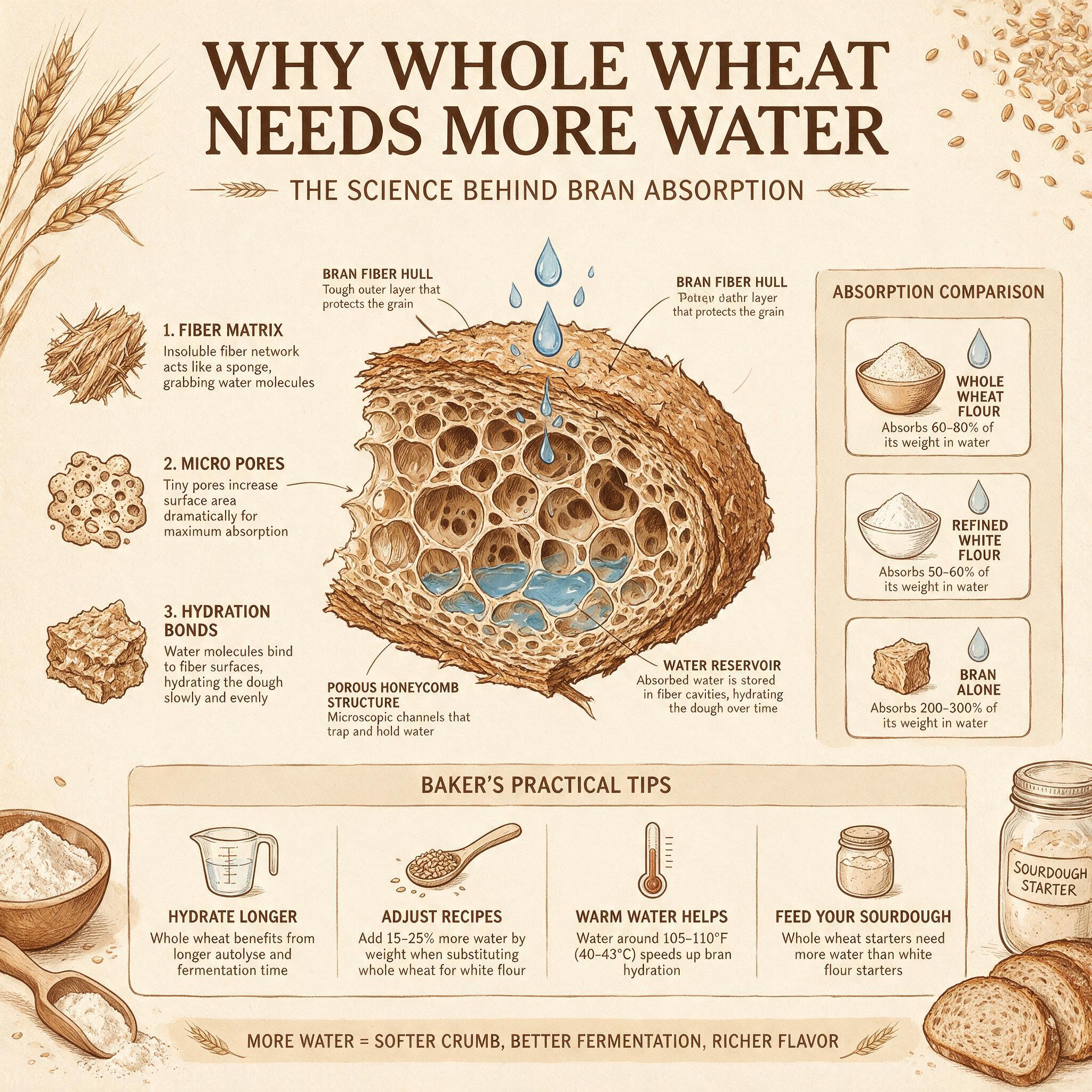
Whole wheat flour contains more arabinoxylans (pentosans) — complex carbohydrates that absorb water and form gels. This is useful for texture and moisture retention, but it means whole wheat dough doesn't feel "done" at mix time. Water absorption continues during fermentation as pentosans hydrate fully, which is why a dough that feels right at hour one may be overly slack by hour four.
A Cereal Chemistry study confirmed that water-extractable arabinoxylans increase dramatically during sourdough fermentation — from roughly 4.5 mg/g to nearly 8 mg/g after several hours. This ongoing water-binding activity explains why whole grain doughs feel progressively looser during bulk.
Higher Protein ≠ Stronger Gluten
Whole wheat flour appears higher in protein on nutrition labels (13–14% vs. 11–13% for bread flour), but this is misleading. The bran and germ dilute the functional gluten-forming proteins. More protein in the grain doesn't mean more functional gluten in your dough — it means more total protein of which only a portion contributes to gluten structure.
As Maurizio Leo puts it: "Whole-grain flour is 'high-protein' because it's the entire grain, not because it's strong white flour." The bran disrupts whatever gluten does form, making the net structural result weaker, not stronger.
The Germ: Enzymes and Oxidation
The germ is rich in enzymes (especially lipase and peroxidase) that accelerate fermentation and can affect dough behavior unpredictably. It also contains oils that can go rancid — the reason whole wheat flour has a much shorter shelf life than white flour. Freshly milled whole wheat develops off-flavors faster than white flour because the germ's oils oxidize quickly.
How to Pick the Right Whole Grain Flour
Hard Red Winter vs. Hard White Wheat
Hard red winter wheat has higher protein content and a more assertive flavor — slightly bitter notes from tannins, nuttiness, and depth. This is the standard whole wheat flour from most grocery stores (including King Arthur and Bob's Red Mill).
Hard white wheat has slightly lower protein and a milder, sweeter flavor with less bitterness. It's easier to work with because it doesn't have the tannin edge of red wheat. This is my recommendation for beginners trying whole wheat sourdough for the first time.
Finer Milling = Better Behavior
The particle size of your flour matters. Very coarse bran cuts more gluten strands; finer milling produces less structural disruption. If you're milling your own flour, a finer grind produces more manageable dough. If buying commercial flour, look for "fine whole wheat" or "pastry whole wheat" if you want easier handling — standard whole wheat is coarser and more challenging.
Freshness Matters More Than White Flour
Whole wheat flour goes rancid faster due to germ oils. Check the milling or expiration date before buying. Store whole wheat flour in the freezer to extend shelf life — it stays fresh for months frozen. I buy in bulk, keep wheat berries in the freezer, and mill fresh for each bake.
The Hydration Adjustment: The 3% Rule
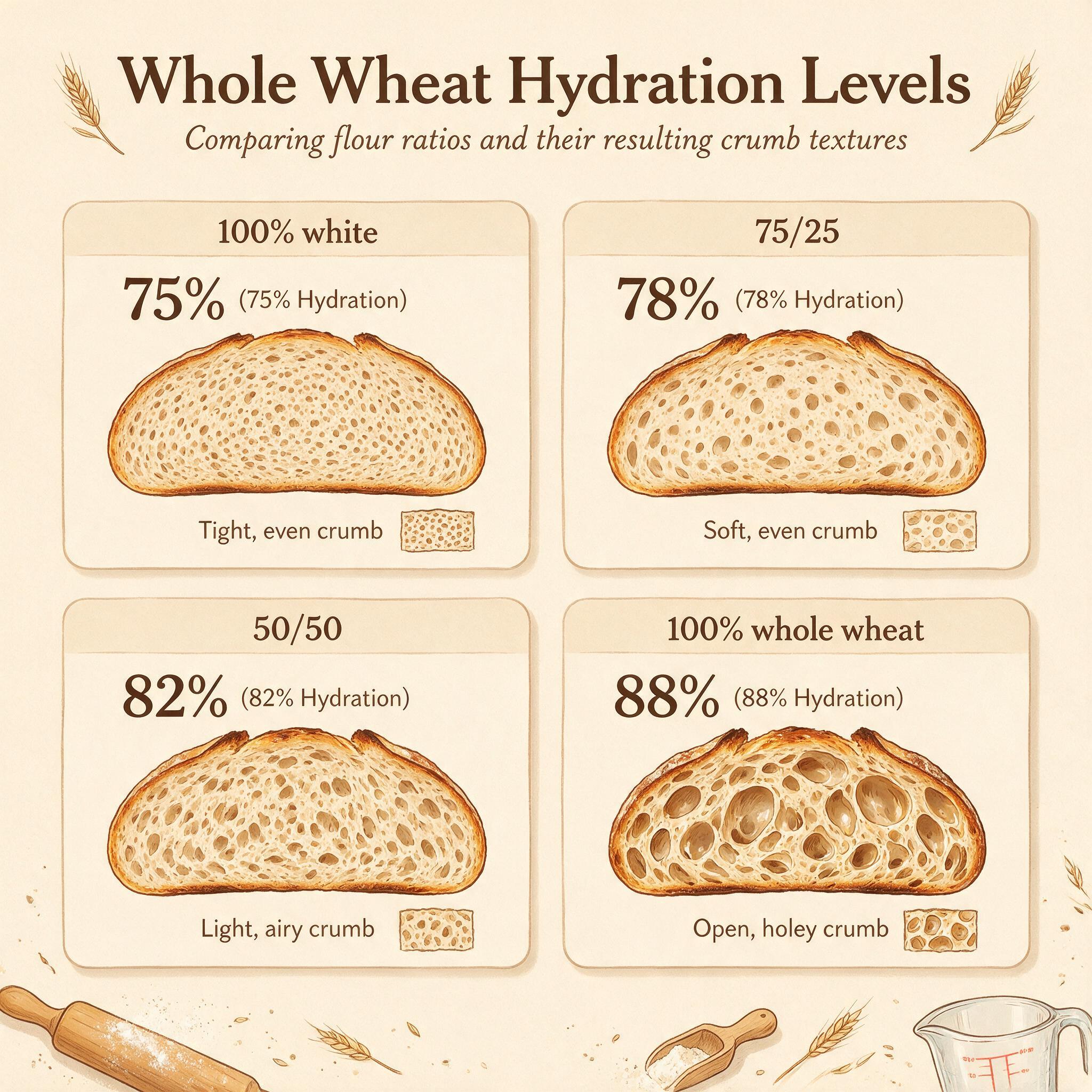
Here's the most important practical adjustment: for every 10% whole wheat added, increase hydration by approximately 3%.
This isn't exact — every flour behaves differently, and your specific flour may need more or less. But the 3% per 10% rule is a solid starting point.
| Whole Wheat % | Base Hydration | Adjust To |
|---|---|---|
| 10% | 75% | 78% |
| 20% | 75% | 81% |
| 25% | 75% | 82–83% |
| 50% | 75% | 85–90% |
| 75% | 75% | 88–92% |
| 100% | 75% | 85–90% |
Note: 100% WW tops out around 85–90% hydration because the gluten structure can't hold more water. Above 90%, even well-developed WW dough becomes unshapable.
Judge Dough at Hour One, Not at Mix Time
The number one mistake beginners make with whole wheat: judging dough feel at mix time. Bran absorbs water slowly — a dough that feels stiff at mix time will be perfectly workable after 60 minutes. Wait at least one hour before adjusting hydration. If it's still stiff after an hour, add water gradually until it feels right.
Techniques for Lighter Whole Wheat Loaves
Extended Autolyse (Non-Negotiable for High WW)
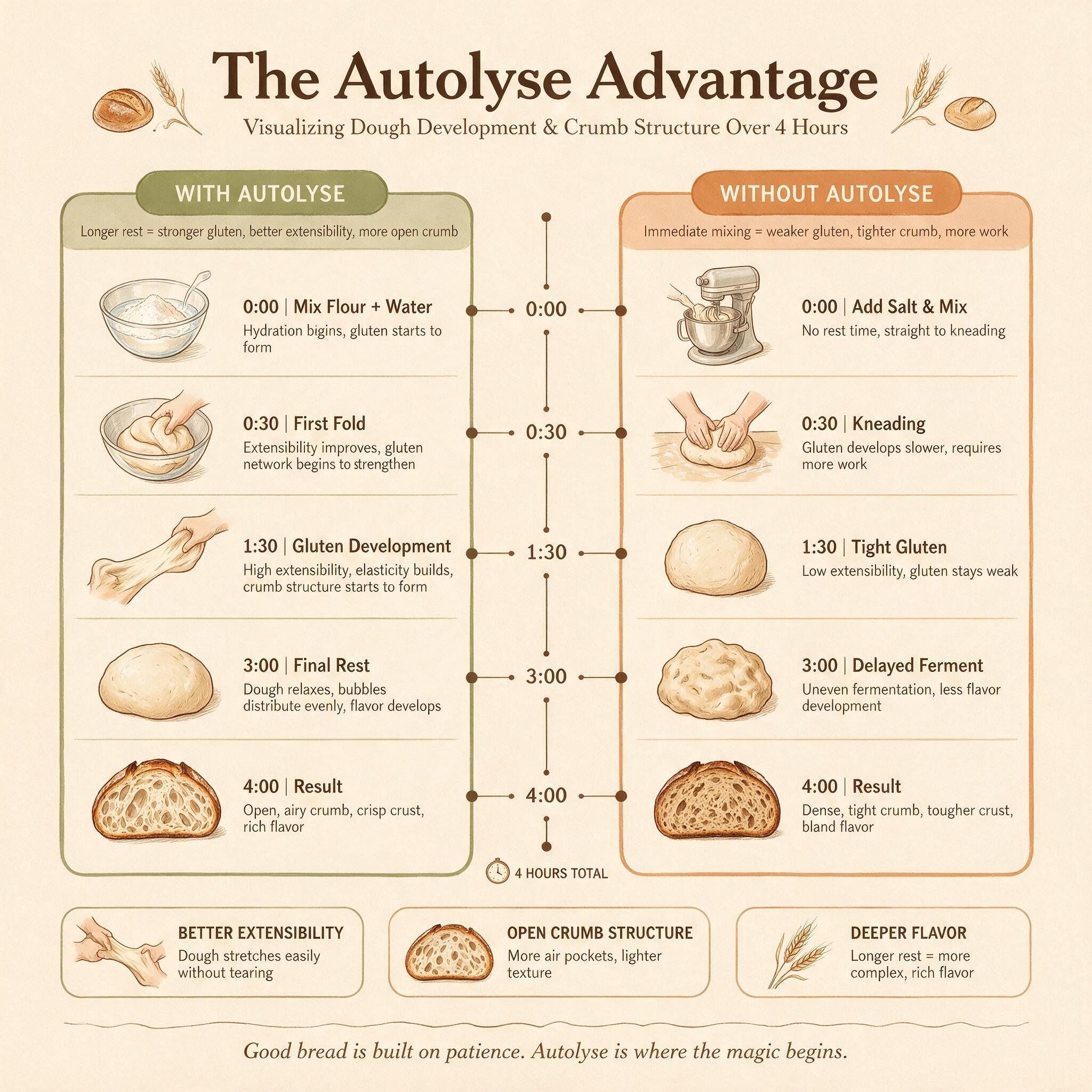
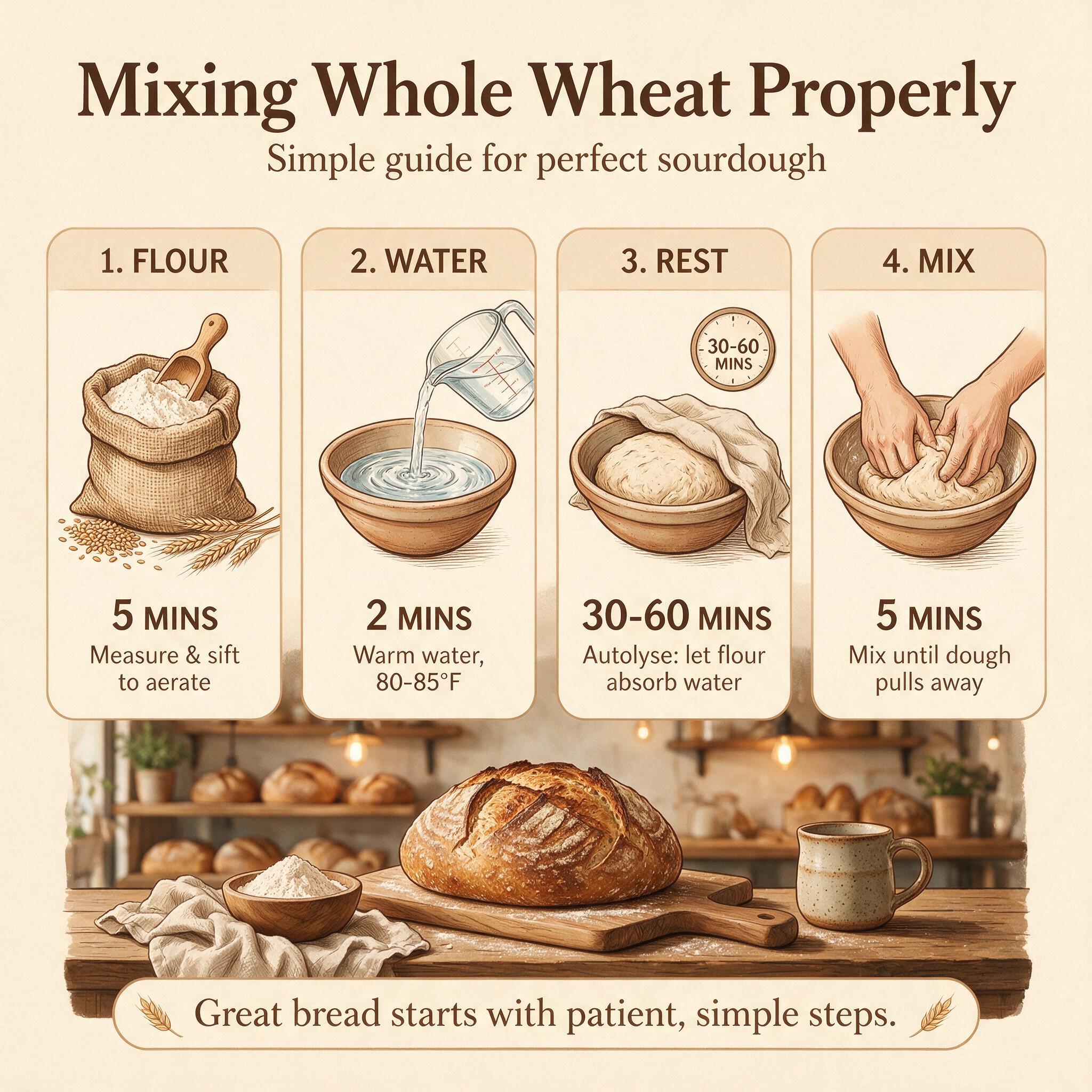
Autolyse — resting flour and water for 30–90 minutes before adding starter and salt — is helpful for all sourdough, but it's essential for whole wheat. The rest allows bran to hydrate, pentosans to swell, and gluten strands to begin forming without mechanical disruption. This makes the dough more extensible and easier to work with before you even start folding.
Recommended autolyse times:
- •10–20% WW: 30–45 minutes
- •25–40% WW: 60 minutes
- •50–100% WW: 90 minutes (or overnight refrigerated)
Sift and Scald
This is Maurizio Leo's signature technique for 100% whole wheat bread, and it produces dramatically lighter results. Sift out roughly 13% of the bran from your whole wheat flour, then "scald" it — mix with boiling water to form a paste, cool to room temperature, and add back to your dough during the first stretch-and-fold.
How to scald:
- Weigh your whole wheat flour
- Sift out approximately 13% of the total flour weight (for 500g flour, remove ~65g of bran)
- Add an equal weight of boiling water to the removed bran (65g bran + 65g boiling water)
- Stir until it forms a thick paste
- Cool to room temperature before incorporating into your dough
The scalding partially gelatinizes the bran, making it softer and less disruptive to gluten strands. The result is a lighter crumb without sacrificing whole grain nutrition.
More Folds, Gentler Handling
Whole wheat dough benefits from more stretch-and-fold sets than white flour (add one or two extra), but the folds should be gentle. Don't knead aggressively — you're building gluten structure while avoiding tearing from bran particles. Four to six gentle coil fold sets over four to five hours builds the best WW structure.
Shorter Bulk Fermentation
Whole wheat dough ferments faster than white flour at equivalent temperatures because the extra nutrients in bran and germ feed the starter more aggressively. Reduce bulk time by 20–30% compared to your white flour recipe. At 75°F / 24°C with 20% ripe starter:
- •White flour: 4–6 hours
- •50% WW: 3–4 hours
- •100% WW: 2.5–3 hours
Watch your aliquot jar rather than the clock.
Bake to Higher Internal Temperature
Whole wheat doughs are denser. They need higher core temperatures to fully gelatinize starches and set the crumb. Bake to 207–210°F (97–99°C) instead of the standard 205°F. Underbaked whole wheat is notoriously gummy.
The Progressive Approach: Building Up to 100%
Don't jump straight from white flour to 100% whole wheat. Work up gradually:
10–20% Whole Wheat
Barely changes handling. Add 2–3% extra water, bulk 5% shorter. The flavor is noticeable; the technique is identical to white flour baking. This is the easiest entry point.
25% Whole Wheat
Slightly more demanding. Increase hydration by 3–5%. Extend autolyse to 45–60 minutes. Bulk 10–15% shorter. Still manageable for beginners.
50% Whole Wheat
The sweet spot per most experienced WW bakers. Manageable with good technique, excellent flavor, noticeable nutrition boost. Follow all the adjustments: +5% hydration, 60-minute autolyse, 20% shorter bulk, bake to 207°F.
75% Whole Wheat
Demanding. Requires the full toolkit: long autolyse (90 minutes), high hydration (88–90%), extra folds, shorter bulk. Still achievable for experienced bakers.
100% Whole Wheat
The summit. Demands overnight autolyse (or at minimum 90 minutes), 85–90% hydration, sifting and scalding technique, excellent gluten development, tight shaping tension, shorter cold proof. This is the loaf that separates dedicated WW bakers from casual ones. But when it works, it's extraordinary — dense with nutrition, rich with nutty flavor, and lighter than any store-bought WW bread you've ever had.
Whole Wheat Sourdough Recipe Framework
For 50% Whole Wheat:
| Ingredient | Amount | Notes |
|---|---|---|
| Bread flour | 250g | White flour for structure |
| Whole wheat flour | 250g | Freshly milled or high-quality store-bought |
| Water | 425g | 85% hydration (+5% from 80% baseline) |
| Active sourdough starter (ripe) | 100g | 20% |
| Salt | 10g | 2% |
| Warm water for autolyse | Extra 25–50g | Use 80°F water to speed bran hydration |
Process:
- Mix flours and warm water (80°F), rest 60 minutes (autolyse)
- Add starter and salt, mix thoroughly
- Bulk: 4–5 hours at 75°F (aliquot jar, target 40–50% rise — shorter than white flour)
- Preshape, rest 20 minutes, final shape with firm tension
- Cold proof: 8–12 hours (shorter than white flour — WW ferments faster even in the fridge)
- Bake: Dutch oven, 500°F, lid on 20 min, lid off at 450°F
- Internal temp: 207–210°F
Frequently Asked Questions
Does whole wheat starter behave differently from white flour starter?
Yes — and you can use either to bake whole wheat bread. A WW-maintained starter may have slightly different bacterial communities and fermentation speed, but either works. The more important factor is that your starter is active and fed with your chosen flour for at least two feedings before baking.
Why does my whole wheat dough feel stiffer than expected at mix time?
Bran absorbs water slowly. A dough that feels stiff at mix time will hydrate further during the autolyse and bulk fermentation. Wait 60 minutes before judging. If it's still stiff after an hour, add water gradually. Whole wheat doughs also feel different from white flour doughs — they're less extensible and more "fragile," but that doesn't mean they're wrong.
Can I use whole wheat starter for white bread?
Yes — you can use any starter to bake any bread. A WW-maintained starter might produce slightly more tang in white bread, but it works perfectly. The flour you feed your starter shapes its character over time, but it doesn't prevent it from leavening other breads.
How do I store whole wheat flour?
Freezer is best. Whole wheat flour keeps for 1–3 days at room temperature before flavor declines. Refrigerator extends this to 2 weeks. Freezer extends to 3–6 months (best quality). I mill fresh or buy in small quantities and freeze immediately.
Closing Thoughts
Whole wheat sourdough is harder than white flour sourdough — but it's not impossible. The difference is entirely in the adjustments: more water, shorter bulk, longer autolyse, gentler handling. Once you internalize those adjustments, the technique becomes intuitive.
My approach: I bake 50% whole wheat for everyday loaves — it's manageable, nutritious, and tastes excellent. On weekends or special occasions, I push to 75–100% with sifting and scalding. The progression from 25% to 100% WW took me about a year of baking, and every percentage point taught me something about how whole wheat behaves differently.
Don't rush the progression. Master 25%, then 50%, then work up. Your hands will learn what whole wheat feels like at each stage, and that intuition is worth more than any recipe.
Happy baking!