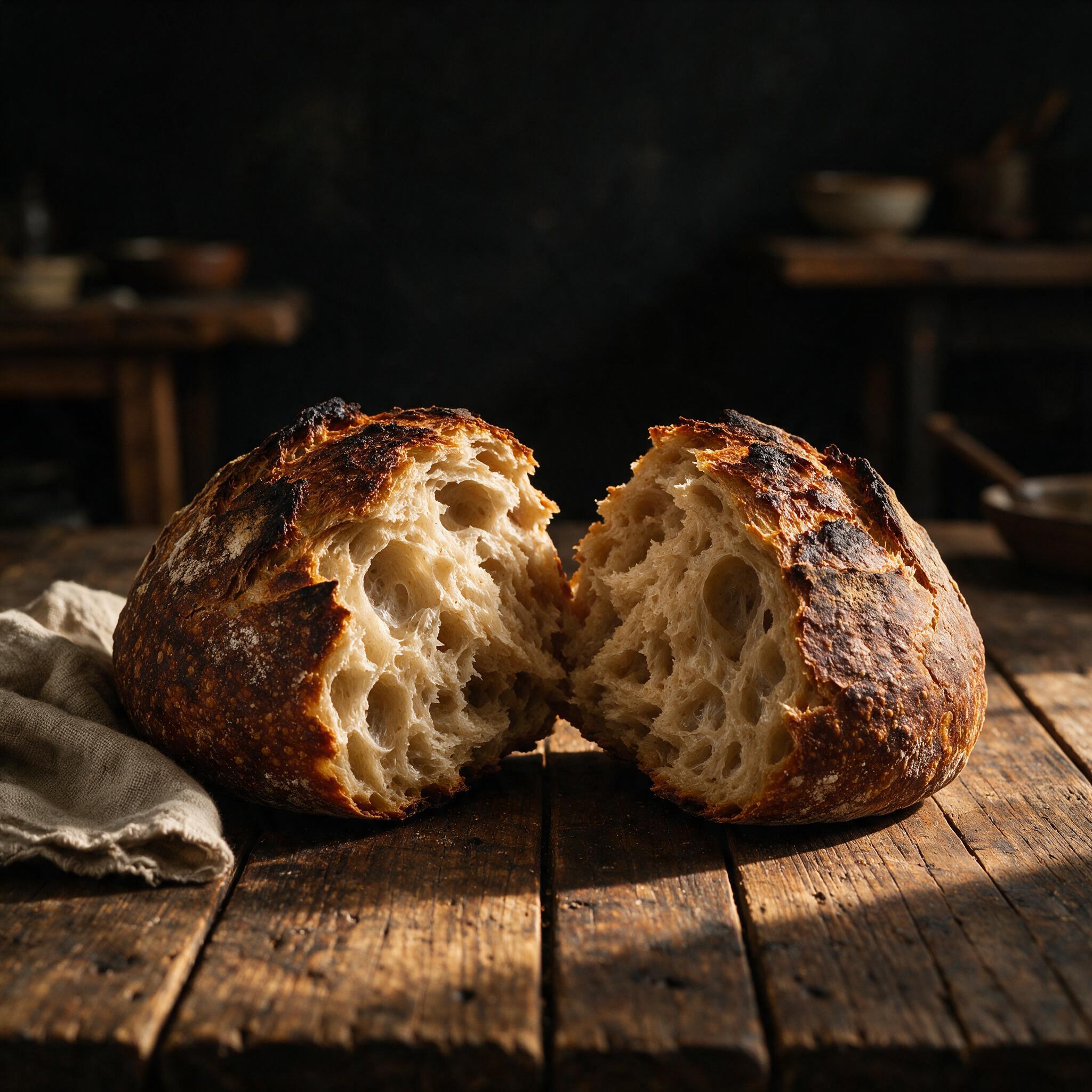
Every sourdough baker hits at least one of these four problems in their first ten loaves. The good news: each one has a specific cause, and that cause happens at a specific moment in the process. The bad news: that moment is usually 14 hours before you find out about it, which makes troubleshooting feel like guessing.
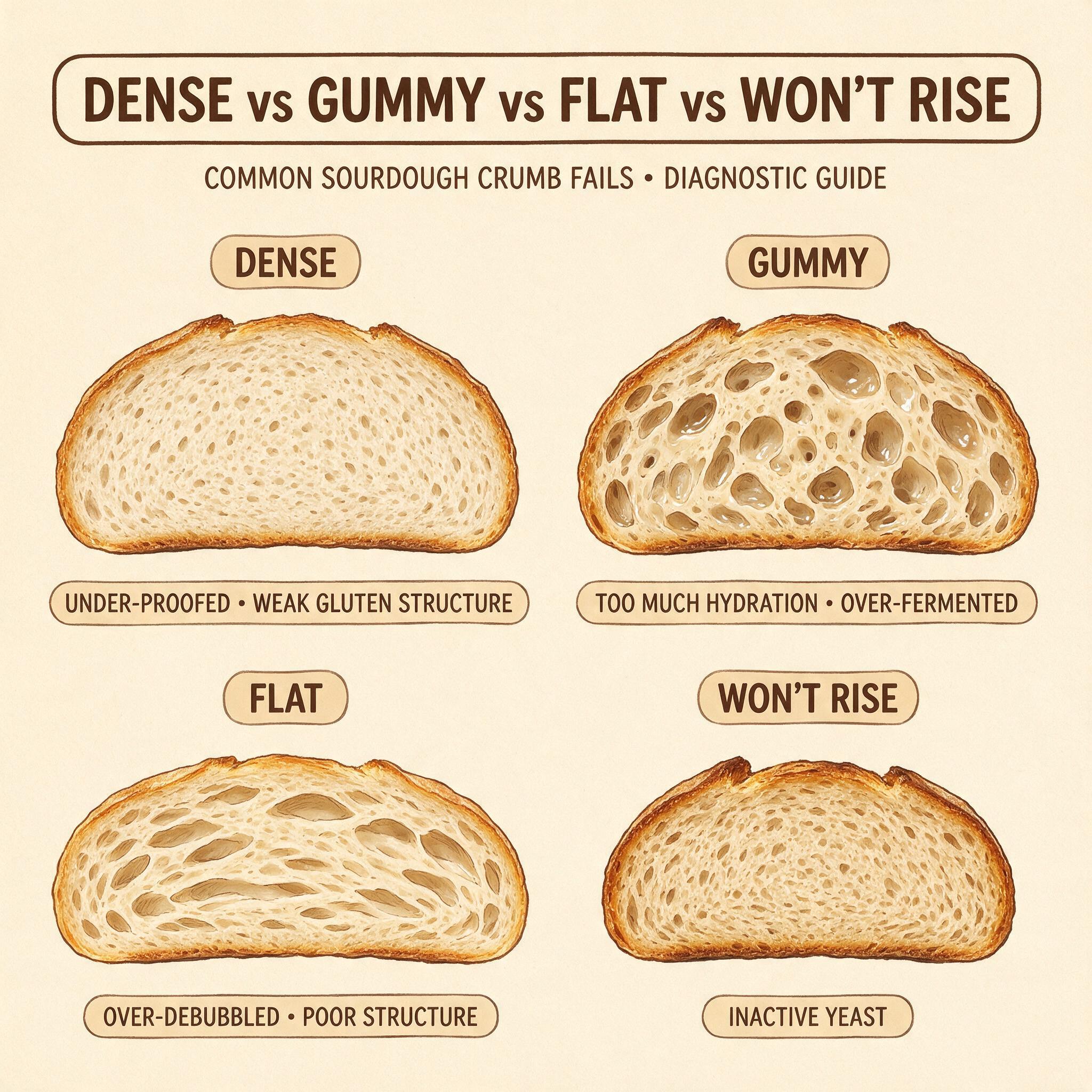
This guide walks through the four most common failures — dense, gummy, flat, and won't-rise — with the actual cause, the diagnostic you can do right now on yesterday's loaf, and the specific fix for next time. Most of the time it's one of three things: underfermentation, overfermentation, or hydration that doesn't match your flour.
Pick the symptom you're seeing and jump to it. Then read the diagnostic carefully — most sourdough problems are diagnosed by feel, not by timer.
Quick Diagnostic: What's Wrong With My Loaf?
Before you start fixing things, look at your last loaf. The crumb tells you almost everything.
If the crumb is dense and uniform — small tight holes throughout, no open areas, heavy in the hand: Underfermented, or starter wasn't strong enough. Skip to the dense section below.
If the crumb has some open areas but the bread feels wet and gummy when you cut into it, and the slices squish instead of holding their shape: Underbaked, or cut too early, or too much hydration for your flour. Skip to the gummy section.
If the bread spread out flat during baking instead of springing up — wide and short rather than tall with a proud ear: Over-proofed, or the gluten was underdeveloped, or your scoring was too shallow. Skip to the flat section.
If the bread didn't rise much at all during bulk, or barely puffed in the oven, and the crumb is tight and small: Starter wasn't ready, or your kitchen was too cold, or your flour is too weak. Skip to the won't-rise section.
If you're seeing a mix of symptoms, the most likely culprit is the one I describe in each section as "the most common cause." Start there.
Dense Crumb: Tight, Heavy, No Open Holes
A dense sourdough has a small, tight crumb with no irregular open areas. The bread is heavy in the hand. When you cut a slice, the crumb is uniform — no big holes, no airy pockets.
The most common cause: underfermentation. Your dough didn't bulk long enough for the gluten to develop and the gas to build up. You'll see this if your bulk was shorter than your usual by even an hour. The fix is almost always just: longer bulk, warmer spot, or more active starter.
Other causes, in order of likelihood:
- Weak starter. A starter that isn't quite ready won't produce enough gas to inflate the dough. Test: drop a spoonful into room-temp water. If it doesn't float within 5 minutes, it's not ready. Solution: feed it and wait until it passes the float test. A starter that's 2-3 weeks old also hasn't built up the wild yeast diversity it needs — give it time.
- Cold kitchen. If your kitchen is below 68°F, your dough ferments slowly. The bulk that would take 4 hours at 75°F takes 8+ hours at 65°F. Either wait longer, or find a warmer spot (inside the oven with just the light on is a classic warm spot).
- Too low hydration. Hydration below 70% with a strong bread flour makes a tight dough that holds less gas. Bump hydration by 5% and see if the crumb opens up.
- Too much whole grain, not enough autolyse. High-percentage whole grain absorbs water aggressively. If you're at 50%+ whole grain, you need a longer autolyse (60-90 minutes minimum) for the bran to fully hydrate. Otherwise the bran punctures the gluten strands and you get a tight crumb.
- Old flour. If your bread flour has been sitting in the pantry for over 6 months, it has oxidized and the gluten has weakened. Buy fresh flour and your crumb will open up.
The fix for next time: Longer bulk (add 1-2 hours), warmer spot, verify starter passes float test, and consider bumping hydration if you're below 70%.
Gummy Interior: Wet, Squishy, Won't Hold Its Shape
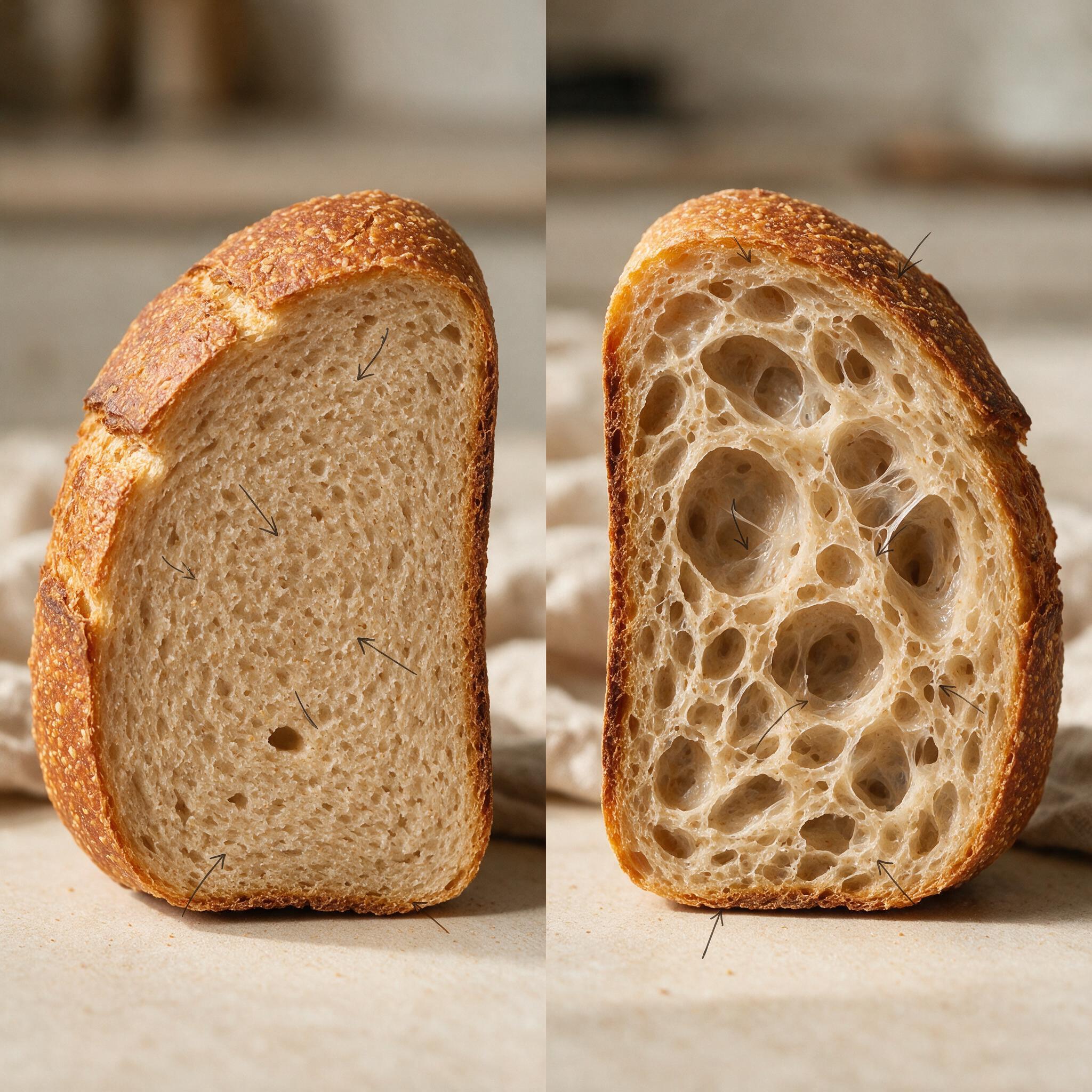
A gummy loaf looks fine on the outside — nice crust, normal color. But when you cut a slice, the inside feels wet and doughy, and the slice squishes flat when you set it down. The crumb may even appear undercooked even though the crust is properly baked.
The most common cause: cutting too early. Sourdough isn't actually finished baking when it comes out of the oven. The crumb sets as it cools — the starch retrogrades, the structure firms up. If you cut into a warm loaf, the crumb hasn't set yet, and it feels gummy. Wait at least 1-2 hours (ideally 4+) before cutting. The internal temp should be at or below room temperature.
Other causes:
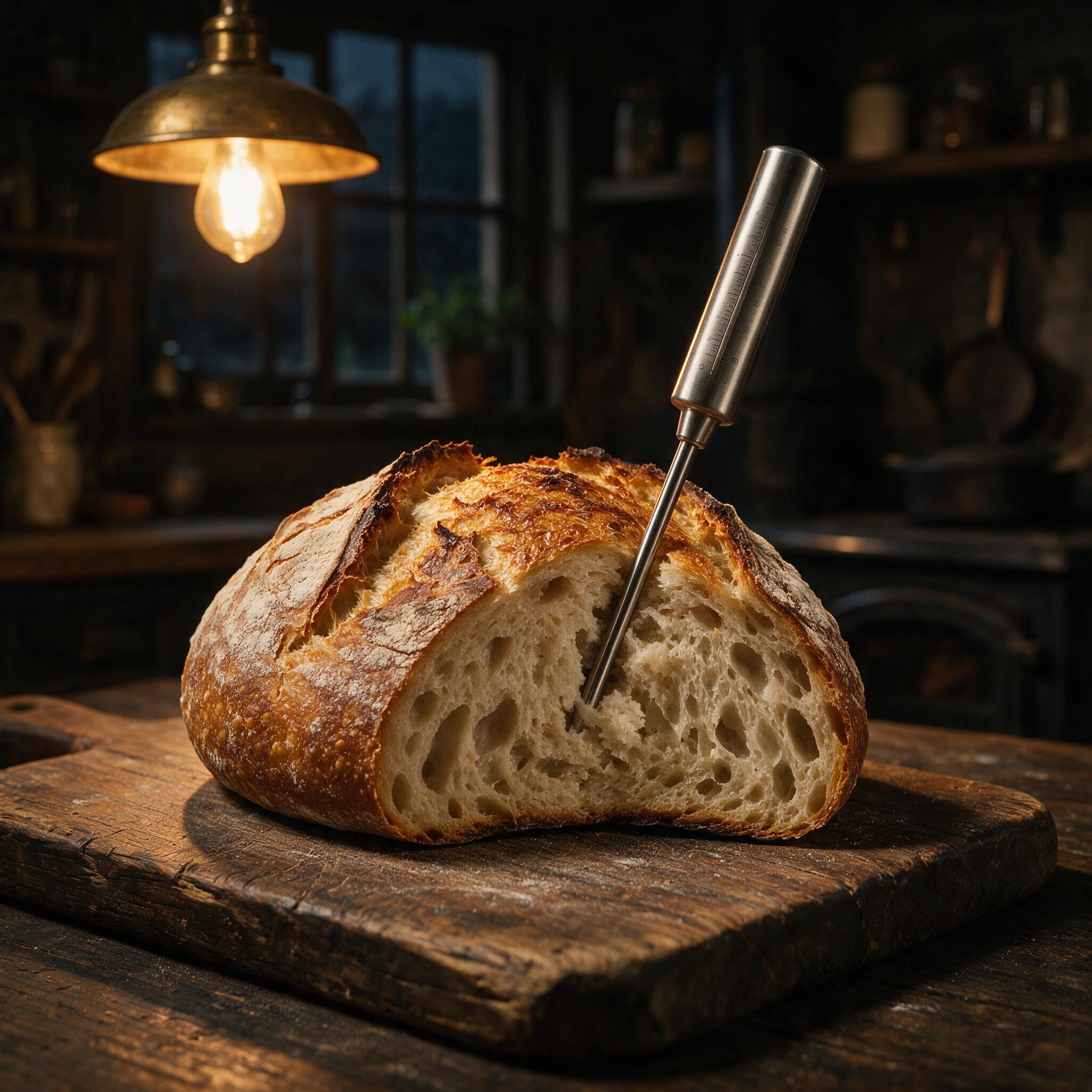
- Underbaked. Sourdough needs more bake time than yeasted bread because of the thick crust development. If the internal temperature is below 205°F when you pull it, it's underbaked. Use an instant-read thermometer — pull the loaf at 208-210°F for the most fully-baked crumb.
- Too much hydration for your flour. High hydration (80%+) is gorgeous with strong bread flour but disastrous with weak AP flour or all-purpose whole wheat. If the dough was sticky and hard to shape, your hydration was probably too high for the flour you used. Drop back to 75% and work up gradually.
- Cold kitchen, slow bulk. If the bulk took 10+ hours, the dough may have been in a "stuck" state where enzymes were active but the yeast was sluggish. The crumb can feel uncooked because the starch structure didn't fully develop. Solution: warmer kitchen or more active starter.
- Inadequate shaping tension. If you didn't build enough surface tension during shaping, the crumb structure is loose and the bread feels gummy even when fully baked. Re-shape and let the surface tighten up before retarding.
The fix for next time: Wait longer before cutting, verify internal temp hits 208°F, and check that your hydration matches your flour strength.
Flat Loaf: Spread Out, No Oven Spring
A flat loaf spread during baking rather than springing up. It's wider than it is tall, the score may have torn instead of bloomed, and the crumb may have a horizontal band of dense dough near the bottom (the "frowny face" pattern).
The most common cause: over-proofing. The dough was shaped, then continued fermenting through the cold retard and into the oven, so the gluten relaxed and the gas escaped instead of springing. Test: after shaping, the dough should hold a poke-test indent that springs back slowly — if the poke leaves a dent that doesn't fill in, it's over-proofed.
Other causes:
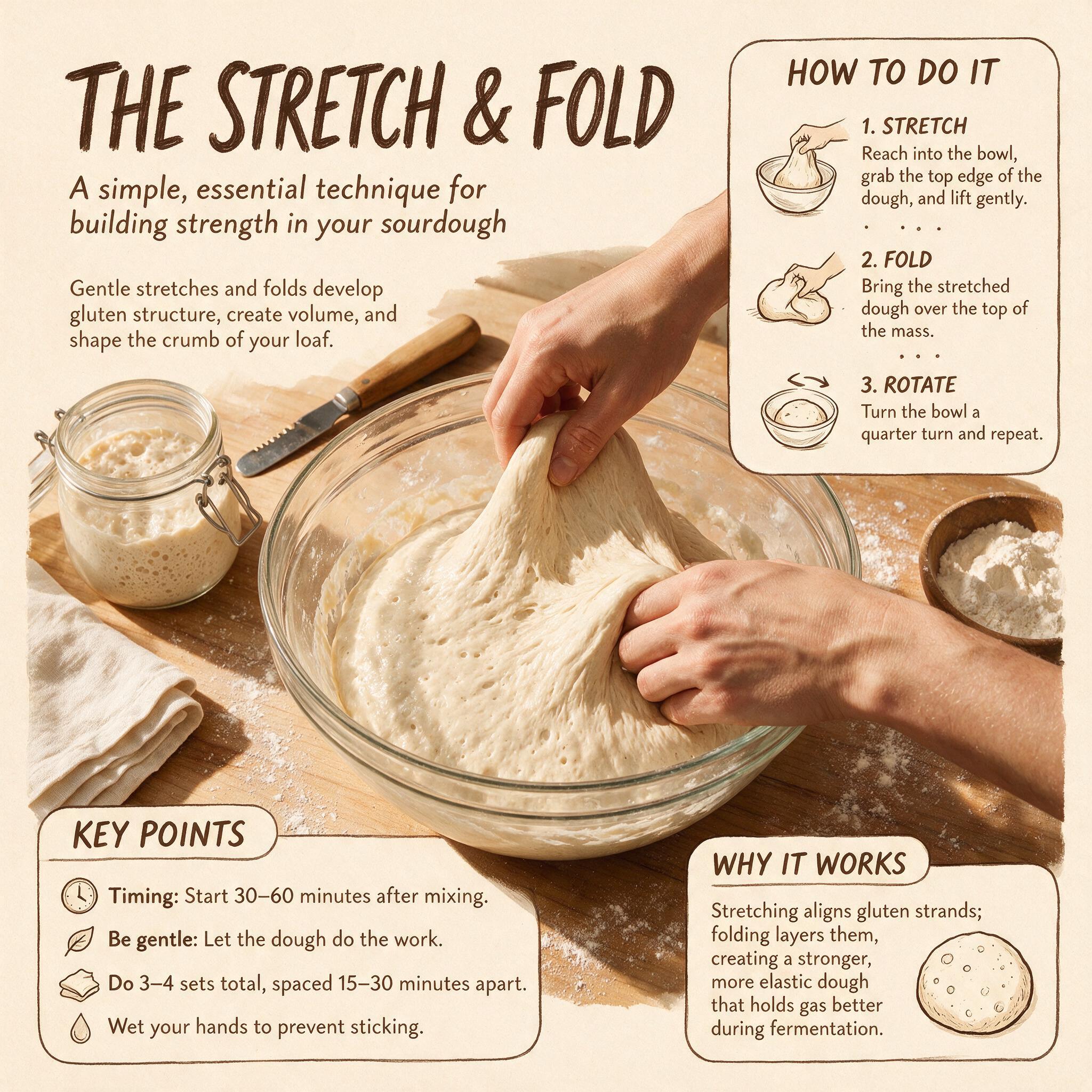
- Weak gluten development. If you skipped the autolyse, or didn't do enough stretch-and-folds, the gluten wasn't developed enough to hold the gas in. The dough spreads during baking instead of springing. Solution: longer autolyse (60-90 min for high-hydration doughs), 4-6 sets of stretch-and-folds in the first 2 hours.
- Dull lame or shallow score. Your score wasn't deep enough to direct the oven spring. The crust tore in unintended places, and the loaf spread sideways instead of opening along the score. Use a fresh razor blade or a sharp lame, and score at least 1/2 inch deep.
- Cold oven, no steam. The Dutch oven trapsteam method is what enables dramatic oven spring. If you're baking on a sheet pan without steam, you can still get a decent rise but rarely a dramatic one. Use a preheated cast iron skillet on the bottom rack with boiling water poured in at the start of bake.
- Overworked dough at shaping. If you degassed too much while shaping, the dough is tense but has no gas. Bake with a tight, gassy shape, not a tight, deflated shape.
- Too much surface flour during shaping. A heavy flour coating on the surface inhibits the final rise by sealing the crust before the oven spring can complete. Use just enough flour to prevent sticking.
The fix for next time: Watch the bulk more carefully, shape at the right moment (poke test), use a sharper blade, and consider cold-shaping for better oven spring.
Won't Rise: Stays Small, No Puff
A loaf that won't rise either stayed small during bulk, or didn't spring during baking. The crumb is tight, the bread is short and squat, and there's no real ear or oven spring.
The most common cause: weak or immature starter. If your starter is less than 2-3 weeks old, it may not have the yeast diversity and acid balance to fully leaven bread. A weak starter will ferment slowly and produce less gas. Test: before mixing, do a peak-rise test. If your starter doesn't reliably double in 4-6 hours at room temp, it's not ready for bread baking.
Other causes:
- Wrong flour. Whole wheat flours, rye, and ancient grains (einkorn, spelt) ferment faster than bread flour. AP flour ferments slower. If you swapped flours recently and your dough isn't rising, the flour is the issue, not your technique.
- Too cold. Sourdough dough below 70°F barely ferments. If your kitchen is cold, the bulk takes 8-12 hours. Either find a warmer spot, increase the percentage of starter in the recipe, or accept the longer timeline.
- Old dough. If you mixed the dough, forgot about it, and came back 24+ hours later, the yeast has likely died off from the acidity. The bacteria are still active, but you'll get an over-sour, gummy, dense loaf — not a risen one.
- Salt added too early or too much. Salt slows yeast. If you accidentally doubled the salt, the dough will rise very slowly. If you added salt during autolyse instead of after, the gluten development was inhibited. Standard practice: 30-60 min autolyse, then add salt and starter.
- Chlorinated water. Some municipal water has enough chlorine to inhibit yeast. If your starter works fine on filtered water but not tap water, switch to filtered.
The fix for next time: Verify starter is strong and ready, match flour type to your recipe, find a warmer spot, and double-check salt percentage.
The Master Diagnostic: Check the Process
Most sourdough problems can be diagnosed with three questions:
- Was the starter at peak? (Test: floats in water, doubled in 4-6 hours, domed on top, passes the poke test.) If no, the bulk will be slow and the loaf will be dense. Fix the starter first.
- Did the bulk go 30-50% by volume? (Mark your bowl at mix time. The dough should rise significantly but not double.) If it doubled or tripled, you over-proofed. If it rose less than 25%, you under-proofed.
- Did the final shape hold a poke-test indent? (After shaping, poke the dough gently. It should spring back slowly over 2-3 seconds.) If it springs back instantly, under-proofed. If it doesn't spring back, over-proofed.
If you can answer those three questions for your last bake, you'll know exactly what to adjust for the next one. The answer to "why is my sourdough dense" is almost always one of those three.
Related Posts
Keep going with these related guides.